

Source : THE AGE NEWS
An upcoming wave of major US floats will further concentrate the world’s largest sharemarket around technology giants, tying future performance ever closer to the profitability of artificial intelligence, investors say.
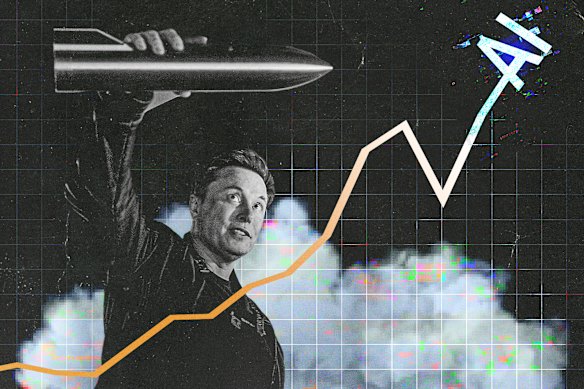
The biggest sharemarket float in history is slated for this week. Elon Musk’s reusable rocket company SpaceX is set to raise $US75 billion ($106 billion), valuing it at an estimated $US1.75 trillion.
SpaceX carries a large AI component. Its initial public offering, alongside those expected to come from Anthropic and OpenAI, will add to the membership of the so-called “Magnificent Seven” group of US tech behemoths: Apple, Microsoft, Amazon, Alphabet, Meta Platforms, Tesla and Nvidia, named for their size and profits and their ability to shape their own industries.
The Magnificent Seven’s weight in the S&P 500 has risen from less than 7 per cent in 2010 to over 30 per cent by 2024, according to research from Old Dominion University.
This concentration makes the market especially vulnerable to shifts in perceptions about the use and value of AI and its applications, according to New York-based Dr Kevin Hebner, managing director and global investment strategist at TD Epoch.
“The market is especially focused on three companies” – Nvidia, Anthropic and SpaceX – said Hebner. “A particular concern given the transition to capex-heavy business models and our view that the positive impact of AI on productivity and revenues will take longer than consensus expects.”
SpaceX purchased Musk’s AI outfit xAI in February, valuing it at $US250 billion, and putting it at the core of his space ambitions. In addition to reusable rockets, and Starlink satellite-enabled internet, part of SpaceX’s plan is to use heavy-lift Starship V3 rockets – still being perfected – to carry solar-powered data centres into orbit. Once there, they are expected to process massive, energy-intensive AI workloads, free from the constraints of terrestrial electricity grids and carbon concerns.
The space vision Musk is floating on the market is “effectively a call option on space and all the future possibilities that come with that”, said Hebner. (Call options give buyers the right to buy a specific asset at a pre-set price).
The seemingly ever-rising valuations are creating their own effects on the market.
Lonsec manager of global equities Hong Hon said: “A handful of stocks, particularly within the Magnificent Seven cohort, now account for a disproportionate share of the overall market capitalisation and returns, effectively skewing the opportunity set for active managers that are benchmarked to these indices.”
This concentration means sentiment around this set of stocks can become critical. In January, AI-chipmaker Nvidia suffered the worst single-day market cap loss in history, shedding nearly 17 per cent or $US589 billion in a brief panic after a Chinese AI company revealed the low cost of training its AI model.
Hon said the structural shift mattered “because traditional index construction approaches (i.e. market cap weighted) naturally amplify the influence of winners”.
Last week, S&P Dow Jones Indices decided against easing its criteria to allow a listed SpaceX to join the S&P 500 before a full year of profitability.
“As markets reward a narrow cohort of stocks, their index weights increase, further concentrating benchmark exposure and reinforcing a feedback loop,” said Hon.
The AI-driven and future-facing valuations of the Magnificent Seven (or Ten, once SpaceX, Anthropic and OpenAI are added) are so grandiose investors are reaching to the past for comparisons
“We’ve seen this before,” said Datt Capital chief information officer Emanuel Datt. “When the American railroads were being built in the 19th century, investors rushed to own the rail companies, but the real wealth was created by the businesses that shipped goods across those rails.”
AI companies, which are helping propel the outsized performance of the market, may not be too different from railroads in the role they have for the economy, Datt says.
Looking at the growing importance of AI among the Magnificent Ten, Datt said: “The question investors should be asking is ‘who benefits from using it?’.”
He questioned if there may be other companies that end up making higher returns from AI in the future, once the current AI investment frenzy has passed, similar to how railroads themselves weren’t as profitable as the commerce made possible by the tracks after they were laid in the late 19th century in the US.
Perhaps a sign of faltering faith in the boundless profits of AI infrastructure was visible last week: concerns about overvaluation of tech stocks sent the S&P 500 dropping 2.6 per cent on Friday, ending a 10-week stretch of gains. The tech-centric Nasdaq 100 fell about 5 per cent.
Even as retail investors reportedly flock to SpaceX stock, the broader question of how profitable AI will be, and indeed, where it sits within the economy, persists.
Hebner said that for exchange-traded fund investors, TD Epoch recommended a “barbell structure” for portfolios. “One emphasis is clearly tech. The second is real assets, such as commodities and infrastructure.
“This reflects the capex-heavy nature of AI, as well as that almost all countries are increasing spending on industrial policy, infrastructure, energy and defence,” he said.
The Business Briefing newsletter delivers major stories, exclusive coverage and expert opinion. Sign up to get it every weekday morning.
 Chris Zappone is a senior reporter covering aviation and business. He is former digital foreign editor.Connect via X, Facebook or email.


