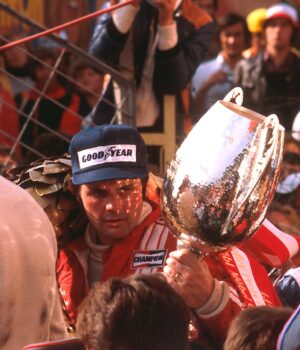
Source : ABC NEWS
The engines screamed in anticipation as the grid for the 1977 Austrian Grand Prix waited for the signal to burst into action.
On pole was the indomitable hometown hero Niki Lauda, almost exactly a year on from the horrific crash in Germany that would leave his face permanently scarred.
A spot behind him was the glamorous and charismatic Brit James Hunt, a man that Lauda described as the only person he ever envied.

Niki Lauda and James Hunt were the stars of the F1 circuit in the 1970s. (Getty Images: David Phipps/Sutton Images)
In third there was the American motorsport legend Mario Andretti, who ended his career with an incomparable resume that included an F1 championship, four IndyCar titles, and a Daytona 500 victory.
And 11 places back from there, waiting in a car that had never won a race, sat the understated and comparably unfashionable Alan Jones, the 30-year-old Victorian who had only joined the F1 season four months earlier to replace Welshman Tom Pryce after his horrific death at the South African Grand Prix.
Alan Jones (left) trains with Frank Williams, owner and founder of F1 team Williams. Jones’s physique was often questioned through his career. (Getty Images: David Phipps/Sutton Images)
Jones, who died on Thursday aged 80, didn’t have the glitz of Hunt or the unwavering focus of Lauda. He would variously be described as overweight, laconic and underprepared throughout his career.
But what he did have was raw talent.
On that overcast August day, the underdog Aussie who used to sell Holdens for his dad at a car dealership in suburban Melbourne would shock the Formula One world with his daring and deftness.
Niki Lauda chats with Alan Jones in the pit lane ahead of the 1977 Austrian Grand Prix. (Getty Images: LAT)
With rain clearing as the race started, the grid was split between those racing on wet weather tyres and those on slicks. Lauda fell behind quickly in his Ferrari as it struggled in the slippery conditions, as Andretti overtook both the Austrian and Hunt following a small collision between the two.
Fans and pundits kept one eye on the superstar American, and another on the Swedish driver Gunnar Nilsson, who had made a stunning run from 16th into second on the back of wet weather tyres.
Quietly, Jones had moved up from his 11th spot into fourth, weaving in and out of the pack on slicks in a daring decision that other drivers had battled with.
Alan Jones in action driving his Shadow car at the 1977 Austrian Grand Prix. (Getty Images: David Phipps/Sutton Images)
As the sun came out, Nilsson was forced to pit to replace his shredded rubber, while Andretti’s Lotus engine exploded both his car and his chances of victory, leaving Hunt to take the lead with Jones hot on his tail.
Lauda, now on fresh tyres and with greater control, hammered through the field to sit in third.
Hunt and Lauda, the protagonists of the 2013 Hollywood blockbuster Rush, were split only by the chubby-cheeked Aussie who let his racing do the talking.
Then, in a moment that would change Jones’s life forever, Hunt’s McLaren blew up in a burst of sparks and flames, his car slowing to a stop on the side of the track as marshals enveloped the vehicle in the thick dust of their fire extinguishers.
Shadow team members run onto the track and jump in celebration as Alan Jones claimed their first, and only, F1 grand prix victory. (Getty Images: LAT)
From the cloud, Jones would emerge as the race leader, holding off Lauda to claim the first of his 12 grand prix victories, and the only race win his team, Shadow, would ever claim in its eight-year F1 history.
Jones’s team would run out onto the road to celebrate as the track announcer told the crowd, with uncertainty, that it was Australia’s first F1 victory in seven years.
“The first Grand Prix win for Alan Jones, and the first Grand Prix win for the hard-working Shadow team,” he said over the PA system.
“And, we think, the first Grand Prix win for Australia in seven years.”
Jones would be surrounded by well-wishers in pit lane. With then-wife Beverley in one arm, and a bottle of champagne in the other, he laid a big kiss on Bev before popping the champers at the encouragement of his better half.
Alan Jones smiles as he speaks with fellow driver Hans-Joachim Stuck after the 1977 Austrian Grand Prix. (Getty Images: David Phipps/Sutton Images)
Taking a big swig of booze before being ushered to the podium and draped in a golden wreath, the band played in the background, leading to one of the more enduring, and ultimately false, stories that Jones would tell of his win.
“[The win] was a bit of a surprise to everybody,” Jones would later tell Wide World of Sports co-host Daryl Eastlake.
“In fact they had trouble finding the Australian national anthem, so some drunk played Happy Birthday on a trumpet.
“That’ll give you an idea how prepared they were for me to win.”
Audio from the day shows the story is not entirely true.
Trumpeters were blasting away somewhere in the distance playing La Cucaracha, among other songs, before launching into Advance Australia Fair as Jones accepted his trophy.
The Australian national anthem of God Save the Queen, which had been reinstated as the country’s tune in 1976 after Gough Whitlam had introduced Advance Australia Fair in 1974, was not played.
It’s possible that in the excitement and colour of it all that Jones had mistaken Advance Australia Fair for Happy Birthday to You. It’s possible that he had blanked out the anthem all together and could only remember the joyous refrains of various other trumpeted songs before he took his place on top of the podium. It’s also possible that he didn’t even recognise the new anthem, which had already become the old anthem, before becoming the new anthem again.
What is unequivocal though is that in the coming years, F1 organisers came to know our national anthem well as Jones left his indelible mark.
In the golden age of F1, Australia’s contribution to it was a bloke who looked more like a bank teller than a movie star.
And it’s that understated legacy that has, and always will, fill Australian motorsport fans with pride.