Source : THE AGE NEWS
The cities that succeed over the next decade will be those that make it easier for businesses to invest, expand and grow.
For organisations deciding where to expand, the equation is practical. Access to skilled workers, competitive operating costs, efficient planning systems, international connectivity and confidence in future demand all influence where capital is deployed.
Deloitte’s State of the City 2025 report, commissioned by Brisbane Economic Development Agency, highlights a city entering a new phase of economic development. It points to an economy that has grown beyond $200 billion, more than $100 billion in major projects underway, Australia’s fastest-growing working-age population and a strategic position as Australia’s gateway to the Asia-Pacific.
Together, those factors are creating a compelling proposition for businesses planning their next phase of growth.
In the report, BEDA chief executive Anthony Ryan says the city is entering a defining period.
“With an economy now exceeding $200 billion and our strategic position as Australia’s gateway to the Asia-Pacific, Brisbane offers fertile ground for entrepreneurs, investors and business leaders to shape the next breakthrough, city-defining project, or global success story,” Ryan says.
The report identifies several practical advantages shaping investment decisions, including strong demand across the commercial property market, planning settings that support growth and proximity to Asia-Pacific markets, which account for almost half of global trade. It also forecasts south-east Queensland’s population will approach 6 million by the mid-2040s, creating one of Australia’s largest future customer and labour markets.
Ryan says Brisbane’s advantage also lies in a highly collaborative ecosystem where government, industry and researchers work together to help business bring new ideas to market.
Rather than just local initiatives, BEDA programs like Future Food and MedTech serve as strong investment signals – showcasing the city’s innovation ecosystem to global investors and connecting high-growth scale-ups with international capital and partners.
Businesses are already responding to those conditions, with private investment flowing into projects that reflect faith in Brisbane’s prospects.
Wharves shoring up conviction
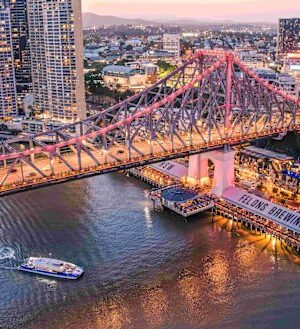
One business that has already backed Brisbane’s potential is Artemus Group, the Australian hospitality and real estate company behind Howard Smith Wharves.
With a national footprint that includes Sydney’s Manly Wharf, the company is doubling down on Brisbane through its proposed $500 million HSW 2.0 expansion, reflecting growing confidence in the city’s prospects.
What began as the transformation of an underused stretch of the Brisbane River has become one of the city’s best-known mixed-use destinations, combining hospitality, tourism, commercial activity and public space, while demonstrating the confidence private investors increasingly have in Brisbane’s trajectory.
Luke Fraser CEO of Artemus Group and Howard Smith Wharves, says attracting talent has become inseparable from luring investment.
Companies are no longer choosing cities simply because they offer available office space or industrial land. They are looking for places where skilled people want to build careers and where investment in transport, public spaces and cultural assets supports economic growth.
“Businesses are realising that if they can’t attract and keep good people, they can’t grow,” Fraser says.
“Lifestyle now plays a much bigger role in that decision, and Queensland has continued its momentum post COVID with some clear advantages over some other locations.
“Brisbane also has real momentum behind it, with population growth, major infrastructure and 2032 all coming together at the right time.”
That thinking aligns with the findings of the State of the City 2025 report, which identifies the experience economy, advanced manufacturing, logistics and health as sectors expected to play an important role in Brisbane’s next phase of growth.
As the city’s population expands and infrastructure investment continues, those industries are expected to benefit from deeper talent pools, stronger domestic demand and closer connections with international markets.
Fraser says another competitive advantage is less tangible but equally important.
“Brisbane is a city where people work together. There is a strong connection between government, council, business and the community, and that helps create the right environment for investment,” he says.
“We’ve experienced that directly at Howard Smith Wharves, where collaboration has been central to what has been achieved.”
That collaborative culture has helped accelerate projects that require co-ordination between the public and private sectors, while giving investors confidence that major developments can move from concept to completion.
Preparations for the Brisbane 2032 Olympic and Paralympic Games are fast-tracking this investment momentum. Beyond the Games themselves, infrastructure upgrades and a heightened international profile represent a once-in-a-generation catalyst for growth. Rather than viewing 2032 as a single sporting event, Fraser sees it as a definitive deadline that is accelerating decisions already underway.
“2032 has given Brisbane a clear deadline and a lot of momentum. Projects that may have once sat in long-term planning are now moving with more urgency, and that is driving investment across transport, tourism, hospitality and precinct development,” he says.
“It is lifting confidence to new levels in the city and changing how people see Brisbane, both nationally and internationally.”
“The experience economy is the biggest opportunity from our perspective,” he says.
“Brisbane has the river, the climate, the lifestyle and the population growth to become a much stronger destination city. We have seen what happens when you create a place people genuinely want to spend time in.
That opportunity exists right across Brisbane, he says.
“If we keep investing in great precincts, great hospitality, tourism and cultural experiences, the city will be in a very strong position over the next decade.
“You have to commit properly,” he says.
“Brisbane responds well to businesses that invest for the long term and build real relationships. We took a site that had been underused for decades and worked with government to create something the city could be proud of.
“The businesses that do well here are the ones that back Brisbane, not just test the market.”
To find out more, please visit Choose Brisbane.