
Source :- THE AGE NEWS
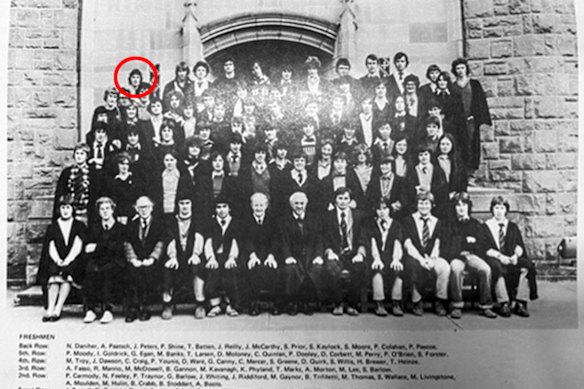
Neale Daniher spent just one year living at Newman College. Yet for many who shared that formative time, his impact is as enduring as Walter Burley Griffin’s stonework masterpiece.
Fellow 1979 freshman Jim Peters says: “When you’re 17 or 18 you don’t know yourself very well, you get up to all sorts of high jinks. But Neale was so steady and clear. I thought, ‘Gee, this guy knows himself really, really well.’”
Plainly, the 18-year-old knew how to play football, too. After captaining Assumption College the previous year, by the 1979 intercollegiate grand final Daniher was midway through a debut season with Essendon in which he would play all 23 games. It’s the stuff of Newman legend that he also played a 24th that winter.
Intercollegiate football was serious business for those with skin in the game, featuring Queen’s, Trinity, Ormond and Newman in contests that drew boisterous mobs of supporters to University Oval bedecked in college colours. The season lasted only long enough for each to play the others once, the top two meeting in the grand final. Bragging rights around College Crescent were huge.
The night before Newman met Ormond in the decider, coach Kevin Curran visited Daniher in his room. A Newman resident himself just two years earlier, he knew Essendon coach Barry Davis had told his young star he wasn’t allowed to play college footy in case he got hurt. Curran appealed to an even greater calling.
“I said Neale, the fact is, you live here with these blokes, they all know the player you are,” Curran recalls. “It’s not going to look too good if you let them down.”
They hatched a plan for Daniher to sit on the bench, and only come on if Newman was in trouble. Approaching half-time, Ormond led by five goals. “I could hear our supporters behind me asking, ‘When’s Daniher coming on?’” Curran says.
Peters, then Newman’s centreman and now a King’s Counsel, recalls the moment Curran released the shackles. “As Neale ran onto the field someone in the crowd yelled out, ‘We’ve won! We’ve won!’”
Time has blurred what happened next – some accounts have Daniher kicking 12 second-half goals, others eight. In another he kicked 12 straight, before he finally missed and the Newman crowd booed. Another depicts a second half played on a loop: “Centre bounce, tap to Daniher, goal. Centre bounce, tap to Daniher, another goal.”
Newman’s centenary history of 2018 settles the score. “Daniher came on and proceeded to kick 11 goals with left and right foot and the crowd went berserk … Newman won the game … Daniher picked up his bag and went off to Essendon training. He didn’t tell the coach.”
For Curran, Daniher opting to covertly defy the Bombers that afternoon was a no-brainer for a young man who quietly left an impression on all around him. “He was doing it because he was part of a fraternity. He was doing it for Newman.”
Marg Cavalieri will never forget sitting next to him in science lectures – she was wildly scribbling notes, Daniher with arms folded and cross-legged, as laconic as could be. He’d ask, “Borrow your notes later, Marg?” She couldn’t say no.
“He was just a beautiful person, somebody who was thoughtful of others already,” Cavalieri says. “He was playing for Essendon but very nonchalant about it. He never big-noted himself.”
Peters remembers a calm, almost spiritual air, and an acceptance of fate that would embolden him for later life’s enormous challenges. “People would say, ‘Neale, you played a fantastic game on Saturday.’ And he’d gently deflect it by saying, ‘Oh well, it’s just one game … I’m always one game away from the twos, you never know what’s going to happen next week.’”
Tony Corrigan, who followed Daniher from Assumption to Newman, recalls an environment where many sought respect by drinking madly, partying madly and “bucketing” fellow residents (tipping water on passers-by from above). Daniher enjoyed a beer but not at the expense of his athletic demands, and was immensely popular without being gregarious. “He was on a path to lead a right and good life.”
That he briefly studied theology spawned “The Reverend” moniker, yet that was post-uni, in his mid-20s via night classes as Daniher felt compelled to examine the Christian values of his upbringing. Mum Edna had liked the idea of the most inquisitive of her 11 children becoming a priest. In the end he chose science at Melbourne, didn’t love it, and left Newman for a computer studies course at RMIT – not a common choice in 1980.
Bill Lang, who heads up the Newman Old Collegians, crossed paths again in an executive coaching capacity when Daniher was coaching Melbourne. “We used to have a bit of a yarn around the challenges of helping people have faith in themselves,” Lang says. “The old Chinese philosophy from Lao Tzu: ‘When the student is ready the teacher appears.’”
By Peters’ reckoning, Daniher was effectively teaching those around him without anyone knowing it. Before becoming a star, barrister Peters was a champion rower who coached the Australian men’s team at world championships. At 18, he thought he was committed, until Daniher straightened him out after he fluffed a mark in a college game.
“Neale wasn’t playing, but he came up to me at quarter-time with fire in his eyes. ‘Jim! When you go for the ball, bloody grab it!’ I thought I was an intense competitor, but nothing like him. I could tell then if he set his sights on something he would pursue it with this fierce determination.”
No one imagined the thing he’d pursue most doggedly would be a cure for the disease that would kill him. Lang’s Newman Old Collegians Facebook post after his passing on Monday hailed a connection to the Catholic college that was “marked by quiet leadership, resilience and service to others”.
Newman’s motto is the Latin, “Lucia Lux Vestra – Let Your Light Shine.” For Lang, it’s a fitting epitaph. “He certainly shone a very bright light in all he did.”
Keep up to date with the best AFL coverage in the country. Sign up for the Real Footy newsletter.