


Source : the age
Less than two weeks after her debut novel Touch Grass was published in June, Mary Colussi received a dream email for many young Australian authors: a message from the head of prestigious UK publishing house Granta, Bella Lacey, raving about her novel’s “originality, intelligence, and distinctive narrative voice” and asking to discuss future projects. The email was detailed and effusive – the kind of praise that “as a writer, you want to believe”, Colussi says. Except it wasn’t from Bella Lacey or anyone from Granta – and the person who sent it almost certainly had not read Colussi’s novel.
One of the red flags, Colussi says, was that “everything that they were praising is something that you can find in the synopsis, and in one paragraph they actually quoted directly from the synopsis”. The definitive giveaway was the email address, which ended with @aol.com. A quick check of the Granta website confirmed her suspicions: a warning note from the publisher about fraudulent emails being sent from scammers impersonating staff and offering publishing deals in exchange for money.
Colussi’s experience is increasingly common, thanks to a new wave of AI-generated scam emails targeting authors internationally, offering publishing or promotional opportunities in exchange for money. In the past year, the Australian Society of Authors (ASA) has been inundated with messages from writers seeking advice and sharing their experiences, some of them receiving multiple scam emails a day.
Email scams targeting authors have existed almost as long as email itself, but they have been turbocharged by AI. The latest wave of scams is “far more sophisticated”, says ASA chief executive Lucy Hayward. “It’s not just that they might be impersonating people from the book industry, it’s that they’re able to provide detail and give the impression that they have read an author’s work, which makes the email convincing. And they can do that because the author’s work has either already been ingested [by AI companies], or it can be ingested by these AI tools and then summarised.”
Kelly Gardiner, an established author and member of the ASA board who receives these kinds of AI-generated emails daily, says “authors have been getting unsolicited approaches from PR ‘experts’ for a while, but the sudden expansion of AI has turned it into a flood”.
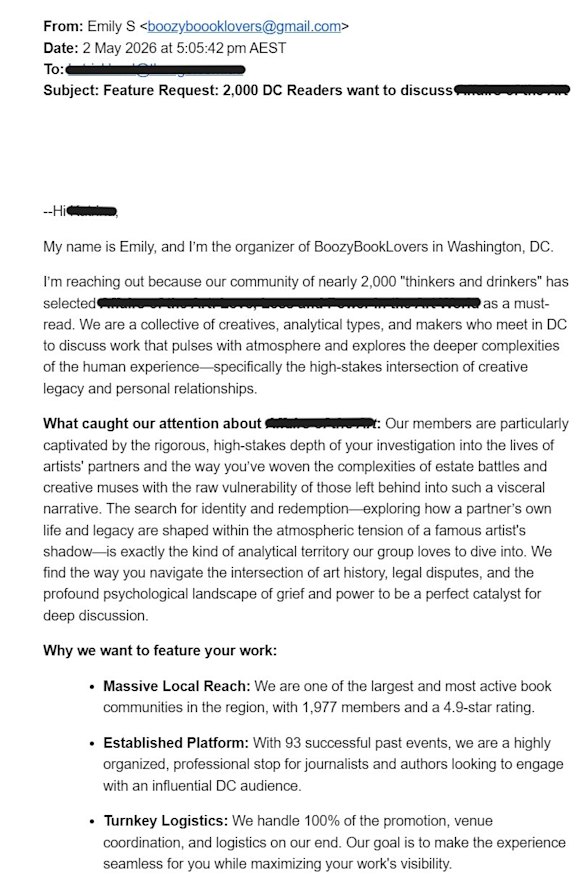
Most authors have a story – or several. Veteran author and academic Dennis Altman has written about receiving effusive, detailed emails about his books from individuals purporting to be acclaimed authors Annie Ernaux and Patrick Süskind; Walter Marsh described being “flooded” by emails offering paid reviews and promotion after the publication of his second novel (ironically, a novel about theft and fraud) late last year; and Jane Sullivan detailed a “highly convincing” email ostensibly from the (real) Melbourne-based Classic Book Club, offering to promote her 2024 crime novel.
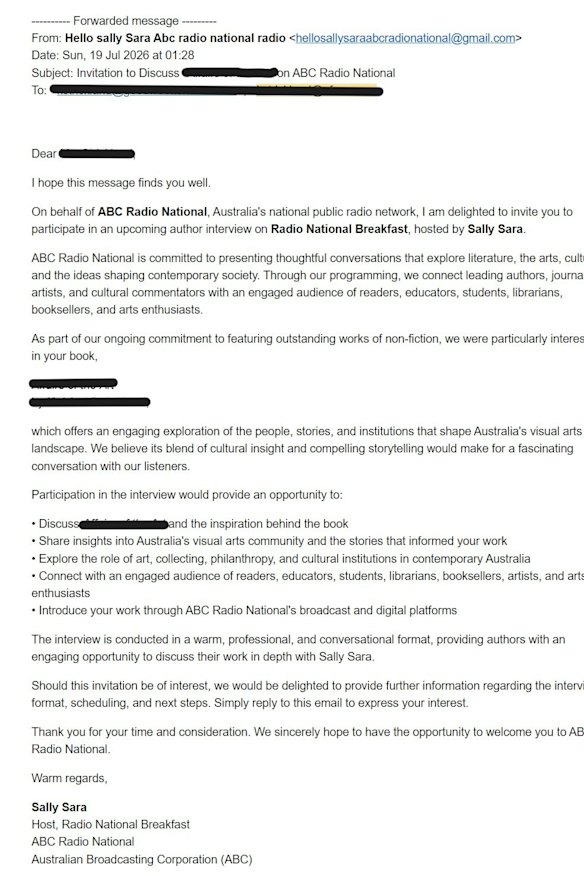
While authors are the primary targets, respected editors, literary agents and media figures are caught on the other side of the sting. Scammers steal their names and professional authority to trick writers into fake pitch offers, promotional junkets or film deals. Such was the case with a recent scam email purporting to be from ABC Radio National presenter Sally Sara, offering an author a guest appearance on her show. By leveraging the cachet of a major public broadcaster, the scammers created an offer that felt almost too prestigious for a writer to turn down (the ABC was contacted for comment).
Some of the initial emails mention money, but most don’t. Instead, they lead with flattery and promises, waiting to hook the author before they raise the issue of fees. These kinds of scams are sometimes referred to as “pig butchering” operations, a term that originated with romance scams and graphically evokes the process of fattening up a prospective victim with flattery before draining them financially.
Like romance scams, author scams target vulnerability and play on emotions. “They’re trying to capitalise on an author’s genuine desire to have their work published, to have their work promoted, to have their work adapted,” Hayward says.
The tactic has proved remarkably lucrative for its perpetrators. In a recent case, the US government determined that just one of these publishing scam operations, based in the Philippines, defrauded nearly 800 writers of more than $48 million over six years.
US author Victoria Strauss, who has covered author scams since 1998 via the website Writer Beware, says they have proliferated over the past decade, fuelled by outfits based in the Philippines, Pakistan and India. The more recent AI-driven scams come from a different location, however.
“I’ve gotten hundreds of reports of these AI scams, and I traced a lot of them back to the payment information, and everything that I can collect and deduce indicates that they primarily come from Nigeria,” says Strauss. “I see them as kind of a descendant of the ‘Nigerian prince’ scams of old.”
Authors who have been inundated with these kinds of emails have become far more adept at identifying them. “The AI-generated copy is its own genre now and you can spot it once you’ve seen a few,” says Gardiner. The emails also have telling similarities: “same terms, same logic, same sentence structures”.

They’re also often about older books. Gardiner says most of the scam emails she receives “are about two young adult books I published years ago. Perhaps it’s something to do with how often they were ingested in a pirate database used to train AI. No real publicist would want to talk to me about them, although sometimes local schools or readers do, so I always have to check.”
Hayward says sifting the real emails from the fake has become a problem in itself. “[At this point] it’s not so much that authors are falling for these scams and handing out money, it’s the volume of the emails that they are receiving. It becomes very difficult to determine what might be a legitimate offer and what is a scam.” One of the key ways to check is looking at the email address, she says, “but for Australia, we have a smaller market, and where book clubs and podcasts are concerned, you might not have someone with a professional email address”.
They’re trying to capitalise on an author’s genuine desire to have their work published, to have their work promoted, to have their work adapted.
“You waste time trying to sift the real from the fake,” Gardiner says. “No doubt some genuine approaches have not got through, too, which means writers and readers miss out on real opportunities to engage.”
How are scammers continuing to thrive, if authors are getting wise? Strauss says the dozen or so emails she receives each week about people who have lost money to these scams involve non-professional and first-time authors.
“There are a lot of people who just want to write one book; they want to write a memoir, or they want to write about their cancer journey or something they feel is meaningful and will help people. There are a lot of older people who retire and write children’s stories, or a memoir,” she says.
These people are vulnerable to scammers in more than one way: not only are they unaware of how the publishing industry works and outside professional support networks and communities, but the personal nature of their material can make them particularly susceptible to emotional manipulation.
“I sometimes hear from the relatives of older people, often on fixed incomes, who’ve lost enormous amounts of money – tens or hundreds of thousands of dollars – and cannot be convinced that they’re being scammed because the scammers are using psychological manipulation to establish personal relationships,” Strauss says.
As she embarks on her career, Colussi can well understand how people are taken in. “Writing a book is such a dream for so many people. They are waiting for that one ‘yes’, and pretending that you are that one ‘yes’ is unfortunately an easy way to take advantage of someone.”
What else is happening in the book world?


