Source : the age
CABARET
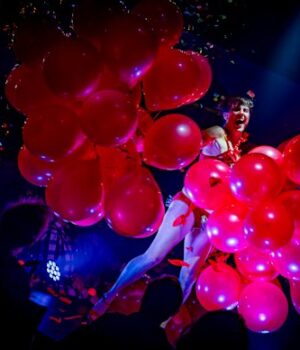
Finucane & Smith’s Dance Palace ★★★★
Luna Park, until September 12
Two Melbourne icons join forces for Dance Palace. To see Melbourne burlesque and performance art legend Moira Finucane and friends, you’ll be obliged to step through a second icon – the mouth of Mr Moon at the entrance to Luna Park.
A venue called Luna Palace has just opened inside the heritage amusement park in St Kilda. The large second-story space has been refurbished to host performances and events, with a well-stocked bar and kitchen, and panoramic views of the park’s historic roller coaster.
The carnival atmosphere is perfect for celebrating 30 years of the House of Finucane & Smith. There’s always been a carnie communitarianism breathing life into this homegrown company, which has been attracting artists who transgress boundaries, or don’t fit neatly into mainstream boxes, since well before diversity became a watchword in the arts.
Normal rules don’t apply to the variety entertainment on offer. Finucane makes the show’s subversive intent clear from the outset in typically formidable style.
While superfans have been known to throw their undies at stage icons, Finucane chucks three decades worth of undies into the audience in a striptease that’s also a monologue about the company’s ethos – plus a cheeky tribute to the merch that helped keep these artists afloat through a funding vacuum.
A multitude of entertainments dazzle and delight over the two-hour gala. Longtime followers of Finucane & Smith will have seen many among this selection of their greatest hits, but there are novel surprises even for veterans.
The erotic art of burlesque comes in every flavour, from the glamour of showgirl fans and sequined pasties (Maple Rose) to the twinkle of Indian boylesque (Govind Pillai), Yumi Umiumare’s demonic Butoh-inspired striptease, and the rhinestone-draped nudity of a country-singing cowgirl (Kate Foster).
Then, there are Finucane’s own fierce and inimitable provocations. Some sign of the artist’s international reach was her trip to Antarctica, and one sequence relates that polar adventure through ecological storytelling, belly-dancing (Raksha Parsnani), and a spot of krill opera.
You read that right. And if you think krill opera is intriguing, cabaret lovers will be astonished by the eclectic range of songs and music in the line-up.
Musical highlights include operatic arias and roof-raising bangers, a moving original song from Yorta Yorta Taungurung elder Glennys Briggs, and a newly composed Chinese pop ballad from Zitao Deng, performed in multilingual harmony.
Maude Davey sings Jacques Brel in a clown costume, and Mama Alto interprets Joni Mitchell with transcendent charm.
Dance Palace is a marvellous showcase of the glamour, talent, resilience and sheer variety that Finucane & Smith have brought to the stage over the years, and the kind of inclusive spectacular that should make Melburnians proud.
Reviewed by Cameron Woodhead
DANCE
Now or Never Festival | Time Remaining ★★
Chunky Move, Melbourne Town Hall, until August 20
I admit that I’m baffled by Antony Hamilton’s Time Remaining. What is this mad, gloomy, thoroughly undramatic spectacle supposed to be about? And what exactly are those poor dancers in their dowdy costumes doing?
The program is no help. It tells us that the show “explores the technical integration of scenic lasers within live performance”. Technical integration? Really? Is this an exercise in systems engineering, then? Not choreography but logisticality?
Well, the dance and the laser show might be technically integrated, but they’re not integrated in any more meaningful sense. Time Remaining is like two separate performances accidentally occupying the same venue – though neither manages to fill the space.
The production is vacuous in the precise sense that it lacks content. In the vast cavern of the Town Hall, everything feels far away and ineffectual, especially when viewed from the balcony seats: a handful of dark figures scurrying through the lights or just waiting about.
There are four laser units mounted on racks suspended from the ceiling. Thin purple beams traverse the hall, slowly and repetitively, producing eerie blue shimmers on its walls. The arrangement is stark and simple and might have made an interesting gallery installation.
The precision of the lasers contrasts strongly with purposelessness of the dancers. Costumed in a Gothic gallimaufry of theatrical hand-me-downs, they writhe in slow motion on the raised stage or caper through the hall like shrieking children.
There is some dance, but it’s so wilfully impoverished that one is forced to wonder whether this production is actually a rejection of live performance – especially the work of choreographing human bodies.
Whatever fascination this performance has belongs to the lasers: the orderliness and constancy of the beams, their innate intensity, their capacity to cut through darkness and the precision with which they can be choreographed.
Beside them, the dancers seem almost superfluous: messy, obsolete and absurdly old-fashioned. What are they doing down there? They’re disappearing.
Reviewed by Andrew Fuhrmann
MUSIC
Stravinsky, Mills and Shostakovich ★★★★★
Australian World Orchestra, Hamer Hall, August 19
Now celebrating its 15th anniversary, the annual ritual of bringing together Australia’s finest orchestral musicians under the banner of the Australian World Orchestra has rightly become an eagerly anticipated fixture in the nation’s musical calendar.
Expert musical storytelling characterised this year’s program, one in which a curious set of Australian fables was bookended by two Russian classics.
Really a concerto for orchestra, Stravinsky’s ballet Petrushka (presented in the revised 1947 version) allowed many of the AWO’s talented players to bask briefly in the limelight as the story of the puppet Petrushka’s being brought to life unfolded.
Conductor Alexander Briger imparted an appropriately light touch to Stravinsky’s droll, whimsical mixture of vigorous folk music and mock tragedy, eliciting laser-like rhythmic accuracy from his forces.
Commissioned by the AWO for this tour, Jonathan Mills’ Songs for the Stranger draws on and adds to material from his opera Eucalyptus, based on Murray Bail’s novel and cast in poetic form by Meredith Oakes.
Tenor Michael Petruccelli, who starred in the opera, brought punctilious diction and highly committed musical communication to this set of five quirky tales, scored predominantly by Mills in a muted, shadowy world of low strings, often haloed by reverberant percussion.
Crackling with collaborative electricity, Shostakovich’s Symphony No. 10 became a powerhouse of musical dynamism from the vast expanses of the opening to the jet-propelled Allegro, and thence to the impassioned delirium of the third movement in which the composer arguably confesses his infatuation with a student. In a work possibly driven by the then recent death of Stalin, the finale was equally unabashed, although punctuated with some superlative wind solos.
Despite last-minute personnel changes, the AWO, both individually and collectively, brought world-class musicianship to a generous and demanding program. It is surely a musical outfit of which we can all be proud.
Reviewed by Tony Way
The Booklist is a weekly newsletter for book lovers from Jason Steger. Get it delivered every Friday.
CORRECTION
An earlier review incorrectly referred to the Australian World Orchestra marking its 50th anniversary. It’s been corrected to say 15th anniversary.