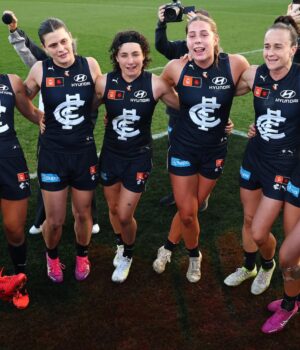
Source : ABC NEWS
Carlton was the darling of the AFLW last year.
It returned to the finals for the first time since 2020, pressed toward a preliminary final, and challenged perennial contender Brisbane on its home deck.
The fear — especially in the AFLW — is that the comedown the following year is hard and fast for those sides that propel themselves up the ladder.
Short seasons, a heavily weighted fixture list, and small playing roster sizes prone to injuries, can all make linear growth far harder to come by. But the Blues have bucked that trend in a big way to start the 2026 season.
Instead of coming into the year expecting to do the same thing, albeit with more experienced players, the Blues have adapted their game style further.
They have tapped further into what worked last year but also added new layers that prove the coaching panel’s willingness to look toward future trends of the game.
The handball game

Carlton is moving the ball fast on the run, including handballs, from a midfield featuring Claudia Whitfort. (Getty Images: Daniel Pockett)
Where in 2025 the Blues moved the ball by foot 61.3 per cent of the time, that has dropped way back in 2026 to 54.4 per cent. In turn, their handball metres gained have shot through the roof from 178 metres per game last year, to an average of 335 across the opening two rounds this season.
This has also driven an AFLW-wide growth in the area, with teams across the league working to get the ball forward by hand more often, but the Blues’ growth is far ahead of any other side at this stage.
Unsurprisingly, this has seen Carlton’s average handballs go from 100.8 last year, to 134.0 this year and, importantly, it is hitting its targets more reliably.
Much of this is built on the midfield trio of Mimi Hill, Abbie McKay, and recruit Claudia Whitfort.
| Carlton’s ball movement by hand | 2025 | 2026 |
|---|---|---|
| Average handballs | 100.8 | 134.0 |
| Average handballs metres gained | 178.0 | 335.0 |
| Average kick rate percentage | 61.3 | 54.4 |
| Average inside 50s | 35.5 | 37.5 |
By moving the ball with speed, on the run, hitting those handball receive options, the Blues are getting the ball forward more consistently than they ever have before.
Transition footy
Last year a pillar of Carlton’s growth was its improved rebounding from defensive 50, and capacity to turn opposition forward entries into their own scoring chains.
That has only grown this year off the back of that handballing transition game.
They have scored +51 points from turnover — the greatest differential in the AFLW across the opening fortnight — and have scored more points from defensive 50 score launches than any other side, at 33 points.
Their rebound rate has increased year on year, as has their score from the back half.
| Carlton’s growing transition game | 2024 | 2025 | 2026 |
|---|---|---|---|
| Average points from D50 launches (AFL rank) | 0.3 (last) | 8.6 (1st) | 16.5 (1st) |
| Average rebound rate percentage | 78.7 | 82.5 | 85.5 |
The solid defensive trio of Harriet Cordner, Ciara Fitzgerald, and Maddy Hendrie established itself last year, so now with Irishwoman Siofra O’Connell added to the line, Cordner has a little more freedom to get off a direct opposition and kickstart much of the attack.
All-Australian and Carlton best and fairest winner Dayna Finn is also a crucial part of this defensive transition, as is Amelia Velardo who has locked down a mid-sized defensive role this year thanks to consistency with her body and role.
A different way to attack
To finish off their work, the biggest change this year has been what the Blues do once inside 50. Last year a reliance on marking targets close to goal was found — Tara Bohanna, Sophie McKay, and Breann Harrington were the main targets in this respect.
This year, that has totally changed. Harrington is sitting out the season while pregnant with her first child, and Bohanna is finding it hard to make it into the team.
So, instead of playing that marking game, the Blues are using space and ground-level forwards to do the damage on the scoreboard.
Nell Morris-Dalton (R) leads the Carlton goalkicking with four goals this season, as marks inside 50 have dropped away.
(Getty Images: Morgan Hancock)
The inclusion of Nell Morris-Dalton as, ostensibly, the key forward target and a supporting cast of smaller forwards around her, has made the Blues harder to defend against.
But the only way this works is thanks to the faster movement up the ground to isolate those players on the deck in goal-side space.
So, while Carlton’s marking numbers have increased around the ground, the crucial mark stats that previously grew for the club — contested marks, and marks inside 50 — have both dropped away.
| A move away from marking forwards | 2025 | 2026 |
|---|---|---|
| Average marks | 48.7 | 60.0 |
| Average marks inside 50 | 7.3 | 5.0 |
| Average contested marks | 6.2 | 3.0 |
All of this comes with the caveat that the sample size is just two matches, but for teams to grow year on year, adding layers to their game style is crucial in staving off the planning of opposition sides.
Carlton has done just that with such a stark change to its ball movement and attack, but all of that adjustment up the field has been done with the same solid defensive base that made it so successful last year.