Source : the age
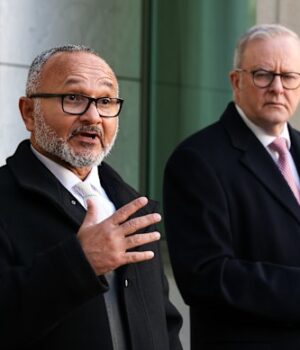
Prime Minister Anthony Albanese and Solomon Islands counterpart Matthew Wale will move to fast-track a sweeping new treaty after a push to overthrow Wale’s pro-Australia government imploded in a blow to Beijing’s ambitions to expand its influence in the Pacific.
Wale’s success at fending off the attempt to overthrow him came as an immense relief to Albanese and foreign affairs officials in Canberra, who see him as one of Australia’s most important allies in the region.
In Beijing, it’s an altogether different story. Xi Jinping’s foot soldiers will be lamenting a lost opportunity to install a pro-China leader in Honiara, just 2000 kilometres from the Australian mainland.
The start of last week’s Pacific Islands Forum in Palau was rocked by the news that Wale had to race home to respond to a non-confidence motion lodged while he was en route to the event. As three of his cabinet ministers stepped down, Wale’s hold on power looked precarious just four months after his surprise election victory.
But instead of gaining momentum, the amateurish putsch effort sputtered and flamed out. Manasseh Maelanga, the former cabinet minister who led the charge against Wale, announced on Sunday afternoon that he was withdrawing his no-confidence motion after failing to secure the numbers to bring the government down. Wale remains in power, his stature enhanced.
This matters to Australia because of the remarkable turnaround in foreign affairs Wale has spearheaded since coming to power in May. For most of the decade leading up to 2024, the Solomons were led by the mercurial Manasseh Sogavare, who was openly hostile towards Australia and signed a far-reaching security pact with China.
That deal shocked Canberra and dominated days of the 2022 election campaign, with then opposition frontbencher Penny Wong branding it the nation’s worst foreign policy blunder since World War II.
His successor Jeremiah Manele was less adversarial, but remained determined to play Canberra and Beijing off against each other.
By contrast, Wale – a long-time critic of China who railed against politicians “sleazing up to Beijing” – has made clear his priority is deepening ties with Australia. Just weeks after coming to office, Wale declared he would review the China security pact and negotiate a comprehensive new treaty with Australia. He also announced he wanted to achieve an ambitious regional security pact, a move that would limit China’s ability to pick off individual countries.
When China test-fired an intercontinental ballistic missile across the region in July, Wale showed no compunction in criticising the superpower, labelling it “not the act of a friend”. One of his top ministers, Peter Kenilorea Jr, has called for security and policing co-operation with China to be sidelined.
This is why, despite no firm proof of meddling, Australian officials were convinced Beijing was helping to orchestrate the move against Wale. “It is just speculation, but I imagine they would have been very active,” says James Batley, a former Australian ambassador in Honiara. “They certainly have the motive.” There was even a chance Sogavare could have returned to power in a nightmare scenario for Canberra and a dream come true for Beijing.
The Chinese government, for its part, angrily denies it seeks to interfere in Pacific nations’ internal affairs. The Solomons have long been known for its cycle of “grasshopper politics” in which MPs jump from one side of the aisle to another, driven less by ideology than personal advancement.
Wale’s rapid attempts to drive domestic reforms and overhaul foreign relations undoubtedly rankled some of his cabinet colleagues, who found him high-handed and accused him of failing to consult on key decisions. Unlike Kevin Rudd, who faced similar accusations as prime minister, Wale has been given a chance to improve and grow in the job.
Wale and Albanese will now look to lock in their comprehensive treaty, which has largely been completed by officials. Initially slated to be struck by the end of the year, a deal could come ahead of schedule, with an Albanese-Wale meeting on the sidelines of the United Nations General Assembly in New York later this month the next opportunity to make progress on the pact.
Wale’s proposal for a Pacific-wide security agreement will prove far more difficult, and perhaps impossible, to achieve given the diverging views within the region. Even so, Wale’s willingness to propose bold ideas that challenge Beijing shows why Albanese is delighted the push to oust him failed — at least for now.
Cut through the noise of federal politics with news, views and expert analysis. Subscribers can sign up to our weekly Inside Politics newsletter.
 Matthew Knott is the foreign affairs and national security correspondent for The Sydney Morning Herald and The Age.Connect via X, Facebook or email.