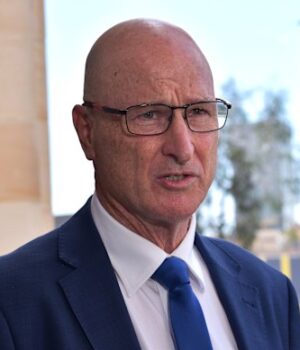
Source : the age
It’s not lost on Bevan Warner that for most of the West Australian public the only thing they know about the last Ombudsman was that he was partial to some international travel.
In 2024 the Ombudsman’s office was thrust from relative obscurity and into the public spotlight as the Corruption and Crime Commission probed former Ombudsman Chris Field’s extensive international travel portfolio in the final two years of his 17-year tenure.
He sensationally resigned from the role hours after the CCC dropped a scathing report accusing him of serious misconduct for failing to seek ministerial approval for international travel for his role as the head of the International Ombudsman Institute between 2022 and 2023.
It was a brutal blow to the people’s advocate office supposedly set up to expose and fix failures of government.
Warner replaced Field in May 2025 and concedes morale at the organisation was “very low”.
He is quick to point out the travel issue has been resolved but that doesn’t mean he and his team aren’t still hopping on planes.
“I can’t independently travel out of the country without the approval of the premier,” he said.
“I don’t have any plans to travel outside the country, I think the focus of the role should squarely be on WA.
“My first trip was to the East Kimberley…we’ve been to 16 different regions in the last 12 months.”
Warner was born and raised in WA and out of school he studied philosophy, latin and politics at UWA for about six weeks before he quit and went surfing for a year.
He went back to uni to study commerce which he said was fashionable at the time.
…all powerful institutions, government, corporations, sporting codes, ultimately act in their own interest…
WA Ombudsman Bevan Warner
“I self sabotaged after a couple of years. I did two and a half years and I realised that if I completed the degree, I’d probably end up an accountant,” he said.
In need of money, he took an entry-level clerk job in the public service which first exposed him to government decision-making but it wasn’t until his early 30s working in the Department of Aboriginal Affairs he turned onto the path leading to the Ombudsman’s office.
“I went to a remote community in the West Kimberley, and the water supply and the septic system was built in a floodplain, and the community was being blamed for children having skin diseases,” he said.
“The placement of the water supply and septic system were decisions made by technical specialists, funded by the Commonwealth and implemented by the state, and it got me thinking about the raw unfairness of it all.
“An Aboriginal community was being criticised through no fault of their own because of decision-making between both levels of government that was also then rolled up as waste and mismanagement.
“If government for the people, by the people, is meant to deliver benefit to ordinary citizens, why in this instance were the citizens the beneficiaries of an entitlement to clean potable water and a hygienic wastewater system being blamed for the failures of government organisations?”
Warner then joined WA Legal Aid before heading east and running Victoria Legal Aid for a decade, then a community housing provider before returning west in 2025.
Referred to colloquially as “the people’s advocate” Warner’s office probes problems in government agencies.
It has extraordinary powers including the powers of a Royal Commission to compel agencies to produce documents.
Warner can investigate matters in a few different ways. The most common is via individual complaints about a government department.
He recalls a recent complaint from a patient about a WA hospital losing their valuables that lead to major changes throughout the health system.
“The health service refused to reimburse that person, they complained to us and when we looked at the administrative procedures for people coming in distressed about safe care or personal belongings, we found weaknesses in both the administrative processes and the record keeping,” he said.
“That particular complaint resulted in the health service agreeing to reimburse, but also to tighten up those procedures and to train staff, orderlies, and care staff in hospitals about good practice in relation to belongings.”
Warner also has “own motion” powers to investigate systemic issues in government.
Warner is no wallflower, making headlines several times this year including by confirming it was investigating WA police interactions with Jeffrey Epstein victim Virginia Giuffre before her death last April.
He also released a shocking report into family and domestic violence in March this year that found 60 per cent of family and domestic violence incidents posed a high risk of serious harm, yet only 2.5 per cent of those were escalated to multi-agency intervention.
The Ombudsman will publish a document by the end of the year on the themes and topics they planned to inquire into over the next few years.
Warner clarifies that his job isn’t to provide political ammunition for opposition parties, it is to make governments work better behind the scenes.
“Over time I’ve developed a working theory that all powerful institutions, government, corporations, sporting codes, ultimately, they act in their own interest ahead of fans, or ahead of shareholders, or the community, ahead of ordinary citizens,” he said.
“It’s not because people who are leading those organisations are bad.
“I think it’s just the nature of large, powerful organisations believe in their purpose, believe in what they’re contributing to society, and therefore, ultimately, push comes to shove, they’ll act in their own interests to preserve their status or their reputation or their place in the world.“
While performing the day-to-day tasks of the Ombudsman, Warner knows there is still a long way to go to rebuild trust in his agency and points out the extensive work done in strengthening internal governance.
“If we have gaps in our systems and processes, then it would be hypocritical to be pointing out weaknesses in others and not fixing our own,” he said.
 Hamish Hastie is WAtoday’s state political reporter and the winner of five WA Media Awards, including the 2023 Beck Prize for best political journalism.Connect via X or email.