Source : the age
When the cathedral of Notre Dame in Paris caught fire in 2019, the call for proposals for its architectural restoration brought a variety of responses, from biomodern designs with Anthropocene swimming pools on the roof to the meticulous replication of Viollet-le-Duc’s 19th-century remodelling of the church.
The latter won the day but this somewhat “immaculate” restoration was nonetheless full of ironies, not the least of which was the fact that when Viollet-le-Duc was commissioned to restore the medieval church in 1844 he conducted a highly creative redesign, incorporating now famous gargoyles out of his own imagination and a dramatic 55-metre spire that bore only a passing resemblance to the smaller spire that had fallen into disrepair during the 18th century.
One of the contributing factors to Viollet-le-Duc’s High Gothic update was Victor Hugo’s novel Notre Dame de Paris, written just three years before the redesign. That this novel directly influenced the “restoration” speaks to the power of literary fiction in 19th-century France where, as Fiona Sampson points out in Becoming George, her new biography of George Sand, the success of authors such as Hugo and Balzac, Sand and Flaubert was in part seeded by the advent of mass literacy in a post-revolutionary Paris newly replete with editors, critics and, of course, literary rivals.
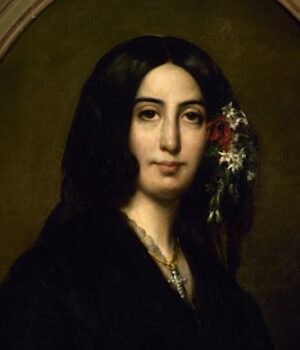
When Sand published her first novel, Indiana, in 1832 she was 27, the meditative yet gregarious daughter of a landed aristocrat from Nohant-Vic and a working-class girl from the Parisian demi-monde. Sand was born into her father’s rural estate with the name Amantine-Lucile-Aurore Dupin de Francueil, but spent her formative teenage years in the English-speaking Dames Augustines Anglaises convent in the sixth arrondissement of Paris, after her paternal grandmother decided her unruly spirit needed to be contained. But it was while young Aurore Dupin was absorbing the sounds of Paris as they filtered through the convent walls – “my paradise on earth”, as she called it – that she became a writer, finding her first audience in the captive convent community where she enjoyed, in her own words, “unheard-of success”.
Amidst the flourishing literary culture of her time, the novelist went on to shine as brightly, and dangerously, as the 2019 Notre Dame fire. And like that fire, she was viewed as cataclysmic by some and as an agent of much-needed renewal by others.
This was in no small degree due to an early celebrity garnered in her 20s by a conflation of her instinct for publicity and her revolutionary approach to gender and sexuality. This saw her not only take on the patriarchy by sporting a male pseudonym and wearing men’s frock-coats and trousers but also by embarking on what Sampson describes rather sensationally as her “notorious career as a sexual polymath”. That this included relationships with well-known artists, writers and musicians such as Alfred de Musset and Frederic Chopin added to the tabloid-style notoriety, but it was Sand’s writing that would go on to prove that all the fuss about her personal life was a relatively trivial by-product of her unfettered creativity and progressive largesse. Nowhere was her personality more on display than in her incredible productivity as a writer.
Indiana was a smash hit and an enduring one, and it’s fair to suggest, as Sampson does, that this “creole romance” had a direct influence on both Wuthering Heights and Jane Eyre. Sand quickly became known in Paris for a literary facility every bit the match for her subversive social persona and lifestyle. Her output from there on was truly astonishing; at one point she signed a 10-book deal with her publisher, she wrote copiously for the newspapers and was a voluminous letter writer, the published volumes of which reach to no less than 24,000 pages.
But significantly, Sand was also a great memoirist, particularly in her very long but highly readable Histoire, or The Story of My Life, which Sampson rightly leans heavily on in her biography. As Sampson points out, the very concept of a “histoire” means something rather different in French than it does in English and thus it is understood that Sand’s own account, written later in life, is itself, like Viollet-le-Duc’s Notre Dame, not a faithful restoration but a “story”, a new creation. Appropriately then, Sampson also reflects on her own process of “restoring” such a writerly life through the inevitably tinted lens of now. She renders Sand as not only relevant to our times by dint of her living as an unabashedly promiscuous and highly productive artist, but also in her approach to our own urgent ecological imperatives.
No one who wrote as much as Sand did could escape producing some duds, but the three rural novels she produced in the middle of her career, La Mare au Diable, Francois le Champi and La Petite Fadette, contain some of the more self-reflexive regional fiction of the time. The Socratic dialogue she writes as an introduction to Francois le Champi, for instance, is prescient in its concerns for how the writer might interrogate any class-infused hackneyed pastoralism in the rural landscape. That this novel went on to form the intertextual centrepiece of Marcel Proust’s great novel of time and memory seems therefore no coincidence, even if Proust also had his reservations about the unevenness of Sand’s literary style.
What comes through most strongly in this lucid and at times insouciant biography is the irrepressibility of Sand’s voice. It is almost as if she has spurred Sampson on, at least stylistically, even from beyond the grave. That she had the idealism, the wit and the courage to never let the claustrophobic conservatism of her era dampen her appetite for life, for art, for country and for justice, is inspiring to behold. So that even amidst the ultra-binary judgements of these digital times we can grasp, some 150 years later, what an important spur and tonic she has been to the more redemptive aspects of our perpetually renewing modernity.
Becoming George by Fiona Sampson is published by Doubleday ($55).
The Booklist is a weekly newsletter for book lovers from Jason Steger. Get it delivered every Friday.
 Gregory Day is a former coach of the Moriac Apricots. He is also an award-winning novelist, poet, essayist and musician based in Victoria, Australia.