

Source : the age
OPERA
The Turn of the Screw ★★★
Palais Theatre, until October 1
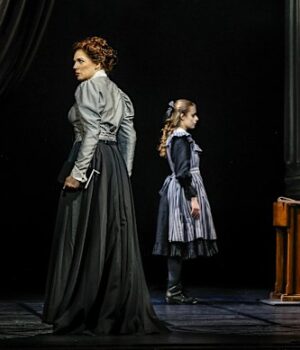
Operatic takes on the supernatural span the centuries, but no modern work is more revered and feared than Benjamin Britten’s The Turn of the Screw. The 1954 opera follows a governess who takes up residence at an English country house, only to find the spirits of two dead servants are haunting the children now in her care.
Finally, an opera where the muffled screams drifting in from Luna Park next door actually add to the drama, rather than detract!
This is a piece that has potential to be The Shining-level unnerving. When staged up close and creepy, the eerie singing and sinister spectacle can captivate like a demonic spirit itself. Here, the huge set and vast stage dwarf the drama – in pivotal moments, the singers are far away from each other; we are far away from them. Detachment creates a disconnect that does not serve some excellent performances.
It is, after all, a chamber opera. Britten scored it for just 13 instruments. Perhaps no Australian conductor knows more about the English composer than Paul Kildea, and the reduced Orchestra Victoria was guided superbly by him.
Rachelle Durkin (Governess) was more maternal than hysterical, with a self-assured, impressive vocal performance to match. His voice sharp and cold, Kanen Breen uses his lithe physicality to intensify Peter Quint’s menace, despite donning the most unflattering wig anyone’s ever been cursed to wear (it’s a confusing choice, when it’s clearly mentioned how handsome Quint is).
One exceptional discovery to come from this production is soprano Genevieve Gray (currently a university student), who sings the older child, Flora. Gray possesses a vocal evenness and an array of colour that belies her youth.
Neither a spook nor a snore, though with moments of satisfaction, this production feels like a missed opportunity to bewitch more people with the mystery and magic of operatic storytelling.
Reviewed by Bridget Davies
THEATRE
Koreaboo ★★★
Malthouse, until October 10
Inspired by playwright Michelle Lim Davidson’s own experiences and directed by Jessica Arthur, Koreaboo is a two-hander that surveys contentious issues of race, diaspora and belonging, with a light touch.
Davidson herself plays Hannah, a young Australian who travels to Seoul in an attempt to reconnect with her estranged birth mother, Umma (Heather Jeong). It’s only their second meeting. We learn that although she was born in Korea, Hannah was adopted as a baby and grew up in Newcastle, NSW.
At the start, the two women fail and flail in communication. Hannah was expecting a summer-long stay – a long enough period, perhaps, for meaningful reconnection; Umma (mother in Korean), however, believed it was just going to be a short vacation. Her behaviour toward her daughter thrums with wariness, as though one were greeting a stranger. Maybe, she suggests, Hannah should be visiting Seoul’s touristy spots instead.
The entire performance is staged in a small convenience store run by Umma, lovingly decked out in all manner of brightly coloured snacks, and with harsh fluorescent lighting thanks to designer Mel Page. The two women move within the space as they interrogate, parry, and deflect.
Davidson explores a raft of issues, including the question of identity. Hannah’s hyphenated background (Korean-Australian) means she’s part of both cultures and wholly of neither, and at first, Umma’s brusque criticism of Hannah’s language skills feels like a wholesale rejection of her daughter’s “Koreanness”. Seeking both maternal and cultural acceptance, Hannah feels crushed to receive neither.
Their common language – and one that helps them move toward connection and bridge distance, it turns out – is K-pop. The title actually refers to someone who’s not of Korean heritage but who is obsessed with Korean pop culture.
Koreaboo swerves to the unexpected and surreal when both performers begin to sing and dance. There is a talent show in the offing to prepare for, and a chance for Hannah to become more Korean. It’s all surface-level cultural appropriation, though, much in the same way that Umma learned English by watching TV, becoming so familiar with the lives of the characters in Sex and the City that she can quote from them.
After a shaky start, Jeong and Davidson become good sparring partners and friends as they navigate the tricky mother-and-daughter relationship anew after years apart. Umma’s backstory is revealed: the reasons behind Hannah’s adoption and how her yearnings for a singing career were quashed because of filial obedience to her own mother. Korean culture is not just skincare and pop music, but, like a lot of Asian countries, there’s an expectation to conform to parental demands.
Koreaboo packs in a lot during its hour-and-a-half stage time – maybe too much, as there is a lot of jumping about trying to cover a lot of ground. The beginning set-up takes a while to develop and can be tightened, and the ending feels rushed.
And although the singing and dance sequences are overextended and as distracting as they are humorous, the play’s value is drawn from highlighting the possible consequences of adopting a child, removing them from their motherland, and raising them in an entirely foreign environment. Even if they embrace the riches of a new life in their host country, there are always losses to be reckoned with.
Reviewed by Thuy On
The Booklist is a weekly newsletter for book lovers from Jason Steger. Get it delivered every Friday.
 Thuy On is an arts journalist, critic, editor and poet.

