
Source : the age
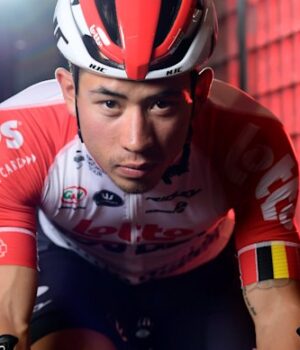
After a brilliant career that included 11 Grand Tour stage wins, Caleb Ewan retired as a professional cyclist in May last year. It stunned the cycling world given the Australian sprint star had a new team, Ineos Grenadiers, and had just won two races. “The intense routine, the sacrifice, the search for constant improvement, the hunger to win – it’s been my rhythm, my identity,” he said. “But what once felt like everything to me no longer does.”
In 11 years as a pro, Ewan became one of the world’s best sprinters, and won five stages at the Tour de France in 2019 and 2020. He now lives in Sydney with his wife, Ryann, and three children, aged seven, five and two.
While he admits that he considered a comeback earlier this year, Ewan has stayed retired and has joined the SBS TV commentary team for the Tour, which starts in Barcelona early on Sunday morning. He talks to Garry Maddox about the switch to the commentary box and if four-time winner Tadej Pogačar can stay in yellow, or if he will be bested by his great rival, two-time winner Jonas Vingegaard.
G’day Caleb! What’s life been like since you retired?
It’s been good. Obviously, a big adjustment. I’m used to waking up every morning trying to figure out how to ride my bike faster, probably for the last 20 years. So to wake up in the morning and have nothing like that to do was an adjustment. I also moved from Europe back to Australia. So I’ve been navigating life after being a professional athlete, focussing on commentary and figuring out what I want to do next.
What was the moment that made you think it’s time to retire?
Towards the end of ’24, I was thinking about it. I thought I’ll give myself one last opportunity to come back to what I was hoping would be my best form because I didn’t really want to end my career on a negative. So I went to Ineos and it was great. I was thinking I’d enjoy it again if I was winning again. But then I started winning and I still wasn’t really enjoying it. I thought that’s probably the sign to stop.
How much did the risks you had to take as a sprinter come into it?
Being a sprinter, you’re on autopilot in the last few kilometres of a race. As I got a little bit older, and as I had more kids, your risk threshold starts going away. In a sprint, you make decisions in a split second. When you start hesitating, you find yourself in bad positions, and it’s really hard from there. Even if I thought I was taking the risk, I wasn’t taking as many risks as I needed to, to be a top-level sprinter. When I was younger, I probably didn’t want to take the risk, but I knew it was just part of what I had to do.
You’ve been racing bikes since you were 10. How have you found ordinary life with a young family?
It’s been great. When you’re a pro cyclist, you’re away a lot at training camps and racing. Even when you’re home, you’re training, so you’re tired all the time and you’re always focusing on recovery. So you’re not able to be as present as you want to be. The last year since has been great because I’ve been basically a stay-at-home dad. I’ve been able to do most of the school drop-offs and pick-ups and take them to sport – all the things that you don’t get to do as a pro athlete. As far as family life goes, it’s been much better.
How often do you cycle now?
I try to get out two or three times a week. But when I do go out, it’s probably for an hour to an hour-and-a half. So a lot less than what I used to do.
Ever hire an ebike?
No. I do have an ebike, though. I’ve got one that takes all three kids on the back. I need it, especially on the hills.
Any thoughts that you’d still like to be racing?
Not really. There are brief moments, especially when you see the joy on people’s faces when they win a stage. I miss that feeling. But when I see all the sprinters suffering in the mountains, I definitely don’t miss that. I know those moments of joy come with a lot of suffering.
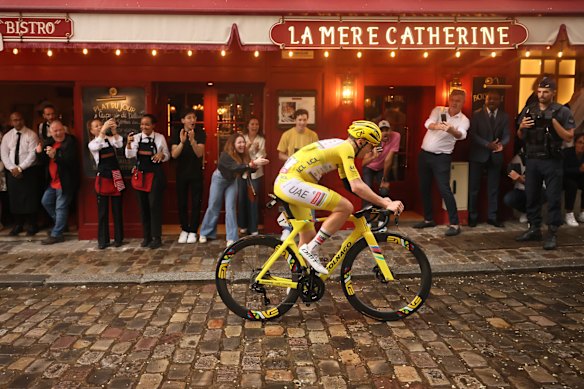
What is it, from a rider’s perspective, that makes the Tour so special?
Just the atmosphere. There’s no other race in the world like it. When I started watching cycling as a kid, it was only the Tour de France. We didn’t have access to all the races like we do now. Cycling was the Tour de France. So to be able to experience it and feel the atmosphere that you watched on TV was always special.
Stuart O’Grady, who rode in the Tour 17 times, once said he hadn’t realised there were châteaux in France until he retired. Did you ever notice any of the spectacular French sights?
You don’t get to really take in the sights. When you’re racing, you’re just looking at the rider in front of you and the road ahead and that’s about it. That’s a good thing when you’re commentating. You get to take in all the beautiful sights of France.
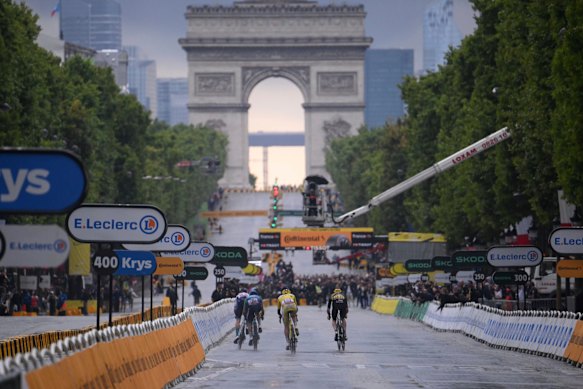
How have you found commentating?
I enjoy it. I’d say I’m not a natural speaker but when you’re speaking on something that you know, it’s a lot easier. Obviously, I’m big fan of the sports still. I said to [fellow commentators] Dave McKenzie and Matt Keenan when I was commentating on the Giro a few weeks ago, it’s like you’re just watching a sport with your mates and chatting about it.
What would you like to get across to viewers as you commentate?
A lot of people will just watch the Tour de France and not follow cycling as a whole, so [I’d like to] explain little intricate things that will be happening in the bunch that someone that doesn’t follow the sport wouldn’t really pick up on. It can be confusing sometimes.
During the Giro, you seemed a little star struck when you were commentating with Cadel Evans, who, in 2011, became the first Australian to win the Tour. What was it like commentating with him?
Growing up, he was a guy I followed a lot. But I know Cadel pretty well now. It was like a full circle moment. I did his last race with him. That was my first season as a pro. It was great to sit next to him. We obviously are very different types of riders, so just to hear how he would race compared to how I would race, there were things I could learn from him.
Who do you think will win the Tour this year, and who’s a dark horse for SBS viewers to watch?
Tadej seems to be on good form again, and he’s always going to be ready for the Tour. A dark horse, I’d say maybe Paul Seixas. It’s obviously a big call to be able to win your first grand tour, especially the Tour de France, but he seems to be the real deal. He’s still only 19, so it would be a huge story, especially being a Frenchman. Jonas was strong [at the Giro]. I’d love to see more of a battle between Tadej and Jonas. The last few years, Tadej has won very convincingly.
What’s your tip for the green sprinter’s jersey?
Mads Pedersen or Jasper Philipsen, [who] won the first stage last year then crashed out in stage three. He’s going to want to prove that he’s one of the fastest, but it’s going to be hard. Tim Merlier looks really good. Olav Kooij, first Tour de France, he’s looking good as well. We’re in for a really exciting Tour de France.
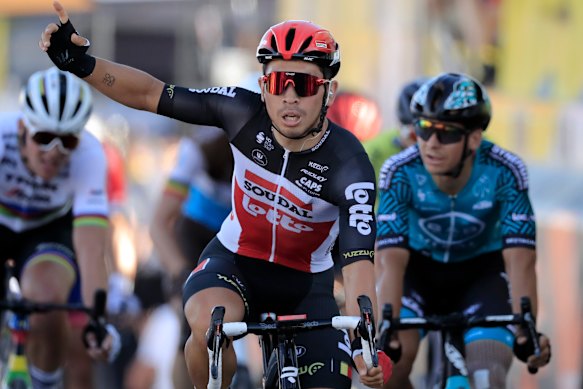
What’s one stage of the Tour you’re really looking forward to?
There are two stages that go up Alpe d’Huez. They’ll be really exciting.
You’re only 31. Mark Cavendish broke the record for most Tour stage wins at 39. What are the chances you’ll come back?
I was thinking about it this year, but I don’t think so. As long as I’m at an age where I could race, there’s always going to be a little temptation. If I ever wanted to do it, it would have had to be [this] season. After that, I would have been out of the sport for too long. I’m content not racing right now. I’m not really missing it that much so I’d say very, very unlikely.
Stage 1 of the Tour de France starts at 12.55am on Sunday on SBS and SBS On Demand. The race runs until July 26. The Tour de France Femmes runs from August 1-9.