

Source : INDIA TODAY NEWS
As India prepares for its first human spaceflight mission under Gaganyaan, scientists are recreating one of the most challenging aspects of living in space, without ever leaving Earth.
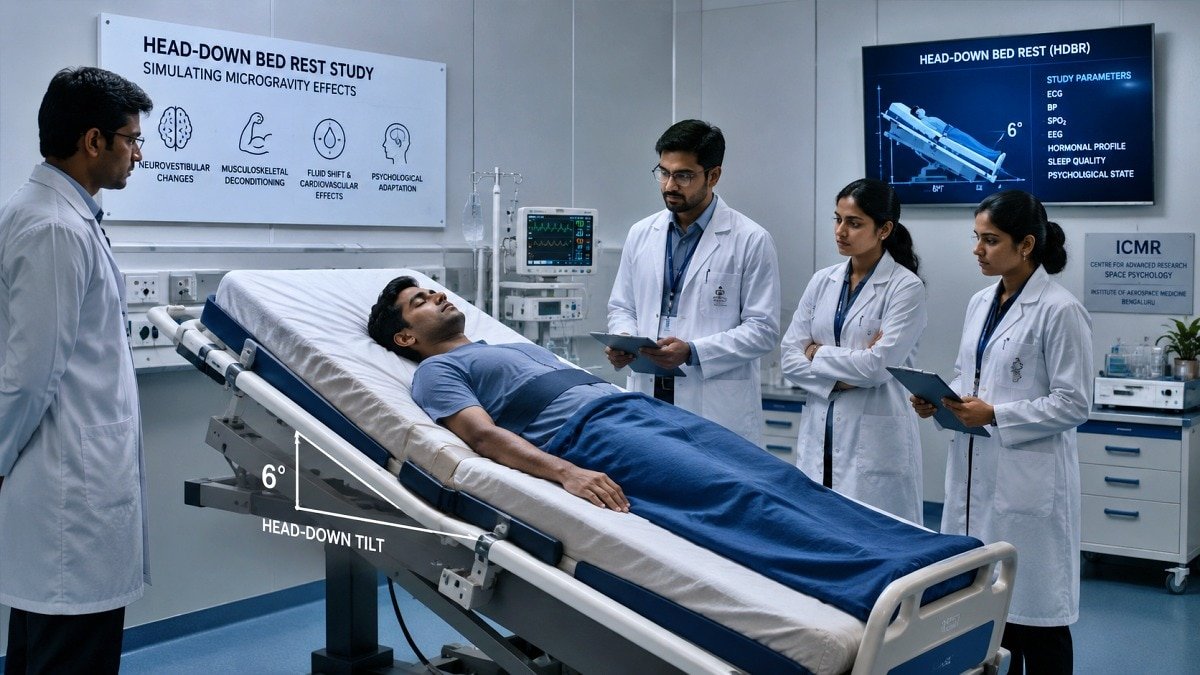
The Indian Council of Medical Research (ICMR) has successfully completed a seven-day Head-Down Bed Rest (HDBR) study at its Centre for Advanced Research (CAR) – Space Psychology at the Institute of Aerospace Medicine (IAM) in Bengaluru.
advertisement
The research was carried out in collaboration with the National Institute of Mental Health and Neurosciences (NIMHANS) to better understand how prolonged exposure to microgravity affects the human body and mind.
The study involved three healthy volunteers lying in beds tilted 6 degrees with their heads lower than their feet, a well-established technique used by space agencies around the world to simulate the physiological effects of weightlessness experienced by astronauts in orbit.
Although participants never left the ground, the unusual position mimics several key changes that occur during spaceflight.
Researchers studied psychophysiological responses associated with human space travel, including cephalad fluid shifts, where body fluids move from the legs toward the head, a hallmark of microgravity that can alter vision, increase pressure inside the skull and affect cardiovascular function.
The experiment also examined the impact of reduced musculoskeletal loading, which causes muscles and bones to weaken in the absence of gravity. Scientists further monitored neurovestibular changes that influence balance, coordination and spatial orientation—systems that astronauts often struggle to readapt after returning to Earth.
In addition to the physical changes, the study could also reveal the effects of prolonged immobilisation and the psychological challenges associated with confinement and restricted movement.
These findings are expected to help researchers understand how astronauts respond mentally and physically during long-duration missions.
Head-down bed rest studies are considered one of the most reliable Earth-based analogues for spaceflight and have been widely used by agencies such as NASA and the European Space Agency (ESA) to test countermeasures against muscle loss, bone deterioration and cardiovascular deconditioning.
For India, the research marks another important step in building indigenous expertise in space medicine, an emerging field that combines physiology, psychology and aerospace science to ensure astronaut health.
The findings are expected to contribute to astronaut training protocols, rehabilitation strategies and the development of countermeasures for future Indian crewed missions, including Gaganyaan and planned long-duration stays aboard the proposed Bharatiya Antariksh Station.
– Ends
SOURCE :- TIMES OF INDIA