

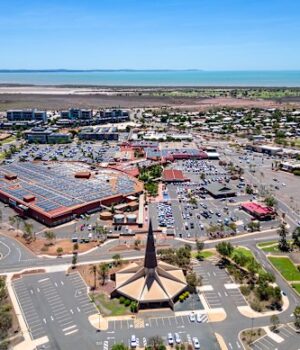
source : the age
Since 1972, the Pilbara town of Karratha has held an annual fête known to locals as the FeNaclNG Festival.
Originally started as a fundraiser for the Karratha Lion’s Club to support local community projects, the family friendly carnival-like event has grown over the years to celebrate its 54th anniversary in 2026.
While locals love the Pilbara’s answer to a classic agricultural show, one of the first things newcomers or out-of-towners notice about the festival is its unusual name.
“FeNaClNG” – mind the capitalisation – is drawn from three of the natural resources that helped build the mining town into the modern-day city it officially became in 2014.
Fe is the chemical name for the iron that made the Pilbara famous, NaCl the compound of the salt that was also mined in the region during its early days, while NG stands for natural gas, from the rich, albeit controversial, North West Shelf.
While the three resources that combined to form the festival’s name continue to provide for the city, there are arguments to be made that a fourth should be added into the mix.
In March next year, fertiliser company Perdaman’s Ceres urea project is set to come online, with full production scheduled to begin in June – just before next year’s 55th anniversary of the FeNaClNG Festival at the end of July.
Backed by the Commonwealth, the operation is set to provide around 2.3 million tonnes of urea each year once at capacity.
Company chairman Vikas Rambal said the nation’s reliance on imported fertiliser was laid bare when the US war in the Middle East led to blockages in the Strait of Hormuz.
While the majority of Australia’s attention was focused on the impact the war had on the price of fuel, the nation’s farmers had more pressing concerns, with more than 90 per cent of urea imported from overseas.
The Ceres project aims to ease concerns that a similar situation in the future will be avoided.
“Farmers love me,” Rambal said to journalists during a visit to the site this week.
“If we don’t have fertiliser in this country, farmers are helpless. It’s a must-have in any country.”
Ceres will use local seawater and LNG from Woodside’s nearby North West Shelf projects to create its urea.
The gas giant says its Scarborough project, which will feed into the company’s Pluto Train 2 facility on the Burrup Peninsula, is around 98 per cent complete, and is expected to deliver gas before the end of the year.
Scarborough Energy Project senior vice president Michael Robinson said the project would provide energy security for the state, while the supply of natural gas from it and the ongoing Browse operation were vital to several industries based around Karratha.
The project is not without its opponents. Research released last year challenged the company’s claims its carbon dioxide emissions would be “negligible”, while there are ongoing concerns about the impact of increased industrialisation on the Burrup Peninsula alongside rock art that is tens of thousands of years old.
Friends of Australian Rock Art and the Australian Conservation Foundation currently have a legal challenge before the Federal Court over the federal environment minister’s decision to approve the expansion of Woodside’s North West Shelf operations until 2070.
Following in fertile footsteps
Ceres is not the first project in the region, however, with Yara Pilbara Fertilisers first commissioned in 2006 and is now producing liquid ammonia from natural gas.
Around half of the 850,000 tonnes per year the Yara site produces is exported for use as a foundational ingredient in fertiliser.
The Yara plant accounts for around 5 per cent of worldwide traded ammonia and is Australia’s largest NH3 production facility.
Since 2016, Yara has also operated a co-located Technical Ammonium Nitrate facility, which takes some of the ammonia produced onsite to manufacture technical ammonium nitrate, providing more than 40 per cent of the key ingredient used in explosives at the Pilbara’s iron ore mines.
Yara Pilbara chief operating officer Laurent Trost said the site also included Project Yuri, a renewable-hydrogen demonstration project which will substitute renewable hydrogen for a small proportion of the hydrogen conventionally produced from natural gas.
However, he adds that decarbonisation needs to be viable and commercially driven.
“There is no green transition with red numbers,” he tells journalists at the company’s site near Karratha.
“Australia has a choice. It can become a country that congratulates itself as emissions fall because industry leaves, or a nation that proves a highly regulated and resource-rich democracy can both sustain and drive decarbonisation.”
Yara is already on the radar for Perdaman, with Rambal suggesting he would be willing to snatch up the operation if it ever came on the market.
Can one of the world’s biggest salt operations help its fertiliser friends?
Just 80 kilometres from Karratha sits BCI Minerals and its Mardie project, considered the third-largest solar salt operation in the world, and the biggest in Australia.
While salt – the “NaCl” in “FeNaClNG” – is the major product, once it is crystallised, what is left behind holds the ingredients for sulphate of potash (SOP), a premium, chloride-free fertiliser used on high-value crops such as fruit, vegetables and nuts, both in Australia and internationally.
While Australia currently imports almost all its SOP supply, BCI is preparing a pilot plant to test whether the fertiliser ingredient can be produced at Mardie, an important next step in maximising the value of the resource.
Commissioning is targeted for the start of the second half of next year, with piloting expected to run for approximately 12 months.
BCI Minerals managing director David Boschoff said when Mardie was fully operational, it would support about 140 permanent roles, and over its 60-year life the operation is forecast to contribute $4.8 billion to the Australian economy.
“What we have built at Mardie is not one business. It is three valuable opportunities drawn from a single resource,” he said.
“Salt is the foundation, SOP is the upside, and the port is the gateway to our customers for both.”
Perhaps one of the trickiest parts of the growth of fertiliser among the major industries supporting Karratha, is how to include it in the FeNaCling Festival’s name.
The writer travelled to the Pilbara as a guest of the WA Chamber of Minerals and Energy.


