

SOURCE :- THE AGE NEWS
US President Donald Trump said he was “not satisfied” in negotiations with Iran to end their almost three-month war, damping expectations for an imminent breakthrough.
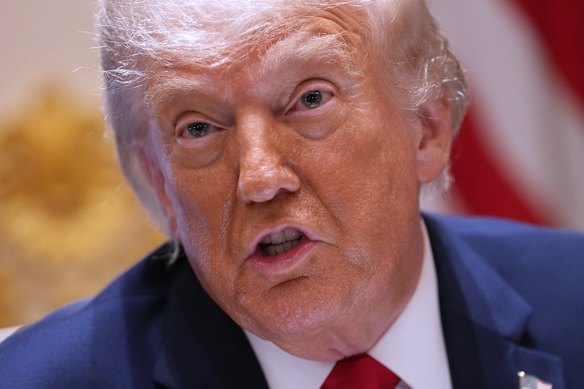
“They want very much to make a deal. So far, they haven’t gotten there. We’re not satisfied with it,” Trump said during a meeting with Cabinet officials on Wednesday at the White House.
“They’re negotiating on fumes. Maybe we have to go back and finish it,” he added, without elaborating on whether that meant further military action.
Trump’s remarks followed an Iranian state television report on a draft interim peace deal, which said maritime traffic through the Strait of Hormuz could return to normal within a month of it coming into effect. The White House cast the report as false.
“This report from Iranian controlled media is not true and the MOU (Memorandum of Understanding) they ‘released’ is a complete fabrication,” the White House said in a social media post. “Nobody should believe what Iranian state media is putting out.”
Further damping prospects for an agreement, Trump said there would be no sanctions relief in exchange for Iran giving up its uranium, PBS News reported, citing an interview with the president.
The president is looking for a settlement that will reopen the Strait of Hormuz and provide him with a credible argument that Iran’s nuclear capability has been diminished enough to declare victory, winding down a conflict that’s been politically unpopular for Republicans.
But as things stand, Trump also risks finding that closure to his war of choice comes with an unsatisfactory ending.
The emerging deal puts off many critical issues to be resolved later and has already exposed the Republican president to fierce criticism – even from some of his own supporters – that Iran’s hard-line leaders will emerge from the conflict battered but emboldened.
It all comes to a head just as the midterm elections to determine control of Congress come into focus and as Republicans worry that rising costs and fuel prices are darkening the American electorate’s mood.
But Trump on Wednesday dismissed the idea that the upcoming elections would shape his Iran strategy. “They thought they were gonna outwait me. You know, ‘We’ll outwait him. He’s got the midterms,’” Trump said. “I don’t care about the midterms.”
Oil remained lower on the day as traders stayed optimistic that a deal was in sight, even amid conflicting statements from the two sides on the progress of talks.
Other key points reported by Iran’s IRIB News included the US lifting its naval blockade on Iranian ports and the American navy leaving waters surrounding Iran.
The draft also said Iran and Oman will have a mechanism in place to oversee shipping in the strait. That’s one of the most contentious issues holding up a deal, with the US saying vessels must be allowed free passage. Oman has not commented in recent weeks on Iran saying the two are in discussions about managing the strait.
“Managing the passage of ships, their inspection and receiving service fees are at the discretion of the Islamic Republic and in partnership and in cooperation with Oman,” the Iranian state TV report said. Iran hasn’t committed to unconditionally reopening the strait, it said.
Iran and the US are negotiating to extend their ceasefire by around two months and reopen the vital Strait of Hormuz. Tehran’s effective closure of the waterway at the start of the war in February has sent oil and natural gas prices soaring and pushed up inflation globally.
Both Iran and the US have said their talks, via mediators such as Pakistan and Qatar, are making headway. US Secretary of State Marco Rubio said on Wednesday that “there’s been some progress and some interest, and we’ll see over the next few hours and days whether progress could be made.”
Iran has kept up “indirect contacts with the Americans,” Ali Bagheri-Kani, deputy secretary of Iran’s Supreme National Security Council, said on Wednesday in Russia. “Until we have agreed on all issues, we consider that we have agreed on nothing.”
Bagheri-Kani added that “a completely different procedure will be introduced” for Hormuz passage and that Iran and Oman are holding talks to determine that mechanism.
Israel expands operations in southern Lebanon
The Israeli military on Wednesday told residents across southern Lebanon to leave as it expands its operations there. The statement said the military will “work with extreme force” against Lebanon’s militant Hezbollah group.
The warning is the first since a ceasefire that went into effect on April 17, and came amid rising escalation in the Israel-Hezbollah war, with Israeli troops crossing the Litani River, edging closer to the southern city of Nabatiyeh.
The escalation comes two days before Lebanese and Lebanese military officials were scheduled to meet at the Pentagon to discuss among things strengthening the ceasefire agreement.
Earlier, the Israeli military had called on the residents of southern cities of Nabatiyeh and the city of Tyre along the Mediterranean coast to leave and stay away from it said were Hezbollah members and military posts.
Israel and Hezbollah has been near-daily attacks since then. Hezbollah claimed responsibility for several attacks on both Israeli troops in Lebanon and northern Israeli border villages. Following a surge in its exploding drone attacks, Israeli Prime Minister Benjamin Netanyahu announced that the Israeli military will expand the scope of its attacks in Lebanon.


