Source : THE AGE NEWS
David J. Lynch
The shocking collapse of US-Canada trade talks is the latest sign that President Donald Trump’s bulldozer approach to remaking the nation’s trade relationships may be reaching its limits.
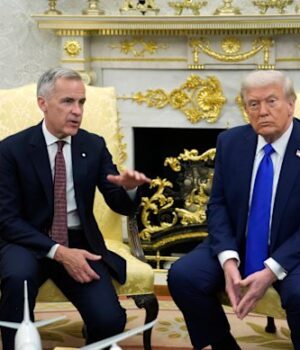
The president tried in recent days to use an untested legal power to force Canada to swallow trade concessions. Instead, Canadian Prime Minister Mark Carney quit the negotiations rather than accept a lengthening list of US demands.
As a result, 50 per cent US tariffs took effect on the weekend on an array of Canadian products, including hockey sticks and Crown Royal whisky.
As Carney prepared to walk away – a rare example of a foreign leader telling the president “enough” – Trump was retreating on another trade front. On Friday, after insisting for more than a year that tariffs do not affect consumer prices, he lifted tariffs on beef imports, saying the move would lead to lower grocery prices.
The two developments, coupled with legal challenges to Trump’s tariffs, leave the president’s signature economic policy in a state of flux.
“It’s a big setback for Trump’s trade policy. We’re at a juncture where other countries may be very closely watching how this plays out as they also are becoming increasingly frustrated with the demands the US is placing on them in these largely one-sided trade agreements,” said Wendy Cutler, a former US trade negotiator who is now senior vice president at the Asia Society Policy Institute.
Indeed, the United States has negotiated 10 “reciprocal trade agreements” over the past year with nations such as Malaysia, Cambodia and Argentina, along with other trade frameworks with the European Union, the United Kingdom and Japan.
Hearing of the concessions that the US offered Canada, including reductions in tariffs on industrial metals, some trading partners might demand revisions to their deals, Cutler said.
Administration officials have approached each bargaining round convinced of two things: decades of US trade policy hollowed out the nation’s manufacturing communities. And a muscular new approach, leveraging the appeal of the $US32 trillion ($44.7 trillion) US economy, can force other nations to give way and encourage the deindustrialisation of the US.
For the administration, trade negotiations are not a contest of equals. The talks start from the premise that US negotiating partners must make concessions, opening their markets and in some cases promising to invest in the United States, simply to win a reprieve from unilateral American trade barriers.
Both Jamieson Greer, Trump’s chief trade negotiator, and Treasury Secretary Scott Bessent have publicly complained that Canada and China are the only nations that retaliated for the tariffs that the president imposed last year.
The administration sees its actions as restoring fairness to an imbalanced global trade system, making such retaliation unjustified. But China’s tough stance last year, which included a temporary interruption of essential rare earth minerals, paid off. Trump lowered his triple-digit tax on imports from China and reached a trade truce in an October meeting with Chinese leader Xi Jinping, who is due in Washington on September 24 for more talks.
The Canada negotiations were aimed at averting the new 50 per cent tariffs, which Trump had threatened in July unless Carney dropped retaliatory measures imposed in response to earlier US tariffs.
On Tuesday, Trump delayed his initial deadline, posting on Truth Social that the two sides had reached “a DEAL” and needed three days to finalise the documents.
The subsequent breakdown spotlighted tensions in the president’s strategy, including questions over the durability of any deal reached with the US administration.
After all, the US and Canada, along with Mexico, already have a trade deal: the United States-Mexico-Canada Agreement (USMCA) of 2020, which Trump hailed at the time as “the largest, fairest, most balanced, and modern trade agreement ever achieved”.
But this year, the president threatened to quit the deal and demanded sweeping changes to it, aimed at promoting more US manufacturing. He also imposed tariffs on Canadian goods starting last year, a breach of the accord.
On Saturday, speaking in Ottawa, Carney alluded to the difficulty of negotiating with a mercurial president.
“We’ve recognised from the start that America has changed,” Carney said. “We recognise that sometimes, its signature is written in pencil.”
Negotiating with the US is also complicated by divisions within the administration. All top officials share Trump’s goal of spurring domestic manufacturing. But as Greer haggled with the Canadians this past week, a split emerged over the US trade representative’s willingness to reduce an existing 50 per cent tariff on aluminum derivatives to 25 per cent in return for Canadian concessions.
At a White House meeting, White House trade adviser Peter Navarro and Commerce Secretary Howard Lutnick, whose department administers the national security tariffs, clashed with Greer, representing industry views that the higher aluminum tariffs were needed to encourage domestic manufacturing.
“Navarro and Lutnick were both yelling at Greer saying, ‘What are you doing? This is stupid. You know, we’re not giving these things away’,” said one industry representative, who spoke on the condition of anonymity to describe the confidential talks.
Late in the talks, the US sought to exclude from tariff reductions heavy trucks produced in Ontario, such as the Ford F-350 and F-450, and the GM Silverado. Over time, that would have made it “more uneconomic” for the automakers to keep making the vehicles in Canada, Carney said. The administration also sought to restrict Canada’s right to sign trade deals with other countries, a key part of Carney’s strategy to reduce dependence on its increasingly unreliable southern neighbour.
Trump’s undiplomatic style – including saying that Canada should surrender its sovereignty to become the 51st US state – made it harder politically for the Canadian leader to accept a deal. Public opinion in Canada has turned fiercely anti-American.
“A 160-year trading relationship has found its red line,” said Flavio Volpe, president of the Automotive Parts Manufacturers’ Association in Toronto. “Demanding that your closest trading partner mirror your trade policy with third countries is akin to asking them to surrender agency over foreign policy. This episode shows that doesn’t work, no matter the disproportionate market leverage of the USA.”
Trump also has a general disregard for the $US3.4 trillion ($4.7 trillion) worth of merchandise that the US imports annually. Speaking in June about his North American neighbours, the president told reporters in the Oval Office: “We don’t need anything that Canada has, we don’t need anything that Mexico has, but they need everything that we have … We don’t need their cars, we don’t need their lumber, we don’t need their energy, we don’t need anything that they have.”
In fact, US farmers rely on Canadian sources for nearly 80 per cent of the potash fertiliser they use each year, according to the US Geological Survey. Northern border states, including New York, Michigan, Vermont, Minnesota and Maine, run on electricity produced by Canadian hydropower. And Midwestern refineries are optimised to process heavy sour crude oil from Canada, helping keep gas prices lower than they otherwise would be, according to the Federal Reserve Bank of Kansas City.
‘We’ve recognised from the start that America has changed. We recognise that sometimes, its signature is written in pencil.’
Canadian Prime Minister Mark Carney
Total US-Canada trade each year exceeds $US700 billion.
The talks’ failure leaves businesses on both sides of the border burdened by a sudden jump in costs. Small businesses in the US will face an especially sharp cash crunch, as they must pay tariffs before their customers pay them 30 or 60 days later, said Jason Miller, a professor of supply chain management at Michigan State University.
“I expect a significant drop in a lot of these different import categories because importers simply can’t afford to bring them in. That may mean certain products not on the store shelves,” Miller said.
In other cases, companies will struggle to find a domestic alternative to Canadian goods, especially for intermediate products such as packaging materials. So they will continue importing and pass along some of the 50 per cent cost shock to their customers.
On Saturday, Carney said Canada would retaliate on September 8 for the new tariffs with its own trade measures. By delaying his response, he is leaving time for cooler heads to prevail, analysts said.
“Then the parties come back to the table. North America is too integrated for it to unravel on the basis of a deal that was put together over 14 days,” said Dan Ujczo, a trade lawyer in Columbus, Ohio.
If a deal had been reached this weekend, it would have paved the way for the official start of negotiations between the two nations over the proposed USMCA changes.
Instead, the administration now must manage a cycle of retaliation and counter-retaliation while perhaps facing a new courtroom fight over the legality of Trump’s 50 per cent tariffs, which were imposed under a never-before-used 1930 trade law.
Meanwhile, Trump’s 50 per cent tariffs on goods ranging from hockey sticks to alcohol are expected to raise prices for American consumers less than three months before the November 3 midterm elections, which have the potential to give Democrats control of Congress.
Those elections, polls show, are expected to turn on voters’ frustration with the rising cost of living.