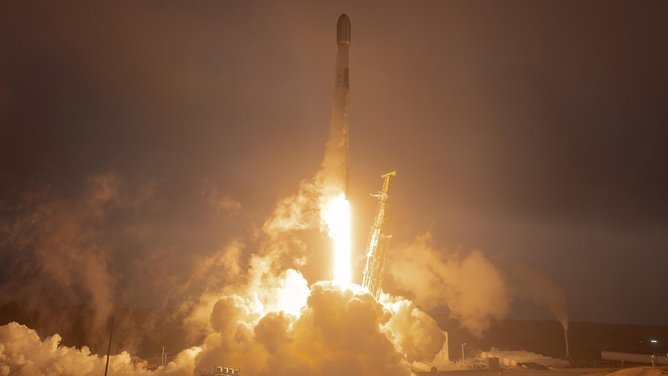
Source : Perth Now news
A hefty chunk of rocket crashing into the moon at seven times the speed of sound has driven home the threat posed to Earth by tens of thousands of large pieces of space junk littering the solar system, with a leading expert warning Australia faces a higher risk than most countries.
Astronomers could be waiting weeks for ultra-clear imagery of Wednesday’s crater-creating collision.
None of the spacecraft orbiting the moon were positioned to capture the moment the spent upper stage of a SpaceX Falcon 9, launched in January 2025, smashed into the lunar surface.
Space agencies across the world estimated the four tonne stage was travelling 2.43 km/s at the point of impact and would leave a crater 18 metres wide and four metres deep.
Astrophysicist and cosmologist Brad Tucker told NewsWire that with “a tonne of debris hitting the Earth now every single day”, there was a “growing problem” with space junk and no clear solution other than scaling back.
“The reality is it’s a volume game problem, and if you increase the volume, you get more problems,” he said.
An associate professor at the Australian National University, Dr Tucker said “there will be a scientific benefit” to the crash because it would give scientists a rare look into the moon’s make up.
Specifically, the disruption would let observers study the dust and see what lies below the surface.
All of that data could feed back into future landing plans.
First-look imagery released by NASA and the Korea Aerospace Research Institute showed the moon after the crash.

Numerous rocket remnants have been deliberately crashed into the moon to achieve a similar result.
But they were intentional, whereas Dr Tucker said Wednesday’s incident was “trying to turn Elon Musk lemons into lemonade”.
“Yes, we can do something positive with this, but it is a negative card that has been dealt and symptomatic of problems in space,” he said.
“SpaceX has done a huge amount of work making things reusable and as responsible as they possibly can … and yet still, with all of the efforts they have made, we have tonnes of SpaceX debris that lands on the Earth.
“There have been multiple of these events in Australia alone of SpaceX debris landing.”
He said Australia is in a latitudinal band at higher risk of being a landing zone for debris.
Parts of Africa and South America are also at higher risk.
He added that “risk is still low” but that it is “only going to keep increasing”.

Keeping watch for dangerous objects hurtling through space is a joint effort undertaken by militaries, civilian space programs and private companies.
The US has by far the best visibility, with its Space Surveillance Network tracking some 25,000 objects bigger than 10cm orbiting Earth.
Objects in low orbit, or within 2000km of Earth’s surface, travel at up to 8km/s – more than 23 times the speed of sound.
But according to NASA, the average speed of orbital debris when hitting another space object is about 10km/s and can be as high as 15km/s.
At that speed, any collision “will involve considerable energy” no matter how big the objects.