SOURCE :- SIASAT NEWS
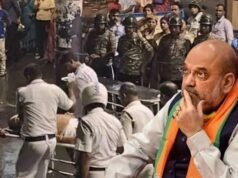
Mumbai: Sahil Wakode’s parents say caste abuse drove their son to his death. The faculty body says the professor they accuse only followed exam rules. A month on, the campus is divided.
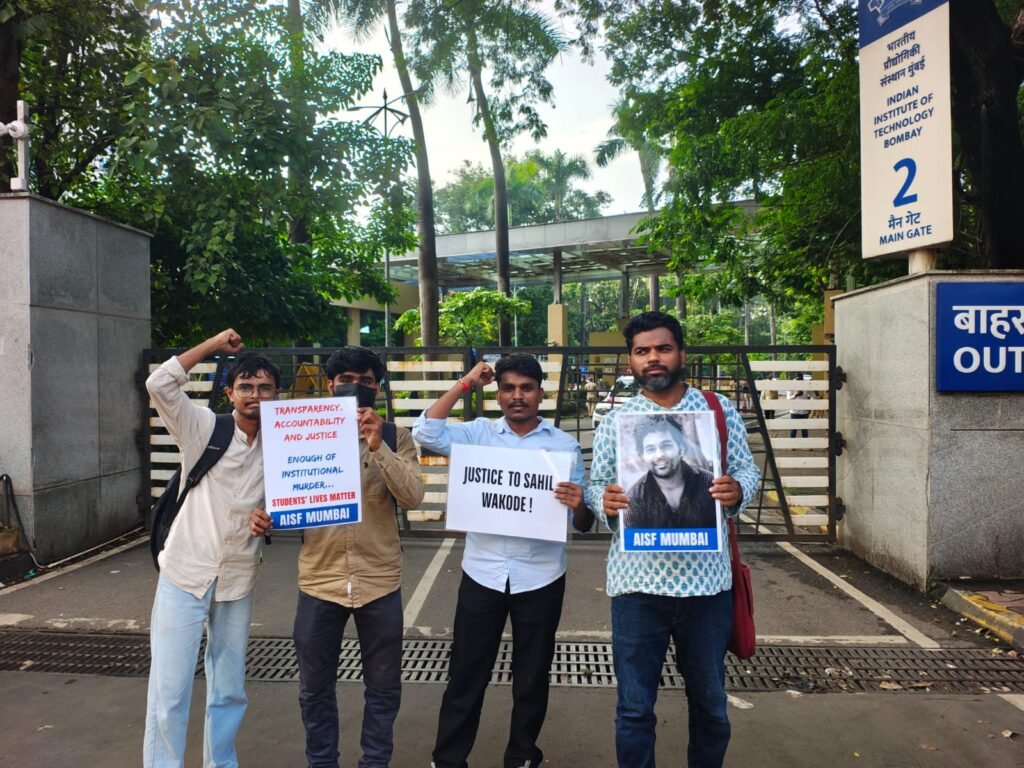
On the afternoon Indian Institute of Technology (IIT) Bombay’s director wrote to students to say a senior professor had been relieved of his post as dean, a small group of research scholars sat on the footpath outside the institute’s main gate in Powai. They held up photographs of Sahil Wakode, Darshan Solanki, Aniket Ambore, Payal Tadvi and Rohith Vemula.
Each was a Dalit or Adivasi student who died by suicide on an Indian campus.


They had expected more from the day. At 8 pm the previous night, the Student Council, which one of the scholars called a nominated body and “basically an extension of the administration,” had agreed to press for the suspension of Professor Suryanarayana Doolla and set a deadline of noon. The director’s email said only that Doolla was being removed as dean and would remain on the faculty.
“We were only going to observe two minutes of silence,” the scholar said. “As soon as it ended, the Deputy Commissioner of Police (DCP) and the police came and told us to leave immediately,” one of the research scholars, who did not want to be named, said. The group said they were not blocking the road. He said the police dragged them into custody anyway. “My own shirt was completely torn.”
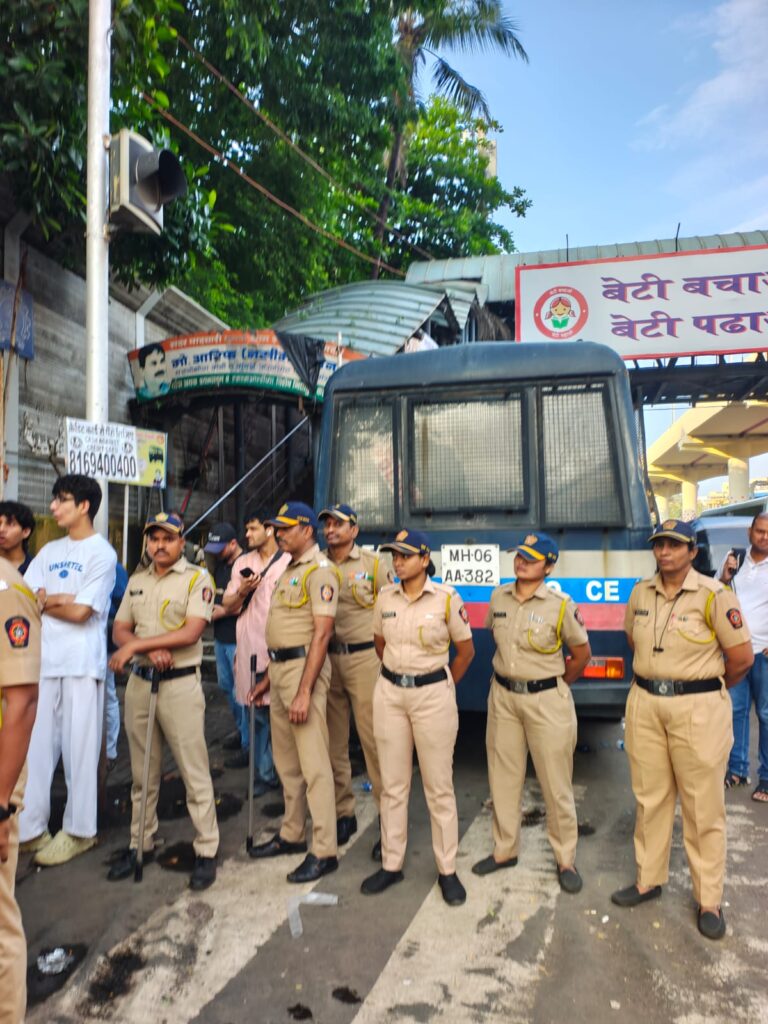
Nearly every student who spoke for this story did not want to be named, fearing show-cause notices, eviction from the hostel, withheld grades or suspension.

The newest photograph in their hands was a month old. Wakode, 22, a second-year BTech student in the Department of Energy Science and Engineering and a native of Yavatmal district, was found hanging in his hostel room on the evening of September 18. That morning, he had allegedly been caught using a phone during a mid-semester exam.
His parents have accused Doolla, who invigilated that exam, of subjecting their son to casteist abuse. Doolla has denied it. The faculty body has marched in his support, students have been on hunger strike and the Mumbai Crime Branch is still investigating.
What happened after the exam
According to the IIT Bombay Faculty Forum, Doolla was invigilating the 11 am to 1 pm paper when he saw Wakode with a smartphone and reported it to the authorities as Senate-approved procedure requires. The institute’s first statement added that Wakode had uploaded the question paper to ChatGPT, that the course instructor and head of department had counselled him and that no disciplinary action had been started.
Media reports have since described closed circuit television (CCTV) camera footage showing Wakode checking his pocket, being asked to leave and being taken aside by Doolla. In October, police said Wakode had given the institute a written apology, admitting he had not prepared well and asking for a second chance.
None of this shows what was said to him in the hours that followed. Students allege that before any disciplinary committee was formed, the head of department and Doolla pressured him in a closed room into writing that statement. Some say Doolla threatened him with a year’s suspension. Doolla has denied harassing him.
Students and Suryakant Waghmore, a sociologist at the institute, point to rule 4.2 of the Senate-approved disciplinary rules. It requires that a student accused of unfair means be given a formal complaint and the evidence, at least two working days to reply in writing and a hearing before a disciplinary committee. If the department held a written statement, Waghmore asked, “why was the rule not followed?”
Days after its first statement, IIT Bombay apologised for describing the circumstances of the death before the investigation had established the facts. “Until the student’s identity came out, the institution started spreading the narrative of cheating,” the scholar said. To students, it fed an old argument about reserved-category students and “merit.”
The family’s complaint
Ravindra Wakode, Sahil’s father, told police that at their last meeting, his son said Doolla had been abusing him on caste grounds for about three months at the behest of the director, Shireesh Kedare, and that he feared being framed in a false case. The family alleges Doolla told Sahil he was from a higher caste and Sahil from a lower one. They refused to take the body until a first information report (FIR) was registered.
The Powai Police booked Doolla for abetment to suicide and under the Scheduled Castes and Scheduled Tribes (Prevention of Atrocities) Act. The Crime Branch, which has taken over, has recorded statements from about 50 people, including Kedare and Doolla. Wakode’s phone has gone for forensic examination.
IIT Bombay says he never complained of caste discrimination to its SC/ST cell or the administration.
The parents’ efforts to protest have repeatedly run into the police. Their lawyer, Nikhil Kamble, said the couple were detained at Bhandup on their way to the campus gate and sent to Azad Maidan, where they began a hunger strike. Police later refused them permission to continue there on weekends, and the father has since asked the police commissioner for protection.
Students say what happened to the parents fits a pattern. One student said that during earlier campus protests, Powai Police officers warned students they had orders to report any IIT student who took part to the administration. “Police officers themselves came and told us, ‘We have received such instructions from above,’” he said. He added that the administration has called in the police to break up even small gatherings on campus, such as reading circles.
It happened again with Sahil’s parents, he said. When they held a press conference outside the main gate, police repeatedly tried to move them away. When they tried to go in to meet students who had by then been on strike for 12 days, the administration shut the gate.
‘Is the deanship a birthright?’
Doolla had been dean of administrative affairs. Kedare’s email, sent on September 21, said further action would follow the investigation. Doolla was later reported to have been sent on leave.
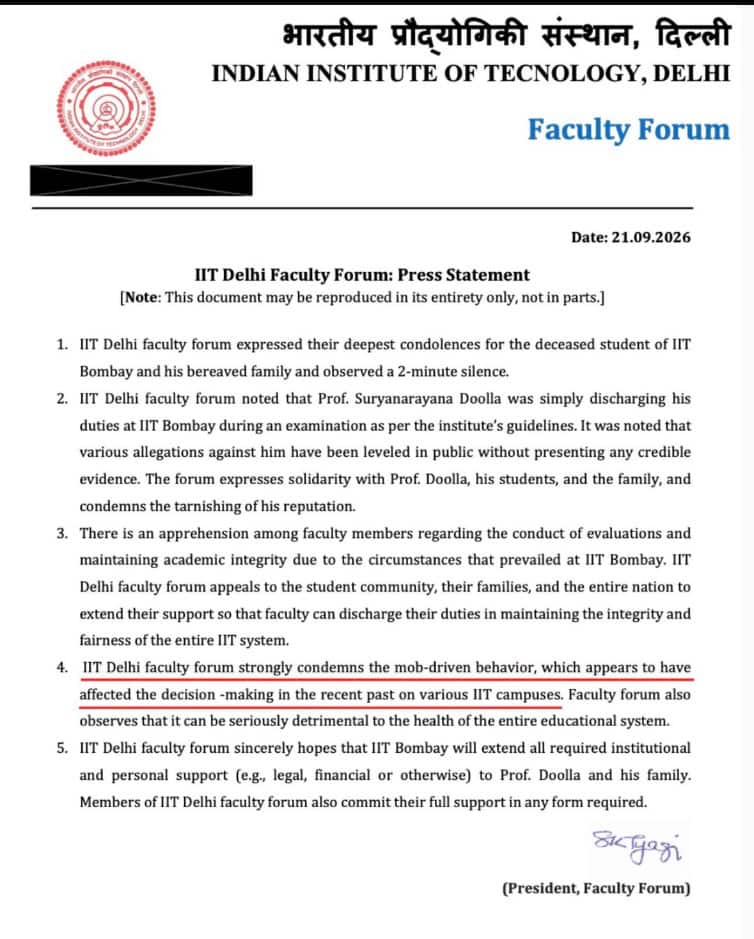
The Faculty Forum, which has more than 750 members and calls itself a formal body of the institute, said it stood strongly with him. Its president, Rajkumar S Pant, said Doolla had followed procedure and was being vilified by false and misleading media reports. Faculty marched across the campus in his support, and faculty bodies at IIT Delhi and IIT Madras backed him.
Pant later said the death may have become a trigger for wider frustrations on campus and that the forum was supporting a colleague who had done his duty, not commenting on the police case.
“They are not ready to accept that the problem is not one individual, but the policies of the institution,” the scholar said. He also alleged that last year Doolla had a Dalit student suspended for a year and put out of the hostel for giving a single sound bite to the media.
Siasat.com could not independently verify this claim.
Not every teacher joined the march. Waghmore, who has long studied caste and exclusion, wrote on X that the forum was not a legal body and was putting pressure on the inquiry. “Not all faculty identify with this group… Not me!!” he wrote.
In another post he asked, “Is the Deanship a birthright? What kind of dean speaks to students with such insensitivity?” He has clashed with the administration before. In June 2025, he was reportedly issued a show-cause notice over an op-ed he wrote for The Times of India.
Same rules, different stakes
Ask students why one incident in an exam hall ended the way it did and most move quickly from the individual to the system.
A student from a well-off family who is fined Rs 50,000, or put out of the hostel for a semester, can rent a flat in Mumbai and pay for coaching or a therapist, the scholars argue. A first-generation student from a village cannot. For him, losing a hostel room can mean losing the degree.
“When society itself is based on inequality,” the scholar said, “you impose the same rules on students from weaker backgrounds in the name of equality and slowly kill them.”
Protesters at the gate told reporters of fines of up to Rs 1.5 lakh for staging a play.
Staff are not free to discuss any of this. Officials approached for this story declined to speak, citing rules that bar faculty and administrators from talking to the media without permission from the competent authority, on pain of a committee inquiry.
Students say the SC/ST cell and the Student Wellness Centre answer to the administration and cannot act against faculty, which makes them unlikely places to report a professor. Wakode’s death is the third reported suicide on the campus in seven months. Since then, the institute has begun replacing ceiling fans in hostel rooms with wall-mounted ones.
What students want
The IIT Bombay board has set up a 10-member committee to look into the death. Students want it reconstituted without any current employee or student, saying some members had publicly backed Doolla. On October 2, a group began a hunger strike and handed over an 18-point charter seeking an independent investigation, a new committee, Doolla’s suspension and Kedare’s resignation. The institute has denied that the director plans to resign.
Politicians have weighed in too. Congress MP Varsha Gaikwad was detained at the gate and Union minister Ramdas Athawale visited and called for a thorough inquiry.
Ravindra Wakode has said he will not stop. “I will continue my fight for justice,” he told a regional news channel.
SOURCE : SIASAT