
Source :- THE AGE NEWS
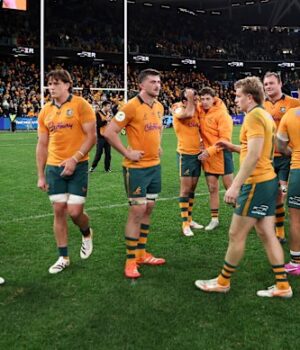
Brave? yes. Wasteful? Definitely. The Wallabies blew the chance to get their Nations Championship off to a winning start, turning a 24-12 lead after 28 minutes into an agonising 33-31 loss in Sydney on Saturday night.
That might sound harsh after the Wallabies matched or beat the Irish in a number of areas, but they need to be hard on themselves because Ireland were sluggish for the first half.
A couple of Wallabies’ mistakes around the 60-minute mark summed up a lack of composure and accuracy. First, Max Jorgensen fired a wild pass into touch after the Wallabies had created space.
Then, Joseph-Aukuso Suaalii threw a loose offload to no one after initially doing well to straighten the line. That’s not good enough, and the mistakes squandered the precious territory and possession that had been won by a strong Wallabies scrum that had been lifted by a noticeably fitter Taniela Tupou.
The goalkicking woes of Carter Gordon and Ben Donaldson were also costly, but the unforced errors in possession need urgent attention as next Saturday’s opponents French will arrive ready to play.
They were very close to beating the All Blacks in Christchurch on Saturday and will add further firepower to the team that will face the Wallabies in Brisbane on Saturday. Their attacking play was superb.
Losing Lonergan was a huge blow
When Ryan Lonergan left the field after 33 minutes after a head knock, the Wallabies led 24-12. Without him, they lost the next 47 minutes by 21-7.
The in-form Brumbies No.9 is a great controller of games, and the Wallabies were guilty of becoming a bit lateral in the second half.
Tate McDermott has his own special qualities, exemplified by his try, but Lonergan was enjoying an excellent Test before his injury and the Wallabies will be far worse off if he isn’t fit to play France.
Carter Gordon’s injury in the second half was also a worry, with the big Reds No 10 showing enough on attack (goalkicking aside) to justify his inclusion.
However, with Waratahs veteran Jake Gordon and the outstanding Western Force No.9 Henry Robertson already ruled out for the year with serious injuries, the Wallabies are already looking a bit light on the style of halfback that Joe Schmidt likes.
The Wallabies’ winner and losers
New second-row partners Jeremy Williams and Josh Canham were standouts for the Wallabies, while Rob Valetini rediscovered his best form as the game unfolded, putting multiple dents into the Irish defensive line.
Life in France is also clearly agreeing with Tupou, who looked lean and explosive when injected into the Test in the second half.
Len Ikitau also showed his class in the No.12 jersey, and the Wallabies’ attacking intent in the first half was a big step up from the end-of-season tour. The jury is out on the effectiveness of Max Jorgensen and Dylan Pietsch switching wings, while the collective discipline was an issue – especially with the current interpretations around the ruck (see item below).
But, the Wallabies’ most obvious weakness was the limited bench impact compared to the Irish. The visitors’ Tadhg Beirne and Nick Timoney brought an energy to the contest that the Wallabies couldn’t match, and Carlo Tizzano was therefore conspicuous by his absence.
Brilliant weekend shows we’ve got our game back
The try-laden first weekend of the Nations Championship confirmed that attacking rugby is back, and the Wallabies certainly bought into the new trend with some genuine ambition in the first half. So, what has happened to prompt this shift without any rule changes?
It’s all in the interpretation, and it is very difficult to miss the influence of World Rugby chair Brett Robinson and his new Chief of Rugby, Mark Robinson. Most notably, the referee teams have clearly been empowered to make quick and decisive decisions instead of checking every try for five minutes with a series of inconclusive replay angles.
That is why everyone should be prepared to live with the decision to award Jamison Gibson-Park’s try against the Wallabies just before half-time.
Was there a forward pass? It was hard to say conclusively, and if we want a quick game that’s the sort of call officials must be backed to make.
Second, there is clearly a lot less leeway for blokes lying on the ground and clogging up the contact area. As a result, legal jackals are harder to make, and we are seeing more quick ball and attacking rugby.
It’s made life harder for players such as Fraser McReight, but the game is now allowing elite players to show their full range of skills.
Rennie’s Wallabies regret
The new All Blacks coach has kept his counsel since Rugby Australia sacked him in 2022, choosing not to address his dismissal or criticise his former employer. But in an interview on Sky Sport in NZ before his first Test in charge against France, he lifted the lid a little.
Rennie said he had no regrets from his time in charge of the Wallabies, but conceded he might have been better at “managing up”. Several former Wallabies and Waratahs coaches over the past decade or so will be nodding their heads at that assessment.
Rennie’s implication that politics is a part of the head coach’s role is on the money, even if most of them don’t realise it until too late. The relationship between the head coach and the chief executive or chair is one of the most important in the game.
It appears strong between Joe Schmidt and Phil Waugh/Dan Herbert, and it needs to be the same with Les Kiss if the Wallabies are to have a good World Cup in 2027.
 Paul Cully is a rugby columnist for The Sydney Morning Herald.Connect via X or email.