Source : the age
I became fascinated by Jeju Island long before I ever set foot on its windswept shores. I’d been researching freediving to try this mildly terrifying activity – basically, diving underwater without any equipment, just holding your breath on a single inhale while trying not to panic – and South Korea’s largest island kept surfacing. More specifically, its haenyeo, the formidable female divers who’ve been harvesting marine life from Jeju’s waters, without the help of oxygen tanks, for centuries. In 2024, they were the subject of a documentary called The Last of the Sea Women, and they even enjoy a UNESCO intangible cultural heritage listing. Many of them, still diving in their 70s and 80s, have attained celebrity status.
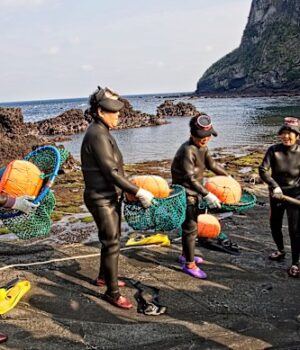
So, within hours of landing on Jeju, my guide and I head straight to watch some haenyeo on their morning dive beneath Seongsan Ilchulbong, an ancient volcanic peak. Around an iridescent, jade-green cove hemmed by sheer, basalt cliffs, more than 100 tourists jostle for photos as the elderly women wriggle into their wetsuits and a traditional haenyeo song blasts from speakers. “It’s about the hardships they’ve endured,” my guide whispers as we listen.
Then the women slip into the water. One by one, they vanish below its surface to dive anywhere between 10 and 20 metres on a single breath, before resurfacing, up to two-and-a-half minutes later, holding aloft their haul of sea urchins, octopus and abalone. This may be a daily tourist spectacle, but watching the women harvest the seafloor in this way, as generations of Jeju women have done before them, makes the hairs on my arms stand up.
Sitting some 80 kilometres off the southern tip of the Korean Peninsula, self-governing Jeju is South Korea’s great island escape, beloved for its beaches, hiking trails and distinctive food and culture. Traditionally, it’s said to have three things in abundance: wind, women and stone. And indeed, almost everything here seems shaped by volcanic rock, from traditional stone houses and walls to the hulking, carved figures that guard their entrances. Hallasan, South Korea’s highest mountain, rises from its centre, while ancient eruptions have left lava tubes, craters and basalt-strewn shores.
At a restaurant overlooking the cove, we sample the haenyeo’s catch, a plate of raw sea creatures washed down with glasses of Jeju’s famously sweet tangerine juice, before a post-prandial hike up the peak. Seongsan Ilchulbong is typically a sunrise spot, but that means a 4am start and the risk of sea fog swallowing the view. By early afternoon, the climb is tough in the heat but, from the lush crater rim, Jeju unfurls clearly below, the intensely blue Korea Strait meeting its patchwork of fields. Scattered among those fields are villages that preserve a much older Jeju.
Seongeup, on the island’s south-eastern side, is a living heritage village of thatched stone houses, shrines and low basalt walls dating back more than six centuries. We pass between two dol hareubang statues, hand-carved volcanic-stone “grandfathers” traditionally regarded as guardians, and wind our way down an olle, one of the narrow lanes connecting to the main road. “There’s a saying on Jeju,” says my guide: “‘Every road begins with an olle and leads to the world’.” The name now belongs to Jeju’s 437-kilometre Olle Trail, whose 27 routes lace the island’s coast and countryside.
Inside a small Seongeup shop, I run my hands over stiff, rust-coloured galot, workwear Jeju islanders have dyed with persimmon juice for centuries, the tannins helping protect the cloth from sweat and dirt. Nearby, signs advertise natural-dyeing and ceramics workshops, and I begin mentally designing a return trip, when I’ll stay in a traditional house, walk the Olle Trail, throw a few pots and dye my own cloth.
For now, though, I’m due in the small village of Sehwa. There I meet 34-year-old Ta-eum Kim, part of a new generation of young women choosing the haenyeo life. She shows me around the Haenyeo Museum, once a gathering place for haenyeo protesting exploitative seafood prices under Japanese colonial rule in the 1930s, before we walk to the bay where she dives. “We don’t catch everything we see,” says Kim. Unlike industrial fishing that can scrape the ocean floor, haenyeo gather their catch by hand, leaving undersized shellfish to grow. “We take only what we need to earn a living so that the marine life in this ecosystem can continue to live as well.”
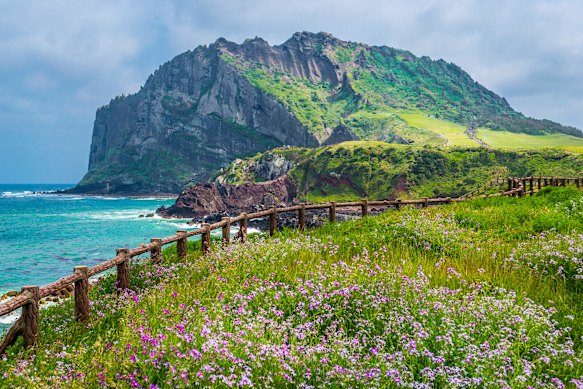
Kim’s words are still with me on my final morning on Jeju. So, too, is the sense that, for all South Korea’s associations with the hyper-modern, this island has something important to say about how we might live now: take only what you need. Work with, rather than against, nature.
With my back to the wind, I walk the coast from Hamdeok, the popular beach town in the island’s north-east. I pass a dol hareubang standing sentinel beside the path and walk on, the sea stretching blue and empty beside me.
The writer travelled to South Korea courtesy of National Geographic Journeys with G Adventures.
Read more from Good Weekend:
Get the best of Good Weekend delivered to your inbox every Saturday morning. Sign up for our newsletter.