

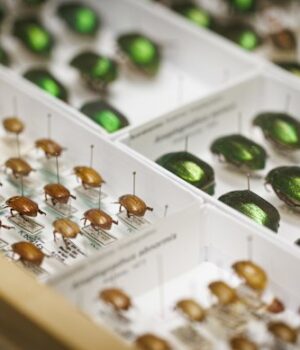
source : the age
You may have noticed by now that Christmas beetles are disappearing. The thing is, despite a decade of headlines asking where all the iridescent insects have gone, we still don’t know if they’re actually declining. You know?
That’s because it takes years of grit, data and determination to convert anecdotal evidence into the hard, published, sciencey kind. Especially when it comes to insect research.
Associate Professor Tanya Latty has taken on the task of gathering this critical data.
Now, after years of running a citizen science project aimed at collecting beetle sightings, she’s at the precipice of being able to answer that yearly question: Where have all the Christmas beetles gone?
What’s really happening with these beautiful living baubles? After the great bogong moth bounceback of 2026, could we be in for a bumper year of beetles?
The key citizen science project
“We’ve been doing the Christmas Beetle Count on an entirely unfunded basis for the last six years, and it’s been driven by community members going out, seeing a Christmas beetle and submitting that to iNaturalist,” Latty, an entomologist from the University of Sydney, says. (iNaturalist is an online database for species sightings.)
“When we started, there were a few thousand sightings of Christmas beetles in Australia. As of today, we’re up to 26,497 observations of 40 species, including nine species that hadn’t been seen for decades before the count started.”
“The problem is that it tells us where people are seeing a beetle. It doesn’t tell us where people are not seeing a beetle.”
So while the Christmas beetle count has built unprecedented data on where and when different types of beetles emerge each year, it can’t tell us for sure whether populations are declining.
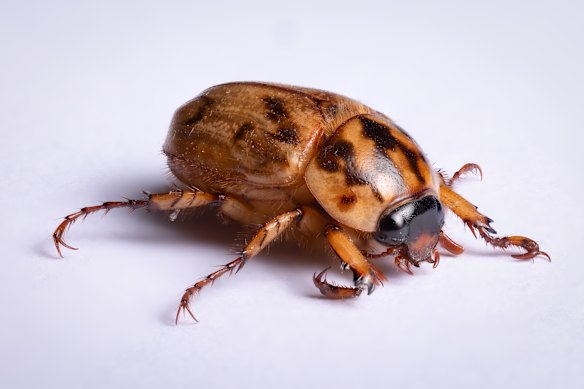
That’s why Latty is taking $30,000 awarded to the project by the Australian Geographic Society to fund a long-term national monitoring network of beetle catchers.
Latty and her colleagues are recruiting and training 50 members of the public to set up UV lights against white sheets in Sydney, Cairns, Canberra, Brisbane and Darwin.
Once a month, the volunteers will run the light traps and record which beetles show up. That data could change the game.
Having rigorous, long-term, location-based baseline population data may finally answer the question of what’s really going on with the Christmas beetles – and what we can do to bring them back.
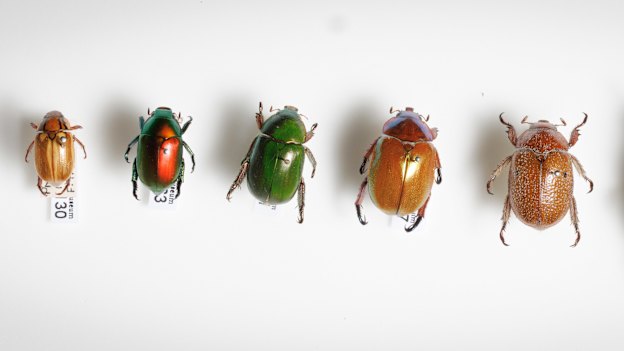
Australia’s most popular beetle at risk
Applying for research funding is tricky without proof the beetles are vanishing.
“The problem with Christmas beetles has always been that technically, they’re not threatened. There’s not really any data that their numbers have decreased, even though everybody feels like their numbers have decreased,” Latty says.
“It’s a bit of a chicken-and-the-egg problem. You kind of need the funding to be able to demonstrate that there’s a decline, but you can’t demonstrate the decline until you have funding.”
Christmas Beetle Count data has already helped identify at-risk species that are confined to small habitats.
One of those species is the gold Christmas beetle, which is so lustrous it looks as if an 18-carat scarab pendant popped off a pharaoh’s neck and sprang to life.
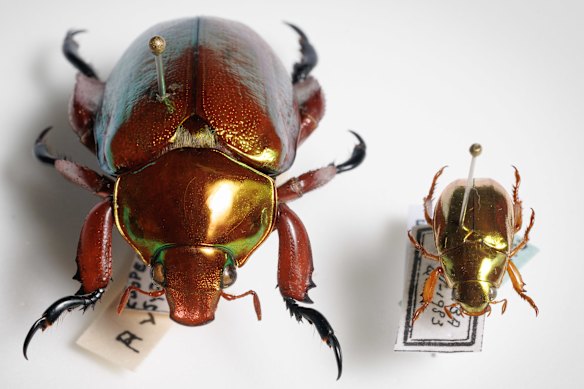
The public just crowned the gleaming insect as the ABC’s Insect of the Year. It lives in a very small, specific range in Far North Queensland.
“If there was a significant natural disaster, then that could conceivably wipe out all the habitat for that one species because it is found in such a small area,” Latty says.
A big beetle year?
After a boom comeback year for the endangered bogongs, could we see a big year for beetles amid their seeming long-term decline?
It’s hard to say, given there are so many unknowns about both insects, Latty says.
“But my gut feeling is it could be a good year. For a lot of insects, a warm, milder winter tends to mean they’re able to grow faster, get bigger and come out a little bit earlier, and we’ve seen that with the Christmas Beetle Count data.”
The first sightings came through in September, she says, “a good month earlier than they did last year”.
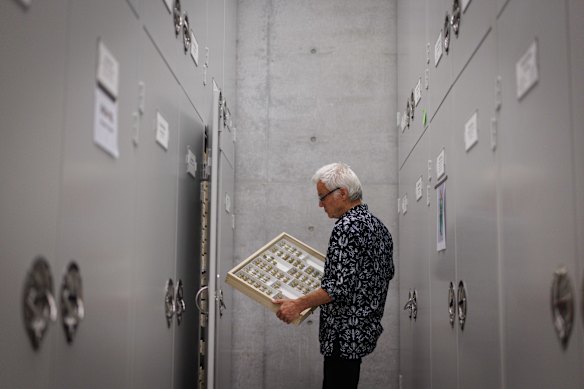
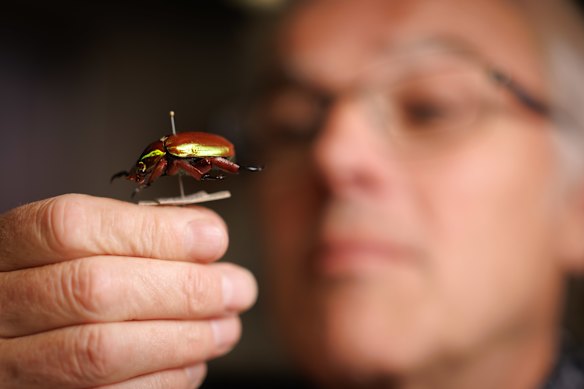
Dr Chris Reid, senior research scientist and beetle expert at the Australian Museum, has already spotted three species near his home in the Illawarra, including the brown campfire beetle and the hairy spotted beetle, which has traded flamboyant colour for a fine fur coat.
He says he used to easily catch 50 beetles in a night under the train station lights near his home. Now he’s lucky to bag five.
The story varies across species – some types of beetle are doing well in bushland – but many others are becoming rarer sights, he says, including the giant, shiny King beetles once common in cities such as Sydney, before clearing of bush and grassland on the urban fringe.
“Sydney has just sprawled. The western suburbs cover what was ideal Christmas beetle habitat – grassland with some scattered trees, or Cumberland Plain Woodland.”
Loss of eucalypt forest and larval feeding grounds around Melbourne has similarly driven suspected declines.
Trapped underground: Theories behind the decline
Reid also suspects drought may be a major driver of declining beetle numbers. The beetles develop underground as “curl grubs” for a year or two, feasting on humus and rotting wood before developing into pupae.
“When the pupa hatches into an adult, the adult has to dig its way out of the soil – that’s why they have these big front claws.”
But if the ground is hardened by drought, the newly hatched beetles are trapped and die before they can ever sparkle in the sunshine.
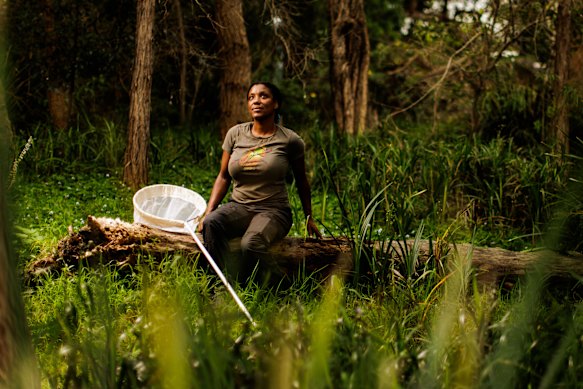
“I think the most important thing about the Christmas beetle survey is that it’s setting baseline data for now, and alongside museum records we’ll be able to see how climate affects things,” Reid says.
Researchers may also be able to compare the genetics of Reid’s museum specimens stretching back to the 1800s with modern beetles, to search for “genetic bottlenecks” in their DNA, a signature of population decline.
Latty is optimistic that data from the beetle count and the new monitoring network will finally start to identify specific problems – and solutions – for beetle conservation.
“They’re such a part of day-to-day life and our culture. It’s deeply sad that we’ve lost this amazing mass emergence of big, colourful, friendly beetles at the holiday time, and I’m glad that people are starting to see that and take the steps to bring them back.”
The Examine newsletter explains science with a rigorous focus on the evidence. Sign up to get it each week.


