Source : INDIA TODAY NEWS
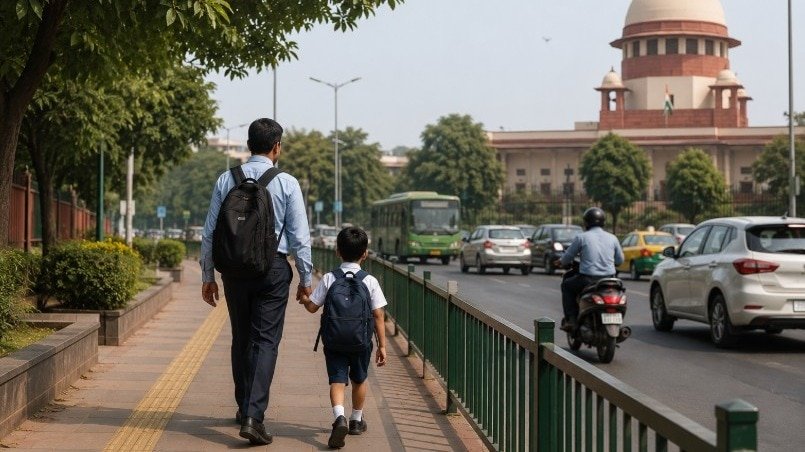
In an unusual warning to the government, the Supreme Court has threatened that its own judges will sit on a dharna outside the Delhi High Court if authorities fail to provide proper pedestrian crossing and footpath near the court premises by November 25, 2026.
A bench of Justices JB Pardiwala and KV Vinod Chandran expressed strong displeasure over the lack of basic pedestrian infrastructure, orally warning that the judges would take to the streets and continue their protest until the problem was resolved.
advertisement
Justice Pardiwala criticised what he described as the authorities’ dilatory approach, making it clear that forming committees would not be enough. The government must demonstrate concrete action on the ground, he said, warning that the court might otherwise summon the Delhi government’s chief secretary in person.
SUPREME COURT SAYS SAFE WALKING IS A FUNDAMENTAL RIGHT
The Supreme Court reiterated that pedestrians’ access to safe footpaths is a fundamental right of citizens. The right to walk safely is protected under Article 21, which guarantees the right to life, and Article 19(1)(d), which guarantees freedom of movement, the court has held in its earlier rulings.
The court has also issued directions to all states and Union Territories to ensure that roads have safe, clearly marked footpaths free from encroachments.
In its recent directions on pedestrian safety, the Supreme Court stressed that pedestrians must take priority over motorised traffic.
“Pedestrians’ rights are primary and will override the movement of motorised vehicles,” the court said.
FOOTPATHS MUST BE MANDATORY, NOT OPTIONAL
The court has directed governments and local authorities to ensure that footpaths are constructed and maintained alongside roads. Providing pedestrian infrastructure cannot be treated as an optional addition to road projects, it said.
It has also called for the removal of encroachments and obstructions from footpaths, including unauthorised stalls, electricity poles, garbage and illegal parking, so that pedestrians are not forced to walk on the main carriageway.
The Supreme Court has asked the Centre to establish or designate a central authority to monitor compliance with its directions. It has also called for a pilot project to develop footpaths in five cities in the initial phase.
SAFETY STANDARDS, AUDITS AND GRIEVANCE REDRESSAL
The court has directed authorities to follow the Indian Roads Congress’ guidelines, including IRC 103:2022, as minimum standards for footpath design and safety. These include anti-skid surfaces, ramps and wheelchair-accessible facilities.
It has also called for regular safety audits of footpaths and pedestrian crossings in major cities and along national highways under the National Highways Authority of India’s jurisdiction.
To improve accountability, the court has directed authorities to develop a public grievance redressal mechanism, including an online portal through which people can report encroachments and poorly maintained footpaths.
The court has further directed states and Union Territories to frame stricter rules under the Motor Vehicles Act to regulate pedestrian movement and non-motorised transport, including bicycles.
The broader message from the Supreme Court is that urban development cannot be measured solely by wider roads and smoother movement for vehicles. Cities must also ensure that people can walk safely and with dignity.
– Ends
SOURCE :- TIMES OF INDIA