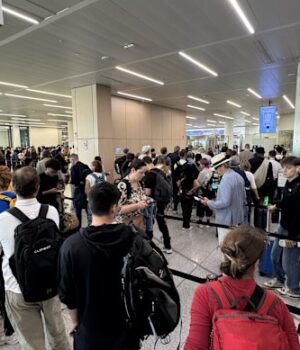
Source : the age
You’re due to fly out of Sydney airport for your dream holiday, so you show up in good time for the flight. If you have family seeing you off, they pay a small fortune to park for an hour or so. When you go to check in, you’re in a long, long queue.
Then, you find your flight is delayed, which means hanging around the terminal for way longer than you planned. Want a coffee? Don’t expect much change from $10s. Want a proper drink? Don’t expect much change, if any, from $20.
Having been fleeced by the airport’s “hospitality” venues, you board your plane, expecting a basic level of security. Safety, even. But instead, it almost collides with another on the tarmac.
This is literally the one job of air traffic controllers, you think, as you settle in for a long tarmac-bound wait in the economy-class strait-jacket the airlines call a “seat”. It’s their one job. Why can’t they do it?
Welcome to the world of 21st-century travel, as brought to you by Sydney Airport. We are supposed to be a world-class city, so where is our world-class airport?
We have already given up on being smooth or reasonably priced, but is it too much to expect that passengers don’t risk death-by-collision on the runway too?
On Sunday, a Jetstar pilot was forced to slam on the brakes to avoid hitting a Qatar Airways jet taxi-ing at a perpendicular angle to it. A crew member was injured, and there was damage to the connection between the Qatar jet’s nose gear and aircraft tug, according to the Air Traffic Safety Board.
Jetstar confirmed that the pilot of the Airbus A320 aircraft was given permission to depart Sydney bound for the Gold Coast on Sunday morning.
The Australian Financial Review reported that the Qatar flight had landed from Dohar, its passengers had disembarked and the Boeing 777 plane was being tugged to a parking bay.
As of Monday an air traffic controller and a ground crew worker had been stood down following the incident. This harrowing mishap, which could have been much worse, was mere weeks after a similar incident at Sydney airport, where planes had been given contradictory instructions by air traffic controllers. And it was only a day after air traffic controller shortages played havoc with Sydney airport, causing hundreds of flight delays and cancellations.
Earlier in July, so many air traffic control workers called in sick that the air traffic control tower at Sydney airport couldn’t be staffed properly.
“These are systemic problems with staffing towers, and we can’t keep blaming COVID,” said Airlines for Australia and New Zealand chief executive Stephen Beckett.
“If three people call in sick, the national network should not grind to a halt. These are well-paid jobs in capital cities. What is going on?”
Airservices Australia, the government-owned organisation responsible for managing air traffic control operations, is currently trying to push through fee increases that would double what airlines pay for its services. Meanwhile, airlines are asking the government to include Airservices in its consumer rights scheme because, they say, its staffing issues are causing delays and cancellations.
The Australian Transport Safety Bureau is now investigating, and on Monday, AirServices Australia chief executive Rob Sharp was summoned before Transport Minister Catherine King to explain the latest debacle.
As ATSB chief commissioner stated, rather obviously: “Those two aircraft should not have come as close as they did”.
So why did they?
As the Herald reported on Monday, Airservices Australia has had capacity problems since the mass retirement of many controllers in 2021, when COVID shut down the aviation sector.
It also takes as long as 18 months to train a new air traffic controller. As Herald journalist Chris Zappone writes, “additionally, questions have lingered about the work culture of the ASA.”
As Zappone reported, the chief executive of the Australian Travel Industry Association, Dean Long, said that Airservices Australia-related delays had jumped following the pandemic.
“Airservices, for whatever reason, does seem to be really struggling to get their performance where it needs to be,” Long said.
The fingers all seemed pointed in one direction, but really, this is a multi-system failure requiring strong leadership to fix.
Airports are highly complex organisations that require a huge staff, technical precision and diligent oversight to function well.
In a country as rich and technologically sophisticated as Australia, fortune shouldn’t come into it.
Most beleaguered travellers – forced to pay extortionate prices for both their flights, and for whatever drink they buy to help endure the experience – don’t know anything about air traffic control.
They shouldn’t have to.
Their job is to show up on time for their flights.
It is the job of Sydney Airport management, the unions, the regulators and government, to make sure the show runs smoothly.
Sydneysiders deserve it – even if we are too beaten down by consistently poor airport service to actually demand it.
Start the day with a summary of the day’s most important and interesting stories, analysis and insights. Sign up for our Morning Edition newsletter.
 The Herald’s View – Since the Herald was first published in 1831, the editorial team has believed it important to express a considered view on the issues of the day for readers, always putting the public interest first.