Source : ABC NEWS
The horse is already moving when Sezim Jumabekova draws her bow.
She has three targets to hit before the track runs out.
She grips the horse with her thighs, twists at the waist, and shoots.
Ms Jumabekova, 29, from Kyrgyzstan, has been riding competitively for only three years.
“I’ve fallen off many times and torn my clothes learning new tricks,” she said.

Sezim Jumabekova tries out new tricks ahead of the opening ceremony. (Supplied: Sezim Jumabekova)
Despite being a relative newcomer to the sport, she is competing in horseback archery in the World Nomad Games from August 31 to September 6 in Kyrgyzstan.
Kyrgyzstan launched the World Nomad Games in 2014 as a stage for the traditional sports and cultures of Central Asia’s nomadic peoples.
What began with 20 countries and 10 traditional sports has grown, in just over a decade, into an international competition of about 100 countries competing across 43 events.
Repackaging heritage as sport
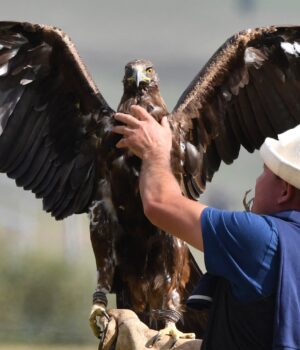
An eagle hunter, also known as berkutchi, competes. (AFP: Vyacheslav Oseledko)
Some of the sports are obscure outside the region, like eagle and falcon hunting and Kok-boru, where a horseback team wrestles for a sheep.
“It’s like AFL and the NRL here in Australia, but on horseback,” said Ahmed Kharat, captain of the Australian team competing in archery events in this year’s games.
Many of the sports have cultural significance and local audiences.
Eagle hunting on command traces back to the Mongol conquests of the 12th and 13th centuries.
Falconry is a traditional sport with hunting assisted by Taigan hounds. (Reuters: Pavel Mikheyev)
Other events trace a long lineage.
An 11-kilometre horse race is among some of the equestrian events that have a rich history in neighbouring Mongolia and Kazakhstan.
Another is Er enish, a traditional Kyrgyz horseback wrestling sport.
The team from Kazakhstan unseated opponents to win gold in both the 60-kilogram and 70-kilogram categories this year.
Two teams compete in Kok-Boru, throwing a stuffed sheepskin into a goal for points. (AFP: Vyacheslav Oseledko)
There are several other competitions competed on foot.
One times how quickly teams put up a yurt, a traditional portable nomadic dwelling used by nomadic families moving between pastures.
In another event called Ordo, teams use sheep knucklebones to flick opposing pieces from a marked ring.
Eagle hunting dates back to the Mongol Empire days. (AFP: Vyacheslav Oseledko)
From Soviet torpedo factories to Insta-stan famous
The World Nomad Games is more than entertainment.
Regional commentators also point to their political and economic purpose.
Kyrgyzstan is a young state, which became independent from the Soviet Union in 1991, building its national identity from its nomadic past.
It was deeply integrated into the Soviet industrial machine, with one of its largest factories producing torpedoes for the Soviet navy.
The 6th World Nomad Games kicked off this week in Kyrgyzstan. (Reuters: Pavel Mikheyev)
When the Soviet Union collapsed, so did those jobs.
“Kyrgyzstan is quite unique as it experienced a lot of outward migration to the countryside after the collapse,” said Kiril Nourzhanov, an associate professor in Central Asian Studies at the Australian National University.
“The economy of Kyrgyzstan was hit for six, and it experienced deindustrialisation, so more people began to engage in agriculture, including the traditional nomadic pastoralism,” he added.
A service economy has emerged in the gap, and tourism now ranks among the country’s most valuable sectors.
Tourism has soared in recent years, with tour companies such as Intrepid Travel reporting a 900 per cent increase in bookings to Kyrgyzstan this year compared to last year.
Delegates from Russia and Iran attended the Shanghai Cooperation Organisation summit in Kyrgyzstan this week. (AFP: Vyacheslav Oseledko)
Gulshat Rozyyeva, a research scholar from the Australian National University’s Centre for Arab and Islamic Studies, called the Games “a major identity booster”.
She said it was an opportunity for Kyrgyzstan to appear as more than “one of Central Asia’s poor countries”.
“It doesn’t have the natural resources like Kazakhstan or Turkmenistan,” she said.
“But it has mountains, and a horse culture, and so the World Nomad Games are important economically, too, as people book hotels, and support local businesses.”
Horse tricks were performed during the opening ceremony. (AFP: Vyacheslav Oseledko)
The Kyrgyz government has invested heavily in that image: horses grazing on a backdrop of snow-capped mountains and pristine blue lakes.
This year the World Nomad Games double as a diplomatic stage, hosting delegates from Russia, Iran, India, and China at the Shanghai Cooperation Organisation summit in Kyrgyzstan’s capital, Bishkek.
Ms Rozyyeva said the balancing act was a familiar one for Kyrgyzstan — asserting a distinct national identity while leaning economically on its larger neighbours.
China invests in infrastructure in the country under the Belt and Road Initiative, while migrant workers in Russia send remittances back home to Kyrgyzstan.
A digital revival of an analogue culture
Ms Jumabekova grew up in Bishkek, far from the high mountain pastures traditionally associated with the country’s nomadic culture.
She was teased for being a city girl, but was drawn to learning about horses and became a guide leading horseback tours, learning acrobatics and trick riding.
She said she was passionate about rediscovering skills from semi-nomadic life.
“Nowadays young people are interested in the digital world,” she told the ABC.
“Each year it gets harder to save our nomad culture, perhaps because it brings in less money.”
Participants from the UK take part in a tug-of-war competition. (Reuters:Pavel Mikheyev)
The irony is that the digital world and Instagram videos from tourists may also be helping preserve it.
Australian archer Daniya Aziz, 23, said that these sports haven’t just seen a revitalisation in Central Asia.
“I think in the age that we are in, because we’re so social media heavy, so technologically dependent, there has been … an urge to sort of disconnect from that,” she said.
“There’s no better way to do that than through these cultural sports because they have that element of physicality and an element of being outdoors.
Speed yurt assembly is one of the more traditional sports in the games. (AFP: Vyacheslav Oseledko)
“It’s a really nice way for us, from diverse backgrounds in Australia, to connect back to that culture identity.“
Ms Aziz said she was attracted to horseback archery for its challenge.
When contestants arrive in Kyrgyzstan, they pick sticks from a hat as part of a lottery and are allocated a horse at random.
“What’s really cool about horseback archery is that it’s building that connection between horse and archer so that when you are going down a track, you’re going down as one unit,” she said.
Kyrgyz archer Asel Sadyrova believes these sports also promote aspirations for girls today, building strength and confidence while keeping alive history that may otherwise be forgotten.
Asel Sadyrova is teaching girls in Kyrgyzstan traditional wooden bow archery. (Supplied: Asel Sadyrova)
“Epics and tales passed down preserve our nation, and my grandfather’s stories about heroic, courageous women who defend their people from enemies make me remember we are the heroines of the modern age,” she said.
“I believe young people want to follow in the footsteps of these heroines.”