

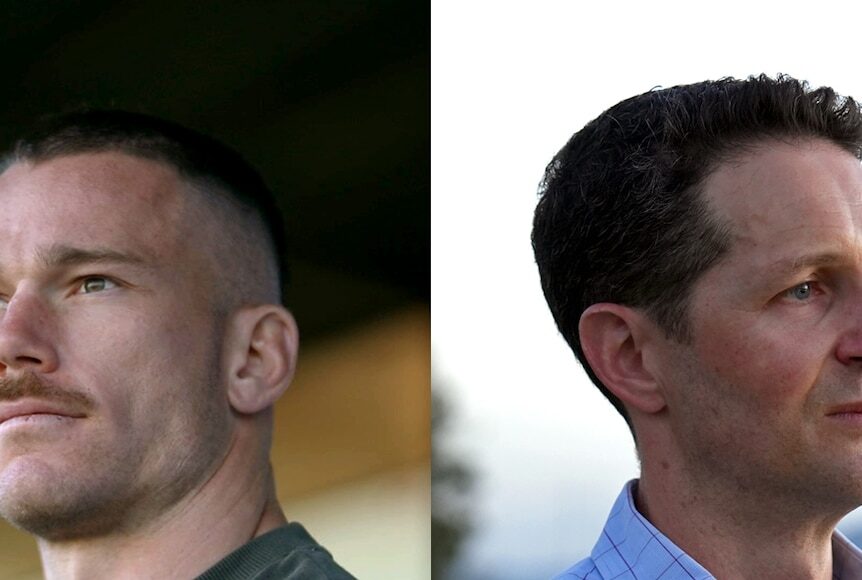
Source : ABC NEWS
As rugby league player Tom Starling, torn shirt, bloodied face and concussed, paced his police cell, a veteran detective’s phone started to ring.
It was a Sunday morning in December 2020 and Detective Sergeant Kurt Hayward was at home.
“I received a few calls that an NRL player had been arrested by the local police,” Hayward told Four Corners.
“I knew that it was going to cause a storm.”
Hayward, who spent 23 years in the NSW police, is speaking publicly about the Starling incident for the first time because he believes he witnessed a failure of the system to hold officers to account.
Starling was arrested during a 21st party at the Shady Palms bar on the NSW Central Coast, when police responded to a confrontation between bar security and Starling and his family.
Officers from the local police station and the riot squad alleged Starling and others had violently attacked them and that, during the melee, Starling had even tried to grab a detective’s gun from his holster.
Starling was released on Sunday morning from the Gosford police station. A journalist and camera operator were waiting to capture the latest NRL player accused of behaving badly.
As Starling ran the media gauntlet, he clutched a police document stating he had been charged with assaulting police and resisting arrest.
The next day, Detective Sergeant Hayward walked into the police station and saw another officer viewing the CCTV footage of the incident. He watched it.
Loading…
Starling is dragged out of the bar backwards by officers. A tall well-built riot squad officer, Sergeant Evan Prowse, punches him at least twice, knocking out the Canberra Raiders hooker.
Still held aloft by police, Starling is then hit several more times while either unconscious or barely conscious by a local officer, Senior Constable Steven Brown.
“The first thing I said was, ‘it looks like [a police officer’s] going to hit the dock,'” Hayward said, in reference to the police cells where people are held after being charged with a criminal offence.
‘It was that obvious that it wasn’t right’
“You could see Starling had already been knocked unconscious and was floppy and Brown throws those punches at the unconscious body,” he said.
“There’s no way you can justify those actions.”
Prowse and Brown deny that they assaulted Starling.
Hayward then read the police report on the incident. To him, it didn’t at all match with the vision he had just seen.
“[It was] a classic case of overcharging and [police] trying to justify their actions by overcharging and saying things that just didn’t happen.”
He hoped that once his superiors saw the CCTV footage, they would launch an internal investigation.
He presumed that then one or both of the officers who punched Starling would be stood down and possibly charged.
That’s not what happened.

Starling was charged with assaulting police and resisting arrest. (Four Corners)
Brutal force
Four Corners is telling this story as part of the Brutal Force series, which reveals a worrying rise in complaints and civil suits targeting the NSW Police Force in recent years.
Last financial year, the NSW Police Force was behind a record $40 million paid in settlements and legal costs to people who sued over alleged police misconduct.
That is up 43 per cent in only five years, according to the police’s own data.
The same year, NSW police were the defendants in 478 civil suits, which equals about two cases every working day of the year.
Lawyers, victims and criminologists say this is indicative of a flawed police misconduct system that often fails to get results, pushing victims and their lawyers to the civil courts to get some measure of justice.
“High levels of litigation are a result of bad behaviour by police,” says one of Australia’s pre-eminent criminologists and police integrity experts, the University of the Sunshine Coast’s Tim Prenzler.
“To be successful in the civil courts in suing the police, you have to have a very strong case,” Professor Prenzler says.
“So where we see success in litigation, there’s probably substantial evidence of misconduct.”
‘Template of untruths’
Tom Starling spent the first few days after the incident hiding at home, watching headline after headline describe him as just another footy thug, terrified his career was over before it began.
“It was like living in a dream or something, like you’re just waiting to wake up,” he said.
Starling was terrified his career was over. (Four Corners: Ryan Sheridan)
“I’d just started playing in the NRL, the only thing I ever wanted to do, and one moment you’re there at your mate’s 21st and then you’re being told you’re being charged with assaulting police.”
Raised in a working-class family on the Central Coast, footy was Starling’s life.
“I used to look at NRL players when I was a young kid like they were superheroes,” he says.
Starling told the Canberra Raiders he wasn’t guilty of the charges and intended to prove that in court. His parents sunk their savings into the case and hired criminal lawyer Samar Singh-Panwar to help fight back against the police.
“I think anyone who views that CCTV footage can see that what occurred was an unjustified, brutal assault by police,” Singh-Panwar says.
“It simply could not be reconciled with the allegations as contained in the fact sheet.”
In court, Singh-Panwar would describe that document, the initial police version of events, as “a template of untruths”.
‘I see a man resisting police’
Hayward was determined not to let the matter go.
“After I saw that footage, I was immediately concerned that the police had done the wrong thing and needed to report that misconduct as an obligation of my role.”
Hayward was determined not to let it go. (Four Corners: Rob Hill)
NSW police officers are required under the NSW Police Act to report acts by other officers that they believe are criminal offences, corruption or other unlawful acts.
A deeply ingrained culture of silence means that’s not always how it works in practice, says Professor Prenzler.
“Suppression of evidence and solidarity are common in all organisations,” he says.
“It’s probably more intense in, in police … because of the more stressful and dangerous nature of the work where police are more dependent on backup and support from colleagues.
“And so naturally, they’re very reluctant to blow the whistle or provide evidence against colleagues.”
Hayward was willing to push back against that culture.
He decided he had to report what he saw as police misconduct to his boss, the crime manager.
“We’re watching the footage together and I’m saying, yeah, there he is … punching an unconscious man three times.
“I said it a few times in the conversation and the crime manager said, ‘Oh, you keep saying that. I see a man who’s resisting arrest, not a police officer punching another man.'”
Hayward says he was told the head of his district, the superintendent — as well as his boss, the region commander — thought police had done nothing wrong and if he disagreed, he’d have to go all the way to the top.
“So I sat and pondered for a little while and then started to write the career suicide note.”
He wrote to the commissioner and reported the incident.
A day or two later Hayward says he was called to the region commander’s office. Instead of being attacked for going over his head, he says the region commander told him he hadn’t been informed of the case and after watching the CCTV he was launching an investigation into police actions.
Hayward had won. He was installed as the officer in charge of the Starling matter and directed to withdraw most of the charges against the Canberra Raiders player.
An investigation was launched into the actions of police on the night. (Four Corners)
However, back at Gosford Police Station, Hayward soon felt the cost of his victory.
Some officers froze him out. Some left anonymous notes on his desk.
Disillusioned by what he had seen, Hayward’s pride in his job waned. About 18 months after the Starling incident, he quit the NSW police.
To this day Hayward remains angry with NSW Police for what he sees as a system that, sometimes, allows police officers — people with significant power in our society — to commit misconduct and get away with it.
“There’s nothing more hypocritical than someone in that position doing those things. You should be arresting people who do that, not doing it yourself,” he said.
A long fight
Over the next two years Starling fought the charges, while trying to keep his NRL career on track.
“It was hard to show up sometimes, put that brave face on and pretend like it wasn’t affecting me, but 100 per cent it was.
A career in the NRL was Starling’s (right) childhood dream. (Getty Images: Mark Nolan)
“I was a young kid trying to live out my dream and I had this dark cloud just following me around everywhere.
“I used to go to games and just think everyone was thinking, ‘oh, there’s that thug Tom Starling that assaulted police officers’ and did all those things that they said about me.”
In the end, like Hayward, Starling’s persistence paid off. In February 2023 the final charge against him was dismissed.
Then, a year later, the officers who punched him, Prowse and Brown, were charged with assault over the incident.
The trial of the two officers is due to start next week, more than five years after the incident. Both are pleading not guilty.
Tom’s brother Josh Starling was found guilty of common assault and resisting police for his role in the brawl, but the court did not record a conviction.
The final charge against Starling was dismissed in February 2023. (Four Corners: Ryan Sheridan)
Once the Brown and Prowse criminal case is finished, Starling will sue the police. By the time it’s all over it’s likely more than six years will have passed since that night at Shady Palms.
Sometimes Starling has moments when he feels like he’s back in that cell.
“It’s something that’s always going to be there. You still Google my name, it’s still there. That never goes away.”
Watch Four Corners’ full investigation Brutal Force on ABC iviewnow.
Loading…