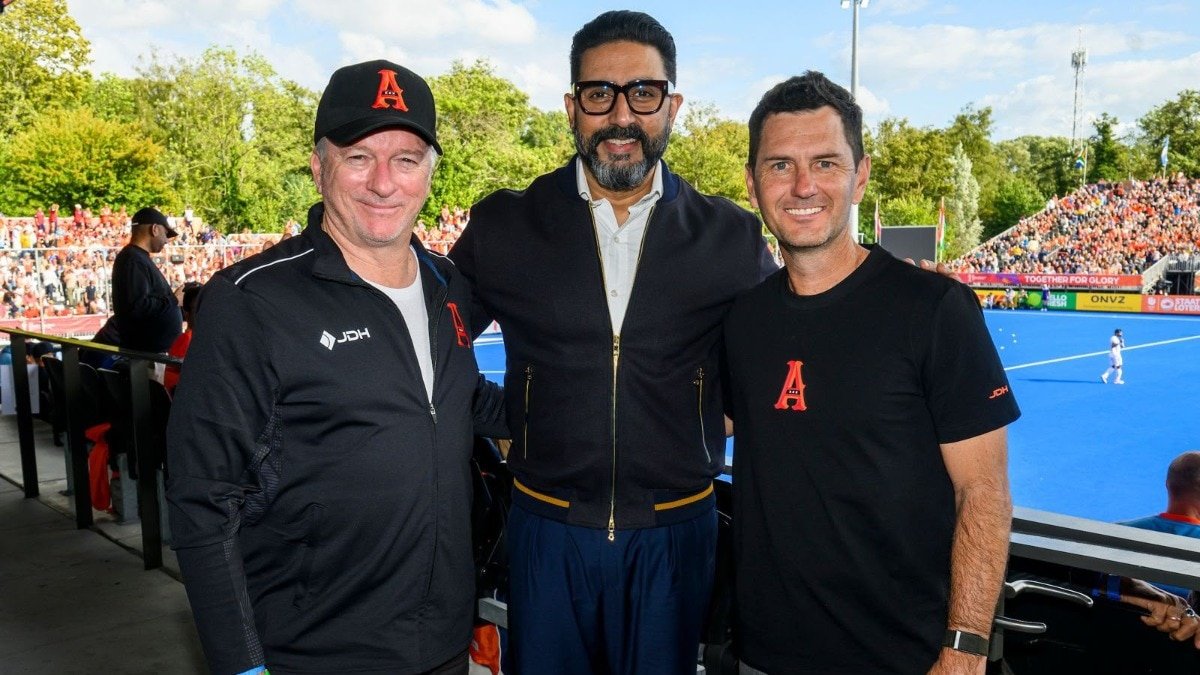
Source : INDIA TODAY NEWS
Forty-eight hours. That was all it took for Steve Waugh to say yes.
When Abhishek Bachchan and his team first approached the former Australia captain about becoming an owner in the European T20 Premier League, they were not sure what the answer would be. Waugh had been away from cricket for 25 years in an ownership or franchise capacity, and the idea was still just that, an idea.
advertisement
Then he signed on.
“Shockingly, 48 hours after we first spoke to him, he signed on as the first ever owner,” Bachchan tells IndiaToday.in. “So he’s the one who started the ball rolling, so I will never forget that, and I will always be grateful to him.”
That first yes has become rather important to the story of the ETPL.
The league begins on Wednesday, August 26 with six city-based franchises across Ireland, Scotland and the Netherlands. It is the first ICC-sanctioned multi-country franchise T20 competition in Europe, with 30 matches across four weeks, and it has assembled an ownership group that reads more like a roll call of cricketing history than the boardroom of a new league.
Waugh is in Amsterdam. Rahul Dravid owns the Dublin Guardians. Jonty Rhodes is part of the Rotterdam Dockers ownership group alongside Faf du Plessis and Heinrich Klaasen. Matthew Hayden is involved with Glasgow, while Glenn Maxwell is a co-owner of Belfast.
“We have huge admiration for him (Waugh) as a cricketer, but, you know, to convince Mr. Steve Waugh to come back into cricket after 25 years was something that we didn’t think was possible, but we said, hey, let’s give it a shot. And he said yes, and he said yes almost instantly.
“And I think that’s where it started off, you know, then when we approached other people, the other owners, be it Jonty, be it Rahul, Glenn Maxwell, Matthew Hayden, these guys also, hey, if Steve was there, it means there’s something worth doing.
“And when we gave him the pitch, took them through all the financials and operations of it, they just, what’s wonderful is I think we’ve managed to pull a group together, which is very rare in sport, pull a group together that shares a common vision,” he said.
“It’s just wonderful to see how personally they’ve taken it. And, you know, I’ll never forget something Mr. Waugh told me about eight-nine months ago, and he said, ‘AB, I’m a team player. And one thing I have is I know that if you can bank on your team and have faith and lean on your team, you can achieve anything. So let’s all work together and make this a huge success’.”
“So he’s just been such a beacon of light for all of us,” Abhishek said.
For Bachchan, though, the most encouraging part has been what happened after the cheques were signed.
“These are people who want to work and make a difference in the world of cricket in Europe,” he says.
NOTHING BUT RESPECT FOR DRAVID
He has seen that commitment first-hand. Dravid has spent a week in the Netherlands attending training camps and taking part in activities. Rhodes has been in Rotterdam reaching out to supporters. Waugh has made several trips to Amsterdam and involved himself in promoting the competition.
“I mean, you know, Rahul has been here in the Netherlands for the last one-week attending training camps, doing activities, you know, drumming up buzz. Jonty’s been here for longer than that in Rotterdam, reaching out to fans. Steve Waugh has been to Amsterdam several times with Jamie Dwyer taking care of promotions,” he said.
“And then to have, you know, Rahul Dravid is just one of the most stand-up, amazing human beings you’ll ever come across. I have nothing but respect, and my admiration for him has only grown after, you know, having had the opportunity to spend the last couple of months interacting with him.
“And then a personal favourite of mine, Jonty Rhodes, I mean these guys are just fantastic, and they’re not just gonna do this for no reason. They, I’d like to believe that they believe in our vision and they have, they share the common vision.
“I’m, I think we’re very, very lucky. The kind of ownership that we were aiming for, I believe we have.”
That distinction matters to him.
WHY CRICKET, WHY EUROPE?
Bachchan has been involved in sport for more than a decade, beginning with football and then buying the Jaipur Pink Panthers in the Pro Kabaddi League. He also has a team in the Indian Street Premier League, Majhi Mumbai, and has spoken often about his desire to build sporting properties rather than simply attach his name to them. His latest move takes him much further from the established Indian sporting market.
The logic is straightforward.
In India, cricket already has an enormous commercial ecosystem, led by the BCCI and the IPL. Bachchan does not believe there is much room for an investor like him to make a meaningful difference at the top of that pyramid.
“In India, there’s very little you can actually do to contribute,” he says.
“I think the BCCI just does such a fantastic job with cricket. I mean, what would I come there and be able to contribute? How can I help the situation? How can I make it bigger, better? I don’t think that would be possible.”
COMMERCIAL SUSTAINABILITY IMPORTANT
Europe offered a different proposition.
There was a sport with an established history in several countries, but without the professional franchise ecosystem that has developed in India, Australia, South Africa, the Caribbean and, increasingly, the United States. The ETPL is trying to fill that gap, beginning with Dublin, Belfast, Edinburgh, Glasgow, Rotterdam and Amsterdam.
That does not mean Bachchan is romantic about the business.
He is quite clear that commercial sustainability is essential.
“As a business, I think commercial sustainability is very, very important because I think we’d be foolish to think that, you know, the commerce of it doesn’t come into play,” he says. “The commerce keeps it alive, keeps it sustainable, allows it to survive.”
That is the pragmatic side of the bet. No sporting institution can be built indefinitely on enthusiasm alone.
But Bachchan also has a different measure of success.
“For me, the mark of success for a sports team are the fans,” he says. “We’re nothing without the fans. No sport is anything without the fans.”
IS STAR POWER ENOUGH?
That is where the ETPL’s biggest challenge lies.
The league is being launched in markets where cricket is not the dominant sporting language. England and Wales, the traditional centre of European cricket, are not part of the competition’s six-team footprint. The ETPL has instead been built around Ireland, Scotland and the Netherlands, with the stated ambition of expanding further into mainland Europe.
That is both its attraction and its risk. The league is not entering a mature market and trying to steal a few percentage points from an established competition. It is trying to make franchise cricket relevant in places where cricket itself remains a minority sport.
The organisers have clearly understood that star power will be necessary to get people to look. R Ashwin and Ajinkya Rahane, who recently retired from international cricket, have joined the league. Steve Smith, Mitchell Marsh, Glenn Maxwell, Faf du Plessis, Trent Boult and other international names are part of the playing pool, while the ownership groups bring their own considerable cricketing credibility.
But the bigger test will be what happens after the famous names have done their job.
Can a child in Amsterdam identify with the local franchise? Can a young cricketer in Dublin see a pathway that did not exist before? Can the league create enough local interest that it becomes more than an Indian-backed T20 competition being watched by Indian audiences?
Those are questions the ETPL will have to answer over time.
Bachchan’s answer, at least for now, is to build patiently.
He says there is already interest from France, Portugal, Germany, Italy and Poland in joining an expanded version of the league. But he is unwilling to rush there.
“Proof of concept first, right?” he says.
“We want to have the first successful season. And then just take stock of how everything went and then, yes, the idea and the dream is to expand across mainland Europe.”
That caution is significant because the ETPL itself has already experienced a delay. Originally scheduled for 2025, the tournament was pushed back by a year after the organisers found that the timelines and franchise-building process needed more work.
Now the ball is finally being bowled.
And perhaps the most telling part of Bachchan’s story is that he does not talk about Europe as simply another place to put a franchise league. He talks about it as a market where he believes he can contribute something. That was the reason he entered sport in the first place.
“What can I do to make a difference? How can I help? How can I be of service, and how can I leave the sport better than when I found it?” he says.
Waugh’s 48-hour decision was the first big vote of confidence. Dravid’s involvement brought another layer of credibility. Rhodes, Waugh and the others have since shown that they are prepared to put time into the project, not merely their names. Now comes the harder part. The ETPL has to turn that belief into a league that people in Europe want to watch, players want to join and young cricketers want to grow up around.
For Bachchan, the ambition is clear. The commercial reality is clear too. The first season will determine whether the two can live together.
– Ends
SOURCE :- TIMES OF INDIA