Source :- THE AGE NEWS
That’s because while fractures that pierce the skin look more grisly than closed-wound breaks, the biggest complicating factor is the risk of infection in the open wound rather than the process to repair the broken bone.
“Normally, for an ankle fracture, you probably quote about 1.5 per cent infection rate after treatment whereas with an open one, you’re probably anywhere from 10 to 27 or 30 per cent range,” Higgs said.
When Cleary was taken into the theatre on Sunday night, it was likely that the first priority was to clean the wound.
“You wash the bone ends out – what we call ‘delivering the bone ends’ – and make sure they’re clean and there’s no sock or clothing or any dirt, any part of the ground in the wound there,” Higgs said. “And then you fix the fractures as per normal, pretty much.”
Sometimes if the wounds are really heavily contaminated, multiple surgeries will be carried out to wash out the wound again instead of fixing the fracture straight away.
Patients are also given antibiotics as soon as possible and continue on a course for 72 hours or until the wound is closed. Higgs said Cleary would probably be given some heavy painkillers including morphine after surgery, but might be on Panadol and anti-inflammatories by the end of the week.
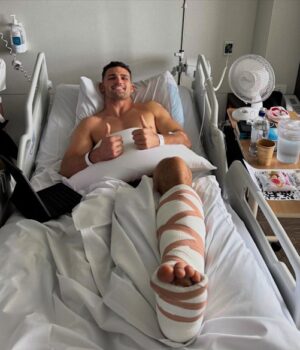
Given the injuries to both legs, Cleary will probably be in a wheelchair at first, but Higgs said it was possible he would be able to bear weight on both ankles as early as six weeks after surgery.
The recovery would have been more complicated had the break been higher up Cleary’s leg. That’s because the bone in the middle of the tibia and fibula shafts is more cortical, meaning it’s harder and has less blood supply compared to bone near the ankle, the metaphyseal bone, which has greater blood supply and greater capacity to heal.
The path to recovery will also be longer for Cleary depending on the grading of the fracture.
“We grade them one, two and three,” Higgs said. “Whereas a grade three would be the most severe one you’d see – in a wartime environment or a severe motor vehicle accident or a severe fall from a height type of thing – these grade ones can occur even from relatively low-energy injuries.”
Higgs said that based on the available footage of Cleary’s injury, it was more likely he’d suffered a grade one or two compound fracture.
Physiotherapist Brien Seeney agreed it was possible, but not certain, Cleary would be back for round one next season, despite classing Cleary’s injury as the worst he’d seen in the league this year.
“Especially in a situation like a football field, where there’s dirt and grass and bacteria and germs all over the place,” said Seeney, known as the NRL Physio on social media. “So avoiding infection is almost the No.1 priority in these early stages.”
He also warned against comparing Cleary’s injury to the worst-case scenarios of the past, including the career-ending compound fracture suffered by Jharal Yow Yeh.
The former Brisbane Broncos and Queensland State of Origin representative picked up several infections after suffering a compound fracture in round four of the 2012 season. Yow Yeh tried to return to rugby league but retired two years later because of the injury.
“There are just so many things that can vary in a case like this,” Seeney said. “With the Jharal Yow Yeh one, everything that could go wrong did go wrong.
“So it just shows you that there can be a worst-case scenario, which can be career ending or even career altering, where he’s never the same player. But there are also plenty of positive cases where guys come back in six to eight months, and they do really well.”
News, results and expert analysis from the weekend of sport sent every Friday. Sign up for our Sport newsletter.