
SOURCE :- THE AGE NEWS
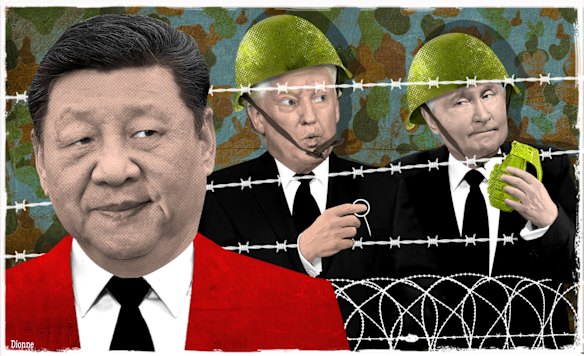
The wars in Ukraine and Iran are different in many ways but united in essential character. Not only because both are illegal. But because both are wars of hubris.
Vladimir Putin and then Donald Trump did not launch their invasions because there was any actual threat to their nations. Putin had to invent “Nazis” running Ukraine in order to make it sound scary. He said Ukraine had “gone so far as to aspire to acquire nuclear weapons”, knowing very well that Kyiv had surrendered all its nukes to Russia in the 1990s under the Budapest Memorandum in return for a supposed security guarantee from Moscow.
As for the alleged nuclear threat to America from Iran, the International Atomic Energy Agency said in early March that “there has been no evidence of Iran building a nuclear bomb”. Trump’s own spy chief agreed.
The US director of national intelligence, Tulsi Gabbard, in late March gave written testimony to the Senate – which she refused to read aloud for fear of enraging her boss – that “as a result of Operation Midnight Hammer” last June “Iran’s nuclear enrichment program was obliterated. There has been (sic) no efforts since then to try to rebuild their enrichment capability”.
Putin and Trump launched these wars of choice, heady with hubris, the overweening pride and arrogance that the ancient Greeks so feared as the precursor to disaster.
We shouldn’t be too shocked. Remember Putin posing bare-chested on horseback in the mountains? And Trump’s boast that he could shoot someone in the middle of Fifth Avenue and not lose any votes? And both of them publishing footage of themselves wrestling opponents to the ground.
“How much dumber will this get?” Hillary Clinton wanted to know early last year. Trump, unable to learn from Putin’s disastrous misjudgment in Ukraine, has now given the world a strong clue. Both men expected their wars would be over in days or weeks.
They declared maximalist demands at the outset of their wars. Putin insisted on “denazification”, total disarmament of Kyiv and the installation of a neutral government. Trump stipulated “unconditional surrender” by Tehran.
Instead, they are being humiliated by much smaller nations. Their grand visions of crushing victories have turned out to be fantasy. In reality, they are stalemated. Neither Russia nor the US appears able to win, yet they seem unable to extract themselves. These great powers are reminiscent of the impetuous rabbit in the famous African-American folk story of the tar-baby published in 1881.
In the tale told by the fictional narrator Uncle Remus, the fox decides to entrap the rabbit by dressing a lump of pine tar in clothes. B’rer Rabbit speaks to the tar-baby and takes offence when it fails to reply. The rabbit hits it, only to find that his paw is stuck fast to the tar. The harder he fights it, the more entangled he becomes.
Putin and Trump boasted of their military might and, in each case, they had much to boast about. Each vastly outmatches its victim in firepower. But their fetishisation of armed force at the expense of strategy was a costly error.
In 2009, long before today’s wars began, a pair of British psychiatrists wrote an influential paper positing something called “Hubris syndrome: An acquired personality disorder?” It was subtitled “A study of US Presidents and UK Prime Ministers over the last 100 years”. It also served as a premonition.
David Owen and Jonathan Davidson described its characteristics as “impetuosity, a refusal to listen to or take advice and a particular form of incompetence when impulsivity, recklessness and frequent inattention to detail predominate. This can result in disastrous leadership and cause damage on a large scale.”
Deafness to expert advice is a hallmark of both wars. Putin refused to listen to his military strategists. The Guardian ran this headline early in the war: “Putin involved in war ‘at level of colonel or brigadier’, say Western sources.” Micromanaging, in other words.
Around the same time, Britain’s Royal United Services Institute pointed out that Putin had invaded in spite of “the existence of warnings from senior military officers prior to the invasion.”
As for Trump, he brushed aside his top military officer, General Dan Caine, when he warned the president repeatedly of the risk that Iran would close the Strait of Hormuz.
Experts like to categorise national power into various types – hard power, soft power, sharp power, smart power. These two presidents give us case studies in dumb power. It’s like a bag of hammers. No amount of power can succeed if badly employed.
Strikingly, Trump has expressed admiration at China’s strategic brilliance. “Isn’t it incredible,” he told a British interlocutor during his first presidency, “they’ve become so powerful without firing a shot.”
Even today, as Russia and the US pay high prices for their blundering bellicosity, China quietly continues to seize maritime territories from its neighbours without a shot being fired.
Xi Jinping’s current focus is on building an artificial island at Antelope Reef, also claimed by Vietnam and Taiwan, in the Paracels island group. The aim is to convert it into a military base, as it has with other reefs in the South China Sea astride the world’s most valuable commercial artery.
He’s building a low-profile, low-cost imperium while Putin and Trump bleed lives, money, weaponry, credibility and national economic vitality to attain, so far, very little of any enduring value.
Trump sees Xi’s success and appreciates it, but seems incapable of learning from it. Putin, too.
Much has been written on how the two wars illustrate the centrality of fast technological adaptation. Much overlooked is the lesson of endurance. Short, sharp wars in the 21st century exist mainly in the imagination of the impatient warmonger, not on battlefields.
“While the opening phases of a high-intensity conflict are critical, they are rarely determinative,” writes Franco-British scholar Iskander Rehman in his 2023 monograph, Planning for Protraction.
“An equal, if not greater, degree of attention should therefore be placed on the study of … prevailing at the end of a draining marathon rather than an intense opening sprint.” Or, first preference, avoiding war entirely.
Peter Hartcher is both international and political editor. His political column appears on Saturdays.
Get a weekly wrap of views that will challenge, champion and inform your own. Sign up for our Opinion newsletter.
 Peter Hartcher is political editor and international editor of The Sydney Morning Herald and The Age.Connect via email.