

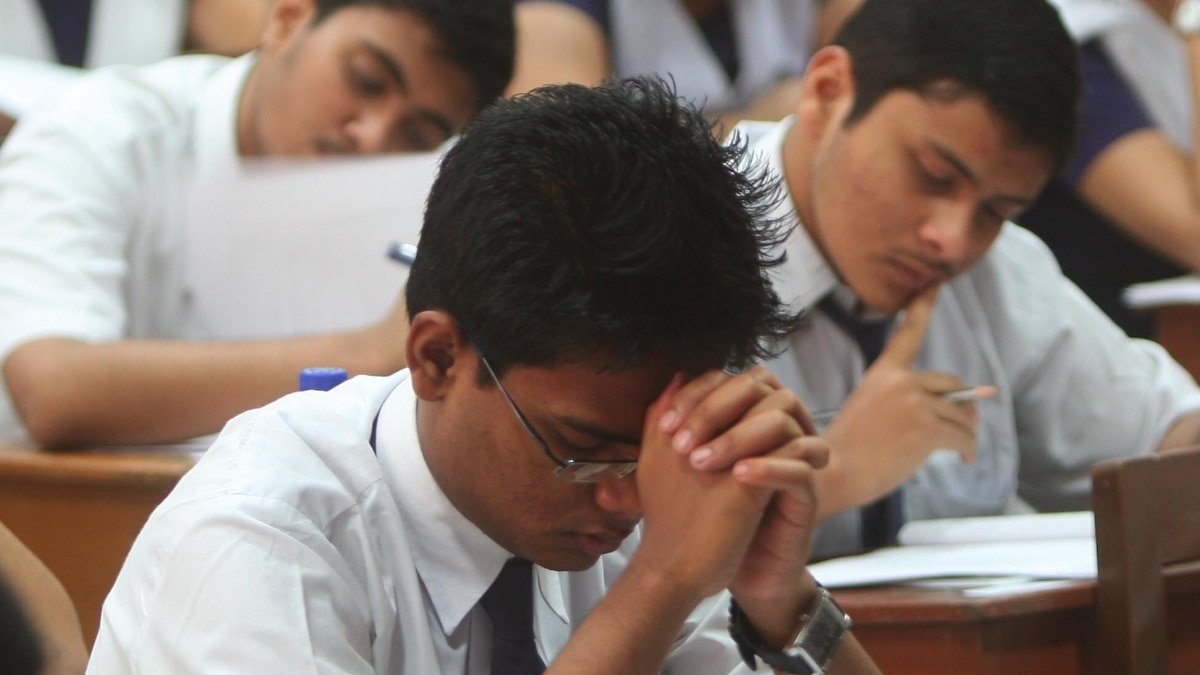
Source : INDIA TODAY NEWS
The biggest question emerging from CBSE’s On-Screen Marking (OSM) controversy may not be about answer-sheet mix-ups, missing pages or disputed marks. It may be about the battle to define the story itself.
For weeks now, millions of Class 12 students and parents have been trying to navigate complaints linked to CBSE’s new digital evaluation system. Some questioned the completeness of scanned answer sheets, others sought re-evaluation after spotting apparent discrepancies. Yet even as these concerns gathered momentum, another narrative began taking shape online.
advertisement
Videos of principals praising OSM started appearing across platforms, describing it as a “transformative reform that improved transparency, efficiency and consistency in evaluation.”
SO WHO BENEFITS FROM THE NARRATIVE?
Almost everyone except the people at the centre of the controversy.
CBSE benefits because a reform perceived as successful is easier to defend than one facing public scrutiny.
Schools benefit because they invested time, resources and credibility in implementing the new system.
Technology partners benefit (in this case the tender was handed over on a platter to Coempt Eduteck of Hyderabad) when the conversation focusses on innovation rather than execution.
But the more the spotlight shifts towards success stories, the easier it becomes for unresolved concerns to slip into the background. In that battle for attention, students and parents often find themselves competing with the very narrative meant to reassure them.
That does not mean the praise was orchestrated. India Today Digital found no evidence of any official CBSE directive asking schools to publicly endorse the OSM. Schools contacted across Delhi-NCR, Mumbai, Chennai, Kolkata and Lucknow said they had not received any formal communication from the Board instructing them to speak in favour of the system.
Yet the timing, tone, and strikingly similar language of the endorsements raises a legitimate question, why was there such urgency to establish OSM as a success while concerns about its implementation were still unfolding?
The answer may lie in a reality that extends far beyond CBSE. Public institutions rarely fear criticism as much as they fear a loss of confidence. Once trust begins to erode, every complaint acquires greater significance, every anecdote gains traction and every technical problem starts looking systemic. In such moments, controlling the narrative can become almost as important as fixing the problem itself.
A REFORM THAT WASN’T SUPPOSED TO ARRIVE THIS YEAR?
At the centre of this debate is a reality often overlooked in discussions about education technology. Systems do not fail or succeed in isolation, they succeed when institutions are prepared for them, stakeholders understand them and users trust them.
On that front, several educators suggest the OSM story may be more complicated than the public narrative currently suggests.
A principal from government school located in the Mumbai suburbs told us that schools had encountered similar digital evaluation experiments during the Covid years, particularly for internal assessments.
“We were trained for OSM marking for Class 9 during Covid, but the system suggested multiple glitches and the idea was eventually dropped by the Board. It was not supposed to be implemented this year. We were surprised ourselves. It was a lesson many of us were not prepared for,” the principal said.
That observation is significant because, if educators themselves were surprised by the scale and speed of implementation, then the current controversy may be less about whether digital evaluation is the future and more about whether the ecosystem was ready for such a transition.
THE PREPAREDNESS QUESTION
A senior principal from a private school in Bhubaneswar, Odisha, echoed similar concerns about preparedness. “We were not a part of the training exercise held by the Board. The OSM for Class 12 was not on the cards for 2026,” she said, adding that they were given very little time to train the teachers internally.
Teachers involved in the evaluation process also point to the operational realities behind the reform. A DAV school teacher that India Today.in had spoken with even before the Class 12 results were declared on May 13, had told us anonymously that the results would definitely be delayed because the OSM suffered from multiple glitches.
India Today was the first to report on the OSM-related issues. Here’s the report.
”The OSM has been facing frequent portal slowdowns, login and server issues, technical breakdowns during checking, delays in loading scanned answer sheets, and repeated interruptions in examiners’ workflow…,” she had informed in April.
For all the discussion around technology, the controversy has repeatedly highlighted a familiar truth. Introducing a new system is often easier than ensuring that everyone affected by it is ready for the change. Education reforms are ultimately judged not by their design documents, but by how they perform under pressure.
A GROWING TRUST GAP
For parents, meanwhile, the controversy has increasingly become a question of trust rather than technology. They are not impressed with this narrative push by principals defending the OSM process. “I have seen some videos of principals praising the on-screen marking. It is a cheap tactic whether the board has asked them to comply or the schools feel the need to do so on their own. It is the student and their parents who are left to suffer,” said a parent whose child has applied for re-evaluation.
Students express a similar sentiment. While many acknowledge the need for modernisation, they say confidence in the system matters as much as the system itself.
”I don’t know if my school has also been directed to put up a video, or whether there is a narrative toolkit distributed by the CBSE. There are multiple questions that we have and we don’t know whom to ask. Our results have become a political tool,” said Swayam Mohanty, a Class 12 student from Delhi.
For many families, the issue is no longer whether OSM is technically superior to traditional marking. The issue is whether they can trust the process at a moment when board examination scores continue to influence admissions, scholarships and future opportunities.
THE BATTLE FOR THE NARRATIVE
This is where the debate over OSM becomes larger than a single examination cycle. Every major reform comes with a social contract. Institutions ask stakeholders to trust a new process, and in return they promise transparency, accountability and responsiveness when problems emerge.
The challenge for CBSE is that the controversy has created the perception, fairly or unfairly, that the defence of the reform began before all questions about its implementation had been answered. The emergence of positive testimonials, videos and endorsements in the middle of an unresolved controversy has only amplified that perception.
In every public controversy there are two battles; one is over facts, the other is over narrative. The CBSE Class 12 OSM row increasingly appears to be both.
The OSM controversy may eventually fade, and the glitches may be fixed. The process may even improve. But for many families, the lasting question is not what technology has done; it is whether they can trust it.
For an examination system that affects millions of students, that question matters more than any success story ever could.
– Ends
SOURCE :- TIMES OF INDIA