Source : INDIA TODAY NEWS
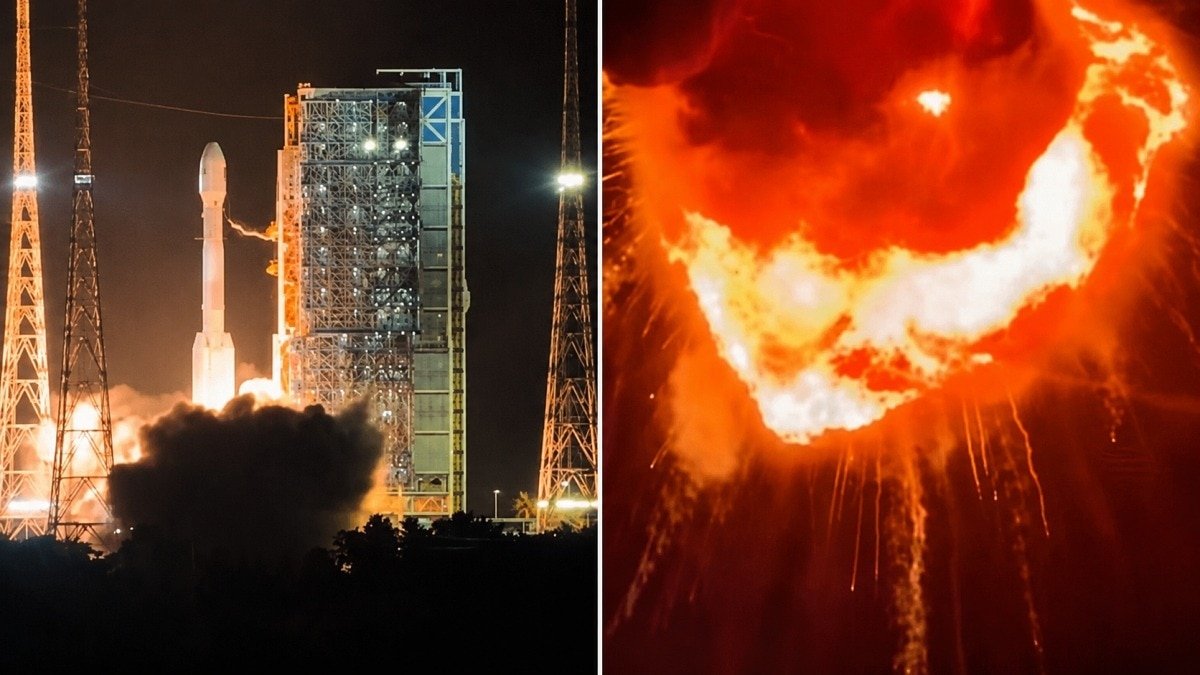
China’s Long March 7A rocket, one of the country’s workhorse launch vehicles for high-orbit missions, exploded shortly after liftoff from the Wenchang Space Launch Site on Monday, destroying the ChinaSat-4B communications satellite it was carrying.
The rocket lifted off at 8:02 pm Beijing time from Hainan. China later confirmed that the mission failed after an “in-flight anomaly”, but has not yet revealed what went wrong. An investigation is now underway to determine the exact cause.
advertisement
So, why did the rocket explode?
At this stage, there is no confirmed answer. Launch footage analysed by space expert Jonathan McDowell showed the vehicle being destroyed at relatively low altitude and speed.
This indicates that the failure occurred early in the flight, before the rocket could put either the satellite or any significant debris into orbit.
The timing is significant because the Long March 7A had established itself as a reliable member of China’s launch fleet.
After its maiden flight failed in March 2020, the rocket returned to flight successfully in 2021 and subsequently completed more than a dozen successful missions before Monday’s accident.
The Long March 7A is a medium-lift rocket designed primarily to place satellites into high orbits, making it different from the launch vehicles China uses for many of its large low-Earth-orbit satellite deployments.
That means investigators will now have to determine whether Monday’s failure was caused by a problem specific to this particular vehicle or whether it points to an issue involving a shared component, manufacturing process, software or launch-site operations.
The failure could therefore have wider implications if investigators identify a common component that is also used on other rockets. However, experts quoted by Reuters said the immediate impact appears limited because the Long March 7A has a specialised role.
The destroyed payload, ChinaSat-4B, or Zhongxing-4B, was reportedly part of the same satellite series as ChinaSat-4A and was intended for high-orbit communications applications.
Importantly, the failure is not expected to directly threaten China’s upcoming Chang’e-7 lunar mission, which is planned for later this year and uses the much larger Long March 5 rocket.
For now, the biggest question remains unanswered: what failed during those crucial first moments of flight? China’s investigation will determine whether this was an isolated accident or a warning sign for the wider Long March programme.
– Ends
SOURCE :- TIMES OF INDIA