

Source : INDIA TODAY NEWS
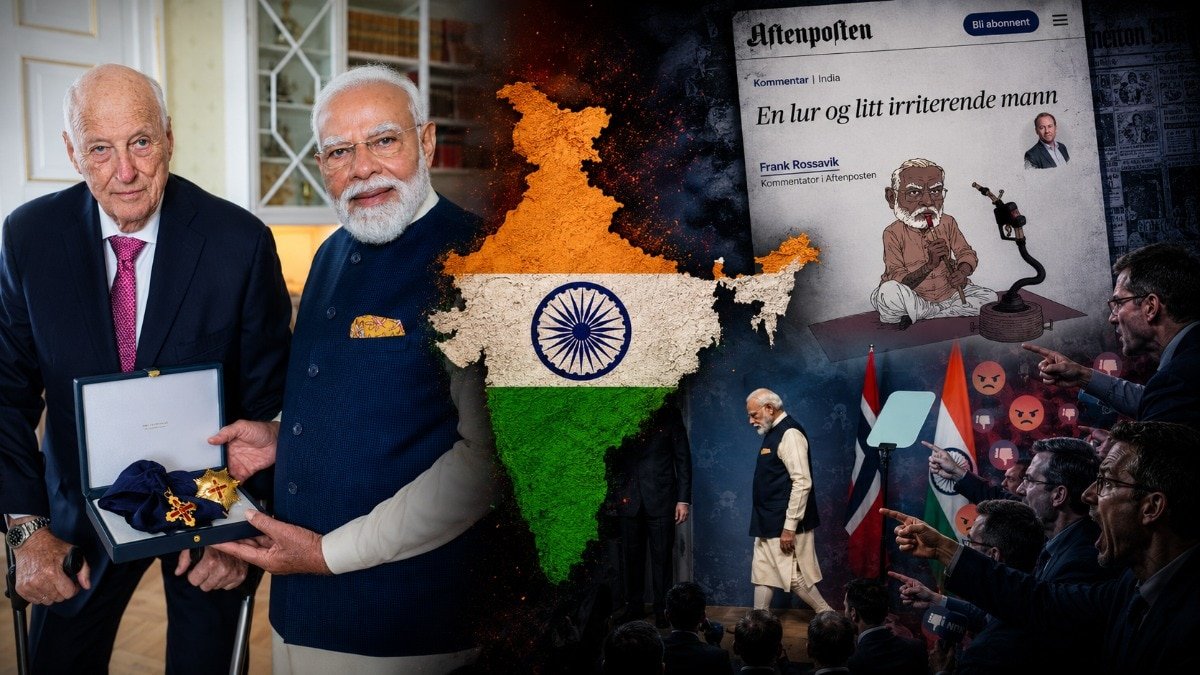
One week brought two starkly different reactions about India from Europe, exposing a contradiction that sits at the heart of its global self-image. Norway awarded India’s Prime Minister its highest civilian honour for a foreign leader, a gesture widely welcomed within India as recognition of its rising global stature. Yet in the same week, a Norwegian newspaper cartoon depicting the Prime Minister as a snake charmer triggered sharp public outrage across Indian social media and political commentary.
advertisement
The contrast between celebration and anger raises a deeper question about how India processes Western attention, whether in the form of praise or prejudice. The issue is not Norway itself, nor a single cartoon or diplomatic exchange, but the emotional weight that Western opinion continues to carry in Indian public discourse despite the country’s rapid rise as a global power.
Norway, Outrage, And Uneven Reactions
Earlier this year, an alleged email attributed to Norwegian diplomat Terje Rød-Larsen, referenced in reporting linked to the Epstein case, reportedly included the line, “When you meet an Indian and a snake, kill the Indian first.” While the remark was widely condemned as racist and indefensible, the reaction remained largely confined to social media outrage and brief headlines, without sustained diplomatic escalation or formal governmental response.
Later, during the Prime Minister’s visit to Norway, King Harald V conferred a major civilian honour on him, reinforcing India’s perception of growing international recognition. However, a subsequent interaction between the Prime Minister and local journalist Helle Lyng, who questioned him on press freedom in India, quickly went viral. The Indian Embassy in Oslo’s decision to engage the journalist further in a press briefing was interpreted by some as an attempt to project democratic openness, yet the episode escalated into a wider media controversy.
The uneven intensity of reactions to praise and criticism highlights a persistent pattern. It raises a fundamental question about why Western validation continues to generate such strong emotional responses within India.
When Stereotypes Meet Sensitivity
As observed in coverage by The New York Times following India’s Mars Orbiter Mission in 2014, a widely criticised cartoon depicted India as a villager with a cow knocking at the “elite space club” door, triggering immediate backlash and an eventual apology from the publication. Similarly, Germany’s Der Spiegel faced criticism in 2023 after publishing imagery contrasting overcrowded Indian trains with high-speed Chinese rail systems.
India is right to reject reductive stereotypes that flatten its complexity into outdated colonial imagery. Yet the intensity of reaction also exposes a second layer, where external approval and disapproval often shape emotional response far beyond the content itself.
Achievements That Stand Without Validation
India’s economic and technological achievements today are substantial and widely documented. According to the International Monetary Fund and the Reserve Bank of India, India remains one of the fastest-growing major economies in the world. Its Unified Payments Interface has become a global reference point for real-time digital payments architecture. During the COVID-19 pandemic, India’s vaccine production capacity played a significant international role, supplying doses domestically and abroad under initiatives such as Vaccine Maitri. The Chandrayaan-3 mission by the Indian Space Research Organisation further demonstrated cost-efficient lunar exploration, earning global scientific recognition.
Despite this, external validation continues to shape sections of public sentiment, particularly in cultural and symbolic domains where Western institutional recognition still carries disproportionate emotional weight.
The Colonial Legacy Of Validation
This pattern is not without historical context. Colonial-era education policy, articulated by Thomas Babington Macaulay in 1835, explicitly aimed to produce individuals “Indian in blood and colour, but English in taste, in opinions, in morals and in intellect.”
While India has been politically independent since 1947, scholars have long argued that such frameworks shaped enduring perceptions of intellectual and cultural hierarchy. The legacy is not political but psychological, influencing how external opinion is sometimes internalised even today.
However, the historical explanation is not the same as continued dependence. India’s global position has fundamentally changed, even if perceptions have not fully caught up.
China As A Contrast In Response, Not Values
China offers a contrasting model of response, not in terms of political system or values, but in how external criticism is processed. Western media criticism of China is frequent and often severe, yet official responses tend to remain strategic and institutional rather than emotionally reactive or publicly cyclical.
The comparison is not about imitation. It is about the management of narrative confidence. It highlights how nations project stability when external commentary does not dictate domestic emotional response.
A Power That No Longer Needs Permission
India today stands as one of the world’s major economic and technological powers, with globally recognised achievements in digital infrastructure, space exploration, pharmaceuticals, and services. These accomplishments do not require external certification to be valid.
Yet perception often lags behind reality, and in that gap between achievement and recognition lies the persistence of validation dependency. The issue is not Western opinion itself, but the emotional weight assigned to it.
A Question Of Confidence
A confident nation does not require foreign praise to feel successful, nor does it unravel under foreign criticism. It strengthens institutions, addresses internal challenges, and defines success through its own democratic and developmental benchmarks.
The question is not whether the world misunderstands India. It is whether India continues to allow that misunderstanding to shape how it understands itself.
The real test of confidence is not global applause or criticism, but emotional independence from both.
– Ends
SOURCE :- TIMES OF INDIA