
Source :- THE AGE NEWS
This was not just another women’s tennis match.
Calling it historic is too much, but world No.1 Aryna Sabalenka and four-time major champion Naomi Osaka – a former world No.1 – played for far more than a quarter-final berth in a rare women’s night match at Roland-Garros on Monday (Paris time).
The tournament had not showcased a women’s contest in the primetime slot for three years, despite being the sole slam with a woman as tournament director, former world No.1 Amelie Mauresmo.
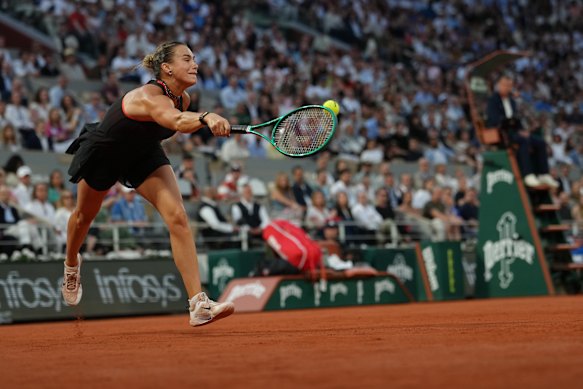
They more than justified their billing in a power-hitting spectacle that Sabalenka won in outstanding fashion, 7-5, 6-3, to keep alive her quest for a maiden grand slam title on the Parisian clay.
“She’s such a great player, and I always have tough battles against her,” Sabalenka said.
“[She plays] super aggressive tennis, and I’m mostly happy with the way I served, and that I was able to put all of that pressure back on her, and I’m happy with the win. It was a very tough one, and it’s amazing to play in the night session in front of you all.”
The contest came on the same day the WTA Tour announced that legendary American Serena Williams would make her comeback at Queen’s Club in London next week after last playing at the 2022 US Open.
Sabalenka has reached at least the last eight at 14 consecutive majors, a period when she has established herself as the dominant force in women’s tennis – but won only four of eight finals, including being runner-up to Coco Gauff at Roland-Garros last year.
But with Gauff, four-time champion Iga Swiatek and Australian Open winner Elena Rybakina already out, Sabalenka is a hot favourite to finally lift the Coupe Suzanne Lenglen, which would be her fifth slam trophy.
Unlike the Australian and US opens, the claycourt major schedules just one night match each day. Wimbledon does not have a night session at all because of a strict curfew.
The much-anticipated clash between Sabalenka and Osaka – two of the sport’s genuine superstars, by performance and profile – represented the first night match in Paris between women since Sabalenka beat American Sloane Stephens in the fourth round in 2023.
Osaka said before the match was scheduled that she had stopped even associating night matches with the claycourt slam because of how rarely women received that stage.
Mauresmo’s argument for the gender disparity was that she had to think of ticket holders, and the shorter, best-of-three-sets format for women meant heightened risk of only two sets being played and not offering value.
However, she received significant backlash at her first event in charge in 2022, when she said men’s matches had “more attraction and appeal”, which she later apologised for, adding that she was taken out of context.
WTA chair Valerie Camillo met with Mauresmo in Paris last week to advocate for more women’s matches being played as night sessions at Roland-Garros.
There was universal delight at organisers putting the Sabalenka-Osaka showdown under lights – but also some scepticism.
After major carnage in the men’s draw across the first week, the rest of Monday’s schedule lacked a male kingpin, so this was opportunistic scheduling. The decision also went against Mauresmo’s logic that women’s matches were shorter than men’s and therefore may not reward fans with enough content.
Sabalenka ended up winning in two sets across 85 minutes. But anyone walking away dissatisfied must be difficult to please.
Both players hit more winners than unforced errors, there were ebbs and flows, and the first set, in particular, was a highly competitive affair.
Osaka – in a shimmering bronze dress as her encore to the jellyfish-inspired outfit she wore at the Australian Open – jumped out to a 2-0 lead after Sabalenka double-faulted on break point. But the 28-year-old Belarusian immediately got back on level terms with a ballistic inside-out forehand winner in the next game.
They traded blows and highlight-reel shots from the baseline, with Sabalenka’s evolution as a player on show with a series of exquisite drop shots that complemented her raw power.
The ninth game of the match, on Osaka’s racquet, summed up what was required to win points on this night.
There was an enormous Sabalenka backhand winner after Osaka had stepped in to the court and crunched a forehand. Two points later, the Japanese star blasted a backhand drive volley winner, then backed it up with an inside-out forehand winner of equal excellence.
Osaka eventually toughed out a service hold after a couple of deuces, but her serve betrayed her the next time around – and Sabalenka made her pay in clinching a one-set lead. By then, Sabalenka was rolling.
Osaka hit her way out of a 0-30 hole in the third game of the second set and staved off a break point two games later, but she was losing control of the match.
Her last chance to pierce Sabalenka’s defences came in the ensuing game. The top seed had to dig deep, including twice being dragged to deuce, once after a blistering Osaka backhand return that painted the sideline.
Sabalenka survived, then pounced.
On what was arguably the best point of the match, she caned consecutive thunderous backhands in opposite directions, then stepped in to hammer a forehand, only for Osaka to force her rival to dig out a low volley, which she did with aplomb.
That delivered Sabalenka the break, and Osaka could not find a way back.
Sabalenka advances to a quarter-final match against Russian Diana Shnaider, who ousted Madison Keys 6-3, 3-6, 6-0.
Another Russian, Anna Kalinskaya, outlasted Austria’s Anastasia Potapova, 6-4, 2-6, 7-6 [10-7], to book her last eight spot against Polish qualifier Maja Chwalinska, who eliminated the final French hope, Diane Parry, 6-3, 6-2.
On the men’s side, Matteo Berrettini beat Argentine Juan Manuel Cerundolo 6-3, 7-6 (7-2), 7-6 (8-6) to exact revenge for his fellow Italian Jannik Sinner.
He awaits the winner between American Frances Tiafoe and Italy’s Matteo Arnaldi.
Fourth-seeded Canadian Felix Auger-Aliassime – the highest-ranked player left at the top of the draw – breezed past Chile’s Alejandro Tabilo, 6-3, 7-5, 6-1. Auger-Aliassime’s quarter-final foe is 10th-seeded Italian Flavio Cobolli, who edged past American Zachary Svajda in four sets.
News, results and expert analysis from the weekend of sport sent every Monday. Sign up for our Sport newsletter.