

Source : ABC NEWS
The race to Brisbane 2032 has already started.
Not on the track, in the pool or on the field, but in the minds of Australian sports fans who have started to identify the athletes they believe will define a home Olympic Games.
Gout Gout. Lachie Kennedy. Cameron Myers. Claudia Hollingsworth. Sienna Toohey.
For many Australians, it already feels like a matter of when — not if — they’ll take centre stage in Brisbane.
But what if they don’t?
What if injury strikes? What if they never make it to the start line at Victoria Park at all? What if the pressure becomes too much?
It’s an uncomfortable question.
But it might be the most important one.
Because six years is a long time in elite sport.

Sam Konstas walks off the pitch at the Sydney Cricket Ground after being dismissed in his second Test match while playing against India in January 2025. (AAP: Dan Himbrechts)
Just ask Ben Simmons or Bernard Tomic or, more recently, Sam Konstas.
Only 18 months ago, the teenager was one of the most exciting young talents in Australian cricket.
By the time he walked out for his Test debut at the MCG at 19 years old, every innings, every shot and every dismissal had become a national talking point.
The spotlight arrived long before his career had truly begun.
Australian sport has always loved a prodigy.
Dr Véronique Richard, a lecturer and researcher in sports psychology at the University of Queensland, said Australia’s passion for sport naturally creates high expectations around young athletes.
“Because of the sport madness of this country, there’s a lot of expectation,” she said.
“I don’t think it’s coming from a bad intention … I think it’s a passion for sport and I think it’s probably mostly support.
“They just want to see them do their best when it matters the most.”
Dr Véronique Richard, lecturer and researcher in sports psychology at the University of Queensland, explains that success in sport is extremely hard to predict. (ABC News: Jessica Stewart)
Difficult to predict
The challenge, however, is that sporting success is notoriously difficult to predict.
While fans and media are quick to identify future champions, research suggests talent identification is far from an exact science.
“We know for instance that a sport like the NBA, where there are very clear physical criteria like height that predicts success … even then, it’s just a 17 per cent prediction someone being drafted in the NBA to becoming an actual good player in the NBA,” Dr Richard said.
“And this is one of the sports we considered as the highest rate of predictability.”
If forecasting success is difficult in a professional league with measurable physical traits, it becomes even more complex in Olympic sports where performance can be influenced by countless variables.
“Six years ahead of the Games, I would argue that the pool of athletes that we think will perform at the Olympics will be extremely different,”
she said.
“So we basically don’t know … and even if we invest all we can in talent recruitment, we need to be realistic — the science is telling us that we are not good at predicting.”
It’s a message that feels particularly relevant in the case of Gout Gout.
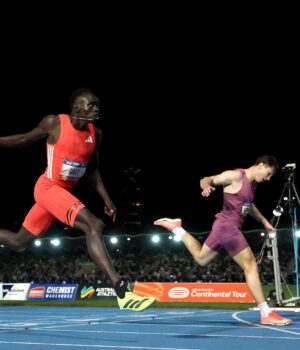
The teenage sprint sensation is producing times that have many wondering just how far his talent can take him — like when the 18-year-old set a new World U20 200-metre record at the Australian Athletics Championships in Sydney in April, running 19.67.
Not even his great hero Usain Bolt was that fast when he was 18.
But when Gout made his Diamond League debut last month in Oslo — his sixth-placed finish was described by many media outlets, as a “disappointment”, a “harsh lesson” or him “falling flat”.
It seems he is already being judged against the standards of champions, rather than those of a young athlete still finding his way at the highest level.
Gout appeared unfazed after the race.
Loading Twitter content
“There’s always pressure on me but all I do is try my best and keep focusing on just having fun,” Gout said.
“I love competing against the big boys and I’ll be back for sure … I put no limits on myself.”
But often it’s the athlete who needs to be saved from themselves and Dr Richard said this is where support systems become critical.
Australia, she argued, is among the best countries in the world when it comes to providing athletes access to sports psychologists, sport scientists, coaches and high-performance programs.
Dual pursuit
This year’s World Athletics U20 Championships in Oregon starts just three days after the Commonwealth Games finishes in Glasgow, proving a huge scheduling conflict for those eligible to attend both.
Race walker Isaac Beacroft is the only athlete who will make the quick journey across the two continents, after Australian Athletics (AA) recommended to junior athletes they prioritise the junior event.
“I took some pretty heavy consideration, but end up landing on that … I can’t really choose between one or the other, so I reckon I’ll just do both because it is logistically possible, but it’ll be a very big challenge for sure,” Beacroft said.
Emerging Australian race walker Isaac Beacroft training ahead of competing at the Glasgow Commonwealth Games. (ABC News: Glenn Mullane)
“Comm Games has been a massive goal of mine for the past two or three years … it’s been that first senior team that I really wanted to make and really wanted to do well at.”
The Blacktown product, coached by his father since taking up race walking as a nine-year-old, trains more than 100 kilometres every week across running and walking sessions.
His ambitions are clear, going for the 10,000m in Glasgow and the 5,000m in Eugene.
“The gold medal is where my sights are set for both races, and I think if I can come away with that I’ll be extremely happy, but if not then I just want to know that I’ve given it everything I’ve got,” he said.
“In this massive resurgence of athletics in Australia, I think AA has done a really, really good job at employing the right people to provide those foundations — physios, dieticians, high performance staff — of where we kind of want to get to as a group and I think it’s a credit to a lot of the success that we are having.”
Words from experience
For three-time Olympian Matthew Denny, those foundations will be crucial over the next six years.
The 30-year-old discus champion hopes Brisbane 2032 will be the final chapter of an impressive Olympic career and potentially his fifth Games appearance.
Three-time Olympian Matthew Denny believes the biggest challenge facing young athletes is consistency. (Getty: Michael Steele)
But having experienced both success and setbacks on the world stage, he understands just how much can change between now and then.
“There is a big difference between doing good performances and then a second doing a good season and then a third doing those together with a good championships,” Denny said.
“And I’ve always been wired that the big priority is always to have a good championships.”
His advice to Australia’s next generation is simple.
“You also have to not get ahead of yourself, you know, stay in your work,” he said.
“You have to be committed to the day, not to the 10 years … they kind of work within each other.”
The reality is nobody can know which names will still be standing on the start line six years from now.
But what Australia can do is ensure that the next generation is given every opportunity to succeed when the weight of expectation inevitably arrives.