Source : the age
They are feature films you will almost certainly never see. Made for comically small budgets. Starring no-one you know.
Yet at a time when even well-funded Australian films regularly struggle to find an audience, young filmmakers keep making ultra-low budget features, even if it means using up their savings, going into debt and burning favours from friends and acquaintances.
Many will never make another film. So why do it?
“It was always probably my biggest dream to just be in a movie,” Jonah Erofeyeff, 21, says. “You look up on the big screen and sort of see yourself there.”
He was not just thinking about himself.
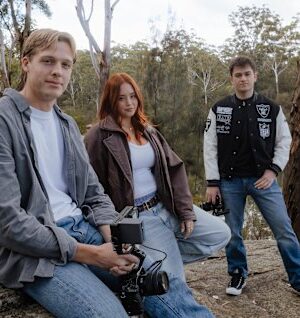
Erofeyeff made Where The Sky Meets The Ground with close friend Emrah Akbulut, 21, after meeting at an acting course. It’s a drama about four friends who have one last adventure before uni finishes – trekking into the bush to find a crashed plane supposedly carrying drugs.
Akbulut was watching the ’80s classic Stand By Me one night when he realised he had shared similar friendships.
“I messaged Jonah as the credits were rolling, and I was like, ‘This is a movie we can make – modernise it and make it Australian, authentic to us’,” he says.
Adds Erofeyeff: “We’re both actors. We wanted to just make a project for us to act in – a feature film with heaps of scenes.”
So the duo made the film – jointly writing, directing, starring and financing it – with $15,000 of their savings. Erofeyeff was working in maintenance at theme park Raging Waters (now Sydney Action Park); Akbulut was packaging wool in a warehouse before moving into baggage handling at Sydney Airport.
They kept down costs on the shoot by calling on friends from their acting classes and Erofeyeff’s filmmaking course at Randwick TAFE for the cast and crew, car pooling to set and bringing snack bags for everyone.
When their film was knocked back by festivals and distributors, the duo paid for their own premiere at the Randwick Ritz, gambling – successfully as it turned out – that they could cover the $5000 cost with ticket sales.
They are now hoping to make another film.
“The main dream is acting, but we always have that drive to make something else,” Akbulut says. “Even if it’s not a full production, we just want to be behind the camera, in front of the camera, doing something.”
Melbourne editor and filmmaking teacher Adrian Ortega was 25 when he shot his first feature film, the comic drama Cerulean Blue, about an introvert (Jack Michel) picking up a high-spirited hitchhiker (Senie Priti), in 2017.
He self-financed it with $35,000 to $40,000 from his savings as a waiter at the Footscray Community Arts Centre cafe and considered it a success when Cerulean Blue premiered at Melbourne International Film Festival in 2019 then was picked up by streaming service Stan.
“It didn’t break even because we played festivals and then, when it premiered in late 2019, COVID happened,” he says. “But it developed a name for myself in the industry to be able to get other projects made.”
Two years ago, Ortega tried Victorian state film agency VicScreen but ended up self-financing his second feature, Westgate, too. It cost $85,000: $70,000 from his savings and the rest from crowdfunding and supporters.
“I thought ‘should I put a deposit on a house or should I make a film?’,” he says. “I chose film again.”
Set over 24 hours in 1999, Westgate is a drama about an Italian-Australian single mother (Sarah Nicolazzo) from West Footscray who still carries the trauma from her father being killed in the West Gate Bridge collapse in 1970.
It was a personal story for Ortega, 34, who grew up in an Italian/Spanish migrant family in Footscray.
“It’s basically my mother’s story,” he says. “Sarah’s basically playing a version of my mother and Julian (Max Nappo) is basically a young version of me.”
After premiering at MIFF and screening at SXSW Sydney last year, Westgate had a modest cinema run, was released on DVD and Blu-ray and is now streaming on Prime Video and Apple TV. While it is yet to break even, Ortega thinks it will with more sales over time.
He is now planning another feature film but with a difference. “I’d love to not spend my own money on a third one,” he says.
Screen Australia’s latest drama report showed that 34 Australian films, including Westgate, started shooting in 2024-25. While 22 of them cost $1 million-$10 million, three cost less than $1 million.
War Machine has been a Netflix hit but only The Travellers ($2 million) and Leviticus ($1.5 million) have made an impact in cinemas so far.
That aligns with the findings of Nick Hayes’ recent report Made Not Seen: Australians go to cinemas in large numbers, but Australian film attendance has collapsed to the point where Indian releases are now more successful at the local box office.
Want to read more about film?
A witchy sequel lacking in magic, plus other new movies to watch this week