

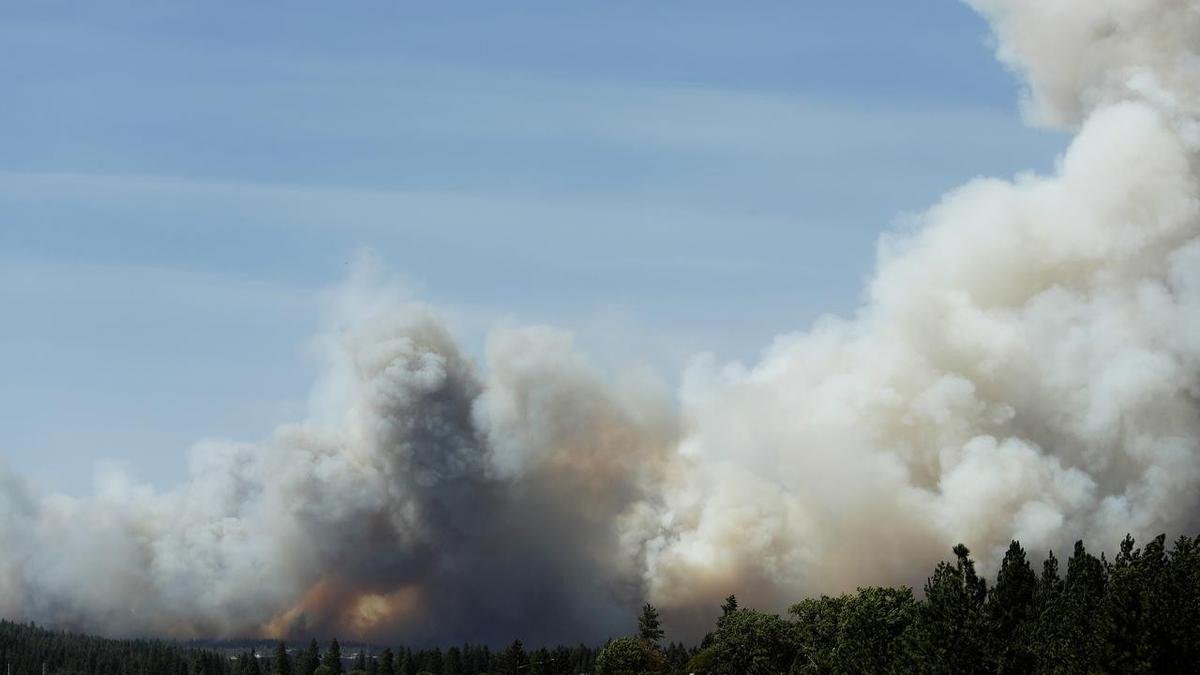
Source : Perth Now news
Wildfires raging on the outskirts of Spokane, Washington, for a third day have destroyed at least 700 buildings and forced tens of thousands of people to flee their homes in and around the state’s second-most populous city.
The cluster of three blazes ranks as the top firefighting priority in the United States as a whole, including the drought-parched Pacific Northwest, where dozens of major wildfires have been burning for weeks, degrading air quality across a wide region.
The Spokane-area fires have scorched more than 3200 hectares since erupting on Saturday in and around suburbs on the northern fringe of the city, home to about 230,000 residents west of the Rocky Mountain foothills near the Idaho border.
On Monday, some 64,000 people were under immediate evacuation orders, up from 4000 a day earlier.
At least 700 structures have gone up in flames, most of them in residential areas, and aerial infrared surveys showed that possibly another 400 buildings, including homes, had been damaged or destroyed.
The cause of the blazes was under investigation. No injuries or fatalities have been reported so far.
An unspecified number of people have been reported missing as flames spread out of wooded areas into neighbourhoods and commercially developed areas.
Around 1100 firefighters were battling the Spokane blazes on Monday, a fraction of the more than 29,200 personnel assigned to wildfires nationwide, most heavily concentrated in Oregon, Washington state and Idaho, according to the National Interagency Fire Center in Boise.
The agency reported more than 100 large new wildfires on Sunday across 15 states, the bulk of them in the Northwest, stretching resources thin across the region.
North of the US-Canadian border, flames continued to rage across British Columbia, where record drought conditions have led to what officials over the weekend called “explosive” fire behaviour in the southern part of that province.
Aerial firefighting assets in Spokane were so far limited to four fixed-wing tanker aircraft, with no water-dropping helicopters currently available, Cossel said.
Fire managers hoped their crews could make greater headway during a narrow window of cooler, less windy weather expected to prevail on Monday and Tuesday, before extremely high temperatures, low humidity and gusty conditions are forecast to return at midweek.
Even though fire activity in some spots has eased in comparison with Sunday, authorities were reluctant to lift evacuations in most of the fire zone.
Firefighters had yet to contain any of the three Spokane-area blazes, officials said.
The Interagency Fire Centre has documented 44,722 wildfires year to date nationwide, the highest number for this time of the year in at least a decade, with nearly 2.1 million hectares consumed, the most from January to early August since 2022.
The conditions driving the increase in wildfire activity in North America, Europe and elsewhere in recent years, especially periods of prolonged drought and extreme heat, are largely a function of human-caused climate change, according to scientists.