

SOURCE :- THE AGE NEWS
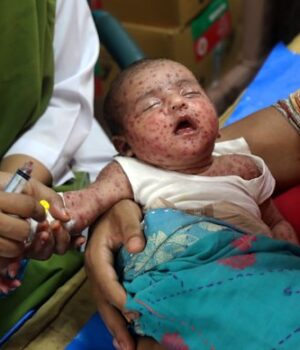
Sylhet: Bangladesh is battling to contain the world’s worst measles outbreak, a crisis exacerbated by weak data, inadequate outreach and vaccination gaps that experts say offers a warning to other nations about the deadly risk of falling immunisation rates.
Bangladesh, whose routine vaccination programme faltered in 2025, reported 202,000 suspected measles cases – 22,000 of them laboratory-confirmed – since the start of the outbreak in mid-March to October 9, the World Health Organization said. That’s more suspected cases than any other country this year.
So far, 1147 people have died of the highly contagious disease, with 94 per cent of reported deaths among children under five years old, the WHO said.
Bangladesh’s experience shows the challenge of containing an outbreak when vaccination coverage falls below 95 per cent, a level the WHO says is needed to prevent outbreaks. Bangladesh almost achieved that in recent years, but in 2025 coverage dropped.
A Reuters review of WHO documents, alongside interviews with more than a dozen scientists, health workers and officials, shows Bangladesh was also hampered in its emergency response by data that left out millions of children, shortcomings in preparation and a failure to reach enough parents.
“This is a real warning to every country,” said Mark Jit, a WHO vaccine adviser and professor at the School of Global Public Health at New York University. Preventing an outbreak through vaccinations was easier, cheaper and safer than responding to an emergency, he said.
“The response will stop the outbreak eventually, but in the meantime, many will have had measles, and some will have died,” he said.
Ziauddin Hyder, special assistant on health affairs to Prime Minister Tarique Rahman, told Reuters in September the government was doing everything it could to end the outbreak. The government did not respond to further questions sent in October for this article.
In the north-east Sylhet region, one of the worst-hit areas in the nation of 178 million people, two-year-old Arman Hossain died unvaccinated in July, 24 hours after admission to hospital for treatment paid for by selling the family’s three-wheeled auto rickshaw. His unvaccinated four-year-old sister survived.
His father Amin Mia, 26, said no health workers came to their remote village in Sylhet to offer vaccinations in time. “They came only after I buried my son,” he said.
Measles usually kills two or three people in every 1000 cases, the WHO says, but the disease can be more deadly in poorer nations because of factors such as malnutrition.
In the town of Chhatak, also in the Sylhet region, the daughter of 30-year-old carpenter Humayun Rashid died unvaccinated in June aged nine months. Labiba Akter could have received an inoculation in April when an emergency program lowered the vaccination age to six months from nine. “No health worker came to tell us,” her father said.
In May, Health Minister Sardar Md. Sakhawat Husain said the emergency drive had brought cases in hotspots “almost to zero” and the outbreak was under control.
Yet in September, Bangladesh reported a daily average of 1198 new cases of measles, which causes a high fever, cough and telltale rash. That was the highest total since May.
The Bangladesh outbreak comes as vaccine hesitancy is rising, particularly in wealthier nations, amid scepticism championed by figures such as US Health Secretary Robert F. Kennedy Jr.
Until recently, Bangladesh had been a vaccination success story. The WHO and the United Nations children’s agency UNICEF estimated that in 2024 it achieved 96 per cent coverage for the first vaccine dose and 93 per cent for the second, which is given to capture the small percentage of children who don’t develop immunity after one shot.
But that same year, protests erupted that ended 15 years of rule by Prime Minister Sheikh Hasina. In the ensuing political turmoil, health workers went on strike, vaccine orders were delayed and follow-up vaccinations that usually accompany routine programmes were disrupted.
In a report published in July this year, WHO and UNICEF estimated first-dose coverage in 2025 had fallen to 90 per cent, while second-dose coverage was 86 per cent, several percentage points below the 95 per cent needed for herd immunity.
Still, when the measles outbreak erupted, Bangladesh responded swiftly and initially seemed to be winning the battle. An emergency program was followed by an initial slowdown in new cases after almost 20 million children received a vaccination in April and May. The government said it had covered every child in the target age group of six months to five years.
But in reality the program fell short. This emerged when another routine health intervention in June had a target list with 4 million more children than the measles campaign despite covering the same age group.
“There is a gap,” prime ministerial adviser Hyder told Reuters on September 14, as measles cases rose again, blaming vaccine hesitancy by parents or child illnesses for keeping kids away.
“When preparedness checks are not done properly, it is often the poorest and hardest-to-reach children who miss out on vaccination and pay the price,” said Professor Mahmudur Rahman, an epidemiologist and chair of Bangladesh’s National Verification Committee for Measles and Rubella Elimination.
In Sylhet, where official records show 180 children have died, eigth of 16 families Reuters interviewed in September said they had not seen health workers offering vaccinations. At least six families said health workers visited only after a child had died from measles in their community.
At the end of September, the government launched a new campaign to target 3.4 million children previously missed. “We will involve people across villages so that no child is left behind,” the health minister told a news conference.
Yet reaching every child remains a challenge. UNICEF and the Bangladesh Bureau of Statistics say as many as 40 per cent of children go unregistered, while government data showed about a third of health worker posts are unfilled.
Reuters
Get a note directly from our foreign correspondents on what’s making headlines around the world. Sign up for our weekly What in the World newsletter.


