Source : Perth Now news
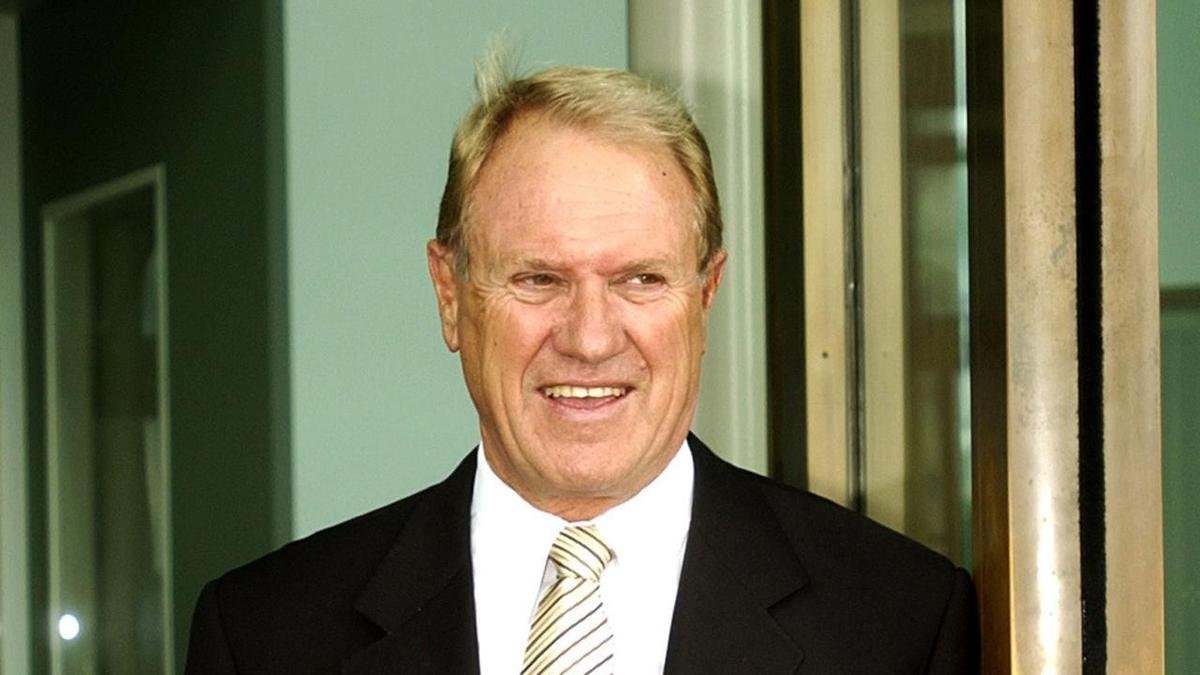
God and Gough Whitlam have both been blamed for pushing Bruce Baird into politics.
Mr Baird failed the medical to become an Anglican priest because of a kidney condition as a newly minted arts graduate at the age of 23 and instead pursued a career in commerce.
Yet despite a long association with the Whitlam family – he admits to voting for Labor at the 1972 federal election – his disdain for the ALP’s politics propelled him into the Liberal Party.
He went on to spend two decades in state and federal parliaments, preceding Scott Morrison as the federal member for Cook, while his eldest son Mike served as NSW premier between 2014 and 2017.
Bruce George Baird, who died aged 84, was born on February 28, 1942, the son of a migrant Scotsman and an Australian mother, and grew up in Cronulla playing street football with the Whitlams’ sons.
But it was the elder Whitlam’s style in federal government that pushed Mr Baird to join the Liberal Party.
“I went to a Labor Party conference and it was ‘comrade this’ and ‘comrade that’ and I just couldn’t see myself saying comrade,” he once said in an interview.
Mr Baird had perhaps the most distinguished business background of those elected with the Greiner government.
He joined Qantas as an executive trainee after leaving school and completed a BA majoring in psychology in 1963 while working in the airline’s booking offices.
He completed an MBA at Melbourne University in 1972 and joined the Australian Overseas Trade Commission in Canberra before being posted to West Germany for three years as assistant trade commissioner at the Australian embassy in Bonn.
From 1977 to 1980, he served as trade commissioner at the Australian consulate-general in New York, where he was responsible for promoting Australian exports.
He was elected to the NSW seat of Northcott in 1984, aged 42.
A committed Christian since his teens, Mr Baird’s religion was an integral part of his political life.
He said he believed God called him to a political career.
In a 1993 interview, he said his faith gave him a sense of direction and purpose and noted that his weekly attendance at the Christ Church Anglican Church in St Ives was a “focal point of the week”.
The one-time, would-be missionary was also a regular member of the parliamentary prayer breakfast gathering nicknamed the “God Squad”.
When Bruce Baird made his maiden speech to parliament on May 8, 1984, the Liberal-National Party coalition was still four years away from government.
Ambitious and hardworking, he became the opposition’s finance spokesman within weeks.
At various times he held responsibility for finance, Aboriginal affairs, industrial relations and employment during the party’s time in opposition.
On the election of the Greiner government in 1988, Mr Baird was appointed transport minister.
Not long after his appointment, his fiery temper led to him becoming the first minister ejected from state parliament in 80 years after he was reprimanded by the Speaker three times for interjection.
He also lost two transport ministry heads and came under fire for slashing train timetables to cut the transport budget.
Known for a while as “Boo-Boo Baird” after a series of gaffes, his early parliamentary style was called “wimpish” by some commentators and his catchcry of “wrong, wrong, wrong” to Labor questions was a habit some sceptics put down as a ploy to buy time to think of an answer.
Moving to take tough decisions early in government, Mr Baird overhauled the public transport system, cut staff by 15,000 from a peak of 37,000 and reduced costs by a third, forcing the system toward fuller cost recovery.
Other highlights of his long career as transport minister included the $500 million replacement of the First World War era “red rattler” trains with modern ones, the introduction of Rivercat and JetCat ferry services on Sydney Harbour, the construction of two major freeways in Sydney and the signing of a contract for a third.
When Nick Greiner resigned in the face of corruption allegations after the Terry Metherell affair and an adverse ICAC finding in 1992, Mr Baird stood for the leadership of the state parliamentary Liberal Party, but scored just 10 votes in a ballot won by John Fahey.
He then nominated for the deputy leadership and beat then justice minister Terry Griffiths by 24 votes to seven.
Mr Baird’s capacity for work and vigorous networking helped secure Sydney’s 2000 Olympic bid, for which he was minister.
Although the success brought Mr Baird his greatest triumph, it was diluted with the disappointment of being cut out of the Games planning process by Mr Fahey after the win.
“I just think the premier wishes to take control of it for his own reasons and to say I’m not amused is an understatement,” he told ABC Radio at the time.
Only after loudly making his displeasure known was he accommodated, with an appointment to a cabinet committee to co-ordinate the government’s Games activities.
Mr Baird moved to federal parliament in 1998 when he was elected to the Sydney seat of Cook.
He never served as a minister and elected to quit politics before the 2007 federal election, going on to author a review of international student rules in 2010 while Labor was in office.
A keen swimmer and tennis player, he married Judy in 1964. She died in 2021.
He is survived by his sons Mike and Steve, and his daughter Julia.