

SOURCE :- THE AGE NEWS
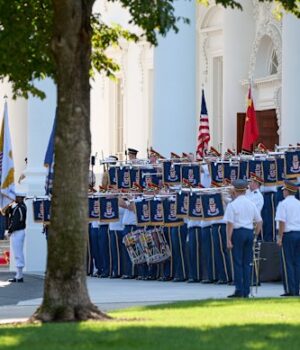
New York/Beijing: Last Wednesday morning, on the north lawn of the White House, the United States Marine Band rehearsed for the elaborate welcome they will bestow upon Xi Jinping when he meets Donald Trump on Thursday.
It was an early sign of the full pomp and ceremony to be wheeled out for the Chinese president on what is his first state visit to the White House in more than a decade.
Most experts believe the show will outdo the substance. “This is less a summit and more a spectacle,” said Kurt Campbell, co-founder of the Asia Group consultancy and a former deputy secretary of state under Joe Biden.
His colleague Evan Medeiros, who was the China lead on the National Security Council for six years, concurs. “There’s been no serious preparation – expectations are incredibly low,” he says. “There’s not likely to be any serious deliverables, and to the extent this summit is about anything, it’s about optics.”
There are still big-ticket items on the agenda for this summit – particularly artificial intelligence, the growing flashpoint in the geostrategic rivalry between the US and China, which both countries wish to dominate.
The summit’s key outcome is expected to be an agreement by Trump and Xi to extend a fragile one-year trade truce struck in Busan, South Korea last year.
‘I think President Xi comes to Washington with a greater sense of confidence about the China mission.’
Kurt Campbell, co-founder of the Asia Group consultancy.
Other low-hanging trade deals are also possible, such as China buying more US soybeans, as well as an AI dialogue channel between the two sides, which was discussed in lead-up talks this week between Treasury Secretary Scott Bessent and Chinese Vice Premier He Lifeng.
More important to the two leaders is the appearance of a dependable detente – a relationship of “strategic stability”, as they agreed in Beijing earlier this year.
Trump is staring down the barrel of the midterm elections. Xi has the fifth plenum, a major meeting of the Chinese Communist Party’s central committee.
Still, when Xi touches down on US soil on Wednesday evening (Washington time), it will be with a growing confidence in Beijing about China’s status as a rival superpower and global leader.
“They think the United States is potentially dangerous – late-stage capitalism kind of thing,” says Campbell. “I think President Xi comes to Washington with a greater sense of confidence about the China mission.”
Wu Xinbo, dean of the Institute of International Studies at Fudan University in Shanghai, says Xi’s hand has strengthened since the two leaders last met.
“If you look at you know how Trump is currently beleaguered by challenges such as inflation, the Iran conflict, and the pressure of the midterm elections, I think this time China is in an even better position,” he says.
It will be Trump and Xi’s third face-to-face meeting in 12 months, over which time China’s economy has withstood US efforts to break its export-led growth model through tariffs and other controls.
Instead, Beijing is on track to record a US$1 trillion global trade surplus for a second consecutive year, while having successfully tested its leverage over rare earths supplies in trade negotiations.
On the global stage, China has seized on Trump’s tariff warfare and interventionism in Iran to position itself as stable, rational major power – a framing Beijing is poised to roll out before world leaders at the UN General Assembly in New York this week, though Xi is not attending.
Instead, Xi and his wife, Madam Peng Liyuan, will fly straight to Washington, where they will be personally met by Trump on arrival at Joint Base Andrews on Wednesday evening – a rare break from protocol. A second arrival ceremony will follow at the White House on Thursday, along with a military review in the Rose Garden and a military flyover featuring a B-2 Spirit bomber and four F-22 raptors.
The two leaders will hold a bilateral meeting, while first lady Melania Trump and Madam Peng will visit the Smithsonian National Museum of Asian Art. Thursday night is a state dinner in the East Room of the White House, and on Friday, both couples will visit the National Archives before Xi and Peng depart.
A slew of tech chief executives will attend the state dinner: Elon Musk, Amazons’ Jeff Bezos, Google’s Sundar Pichai, OpenAI’s Sam Altman, Dell Technologies’ Michael Dell, Nvidia’s Jensen Huang and Apple’s Tim Cook. Banking boss Jane Fraser, the CEO of Citigroup, will also attend.
Campbell says Trump is mainly interested in the aesthetics: who will come to the state dinner, how the White House would look for Xi’s arrival, and what else to show the Chinese leader in Washington.
“You’re going to see a president focused on delivering a perspective of power and prestige,” he says.
“The interesting thing is how much President Trump admires and feels comfortable with authoritarian leaders. That’s just undeniable. He is more comfortable dealing with Putin and with President Xi – even [North Korean dictator] Kim Jong-un – than our closest allies.”
One thing that analysts do not expect to receive much airtime is Beijing’s increasing belligerence in Australia’s backyard. When China tested a ballistic missile in the South Pacific in July, Washington was largely silent. That silence did not go unnoticed in Canberra.
“In the last 12 months, we’ve seen a growing assertiveness by the Chinese on maritime territorial disputes,” says Evan Medeiros.
“What I see is … a lot of probing. How much does America care? How much is the US going to push back? How much is the US going to support allies or partners in the region?”
The Trump administration is yet to answer these questions in a systematic or serious way.
“What I worry,” says Medeiros, “is that the Chinese will use this summit as yet another way for them to project this veneer of managing the relationship well, but suddenly sending the signal to Asia that the United States is looking to us [China] as the centre of gravity in the Asia Pacific.”
This, Medeiros adds, “is a very subtle Chinese strategy to undermine support and credibility of the US alliance architecture”.
Analysts are sceptical that the carefully crafted optics of the two leaders’ personal rapport will translate into any major policy breakthroughs.
“There’s still a lot of underlying differences and tensions, from dissatisfaction about export control measures over rare earths, frustration with Washington’s import ban on Chinese drones and other advanced technological products, to distrust in each other’s stance on AI,” says William Yang, a Taipei-based senior analyst the International Crisis Group.
Meanwhile, Taiwan will be closely watching how the pending $US14 billion arms package to Taipei features in the summit, Wang says.
After his two-day meeting with Xi in Beijing in May, Trump triggered anxieties among allies when he described the arms sales as a “very good negotiating chip” and echoed Beijing’s framing of Taiwanese president Lai Ching-te as somebody “that wants to go independent”.
Wu says a measure of the summit’s success will be whether the leaders agree to two further meetings this year – with Trump attending the Xi-hosted APEC summit in China in November, and Xi reciprocating by attending the G20 Miami summit in December.
Get a note directly from our foreign correspondents on what’s making headlines around the world. Sign up for our weekly What in the World newsletter.
 Michael Koziol is the North America correspondent for The Age and Sydney Morning Herald. He is a former Sydney editor, Sun-Herald deputy editor and a federal political reporter in Canberra.Connect via X or email.
 Lisa Visentin is the North Asia correspondent for The Sydney Morning Herald and The Age based in Beijing. She was previously a federal political correspondent based in Canberra.Connect via X or email.

