

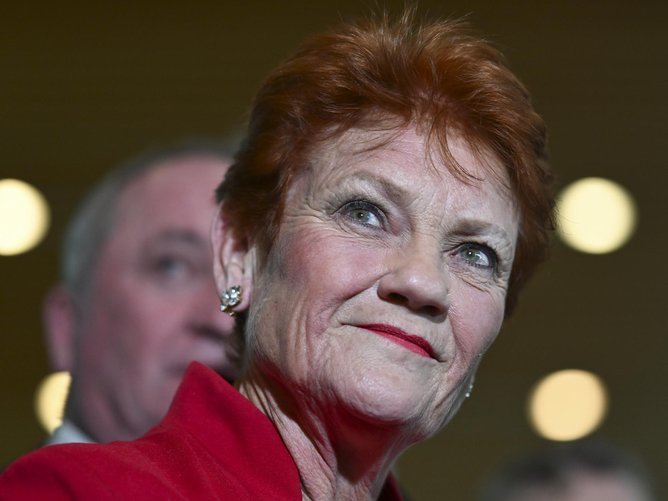
Source : Perth Now news
A severe voter backlash against the federal budget has up-ended Australian politics, driving One Nation ahead of Labor for the first time in primary support.The latest AFR/Redbridge Group/Accent Research poll shows One Nation’s primary vote increased by four percentage points to 31 per cent over the past month, while Labor’s primary support decreased by three percentage points to 28 per cent.
The Coalition’s primary vote shifted from 22 per cent to 20 per cent.
The survey of 1005 voters, taken between May 25 and May 28, followed the introduction of budget measures that altered previous policies regarding capital gains tax, negative gearing, and trusts.
Redbridge director Tony Barry told the AFR the data indicated 63 per cent of respondents now view the country as heading in the wrong direction.
“The downstream effects of the budget and another interest rate rise is Labor have lost more vote share, but the Coalition aren’t the beneficiaries on a primary vote basis,” Mr Barry said.
“With almost two-thirds of the electorate now saying Australia is heading in the wrong direction, that pervasive negative mood sentiment is fuelling more anti-Establishment support and a view among a growing cohort of voters that the answer lies outside established norms and major parties.”
On a two-party-preferred basis, Labor’s lead over One Nation narrowed from 55-45 per cent in the previous poll to 51-49 per cent.
When measured against the Coalition, Labor holds a 51-49 per cent lead, which adjusts to 52-48 per cent when applying the preference allocation from the 2025 election.

The personal ratings of political leaders also recorded shifts. Prime Minister Anthony Albanese’s net favourability decreased by 10 points to minus 19 per cent, while Treasurer Jim Chalmers fell to minus 18 per cent.
Opposition Leader Angus Taylor’s rating moved from minus 2 to minus 4 per cent.
Conversely, One Nation leader Pauline Hanson’s net favourability rose by one point to zero.
In the preferred prime minister stakes, Mr Albanese’s lead over Senator Hanson narrowed to 31 per cent versus 25 per cent, while Mr Taylor remained at 14 per cent.
Speaking to Sky News, Senator Hanson indicated she was prepared for leadership and was considering a transition from the Senate.
“Do I want to be prime minister? Well, I tell you what, I won’t knock the job … because I believe that I have the ability to do it,” Ms Hanson said.
She added that a move to the House of Representatives “is in consideration, by all means”.
The poll indicates the budget faced a mixed reception across demographic groups.

Among younger cohorts, 13 per cent of Generation Z and 26 per cent of Millennials stated the budget would be good for them personally.
Overall, 23 per cent of respondents felt the budget would benefit the nation, compared to 55 per cent who believed it would not.
Regarding specific policy areas, the Coalition now leads Labor on economic management by 28 per cent to 22 per cent.
On the issue of the cost of living, Labor holds a single-point lead over One Nation at 21 per cent to 20 per cent, which represents a statistical tie.
While Labor’s single-month decline falls within the poll’s 3.4 per cent margin of error, its primary vote has shown a downward trend since registering at 36 per cent in December.
The tracked policy changes include a restructuring of the 50 per cent capital gains tax discount from July 2027, replacing it with an inflation-indexed model that implements a minimum 30 per cent rate on real gains without five-year averaging.
Additionally, negative gearing will be restricted to newly constructed properties, accompanied by a standard $1000 tax deduction and an annual $250 Working Australians Tax Offset starting in 2027–28.