Source : the age
On the surface, Mārama and Mum, I’m Alien Pregnant couldn’t be more different. One is a gothic revenge tale about a Māori woman who uncovers disturbing truths about her heritage upon visiting a period English estate. The other is a body horror about a Millennial who accidentally becomes pregnant with an extraterrestrial baby.
You see? Very different.
But it’s within their differences that these films – both of which are screening as part of the Melbourne International Film Festival – display the breadth of a lesser-known genre: New Zealand horror.
“Hollywood tries to make you scream. We just want to make you groan,” says Jordan Mark Windsor, half of Thunderlips, the Auckland-based filmmaking duo behind Mum, I’m Alien Pregnant.
While many scary movies have been filmed in New Zealand – Evil Dead Rise and 30 Days of Night included among them – far fewer have come from Kiwi filmmakers.
There are exceptions, of course, including Taika Waititi’s globally popular vampire horror-comedy What We Do In the Shadows, and Peter Jackson’s ’80s splatter-comedies Bad Taste and Braindead. But the overarching consensus was that Aotearoa wasn’t really known for horror.
Bit by bit, however, this is changing. Both Mārama and Mum, I’m Alien Pregnant have impressed the international festival circuit, the former winning the Grand Jury Prize at the Seattle International Film Festival and the latter scooping Best First Feature at Canada’s Fantasia International Film Festival. This is hopefully a sign of a growing appetite for risk-taking within the New Zealand horror industry, says the other half of Thunderlips, Sean Wallace.
“We’re doing really interesting stuff that perhaps wouldn’t have gotten made 10 years ago when we were starting out,” Wallace says. “Maybe they’ve looked at what we’ve been funding and realised they haven’t really been making any money – they’ve been kind of safe. So, let’s take some risks.”
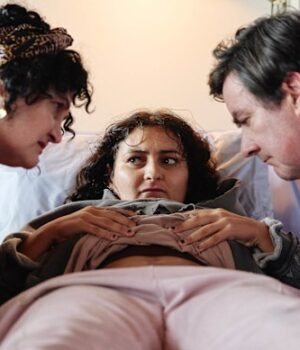
Mum, I’m Alien Pregnant could certainly be considered “risky”. Set in New Zealand suburbia, it follows a directionless Millennial woman who becomes unexpectedly pregnant after a strange encounter with her neighbour, an awkward man with a tentacled alien penis.
This results in an unwanted, otherworldly pregnancy, which she must face while side-stepping dismissive doctors, overbearing mothers and uncontrollable breast-milk-squirting episodes. It’s quirky, grotesque and extremely horny. In other words, it’s a tough sell.
However, beneath the amniotic slime lies a greater message about bodily autonomy, pregnancy and parenthood. “We wanted to make a movie that made people who’ve had babies feel seen, and everyone else feel sick,” Windsor says.
It was largely thanks to this – as well as the lo-fi yet charming practical effects (including an alien penis rig that actor Arlo Green had to be sewn into) – that the New Zealand Film Commission agreed to fund the movie, which then eventually landed at Sundance.
Mārama, meanwhile, is adventurous in different ways. Largely billed as the first gothic Māori horror, it follows a young woman in 1859 who travels to a grand estate in North Yorkshire, England to search for information about her heritage.
Once there, she finds herself haunted by visions and surrounded by stolen Māori artefacts, eventually uncovering the nightmarish colonial legacy staining her past.
“I’ve seen quite a few Maori films. But [of] the female-led films, I haven’t seen any set outside Aotearoa – even though we know that Māori travel. They did since the first ships came to Aotearoa to colonise,” Mārama director Taratoa Stappard says. “All of those stories are untapped as yet.”
Stappard’s film is one of the first to tell this kind of overseas anti-colonial tale, displaying Māori culture through tā moko (facial/body tattoos), whare whakairo (a traditional Māori carved meeting house), and an incredibly evocative on-screen haka.
Its atmospheric, “serious” nature sets it apart from other New Zealand horror, much of which leans on deadpan Kiwi humour and gnarly body horror (examples include Black Sheep and Death Warmed Up).
Like with Mum, I’m Alien Pregnant, Stappard believes the NZ cinema industry, though generally tight on resources, is searching for these points of difference – either off-the-wall stories or untapped tales.
“Horror is having a moment [globally]. Backrooms, Obsession – they’re making huge money from very little investment,” Stappard says.
“Maybe they’re looking for something a little bit specific, interesting and niche. Someone somewhere is fulfilling a desire to fund a new avenue.”
While many Hollywood horrors depend on jump-scares or high-concept dread to pull audiences, the new wave of Aotearoa horror appears less concerned about “box office” and returns.
These are still important factors, Wallace notes, but movies like Mum, I’m Alien Pregnant were made with local audiences in mind. It just so happens that horror more broadly is currently incredibly popular with global audiences.
“We didn’t really set out to make a movie for the rest of the world,” he says. “We just like trying to tell really interesting stories that reflect the world around us.”
Mum, I’m Alien Pregnant will screen as part of MIFF on August 14 and 15, and Mārama will screen between August 21 and 23.
Must-see movies, interviews and all the latest from the world of film delivered to your inbox. Sign up for our Screening Room newsletter.
 Nell Geraets is a Culture reporter at The Age and The Sydney Morning Herald.Connect via X or email.