

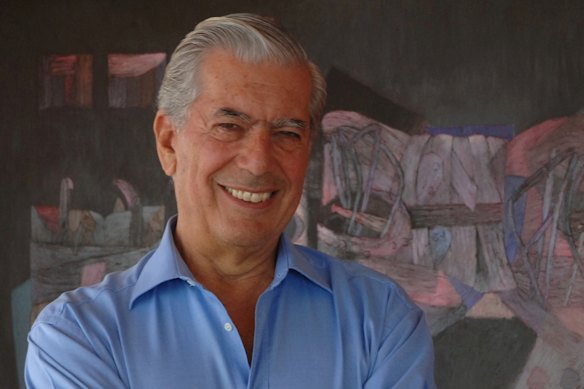
Source : the age
Mario Vargas Llosa was a dazzling writer. The Peruvian Nobel Prize winner who died last year was someone who didn’t just produce masterpieces, he wrote book after book demonstrating an astounding range: Conversation in the Cathedral, Death in the Andes, Aunt Julia and the Scriptwriter. These are all books which show what the novel can do.
He would double conversations from different parts of the same book, he would twist and turn and play with narrative gambits he had learned from Faulkner or Borges. He would feature recurrent characters and explore every fictive possibility, whether the upshot was playful or labyrinthine.
On top of this Vargas Llosa was a man of the world in every sense. He began life as a lefty, ran for the presidency of Peru in 1990 and was defeated (whatever the attractions of his liberal monetarism) by Alberto Fujimori. His uneasy friendship with the great Colombian writer Gabriel Garcia Marquez ended when Vargas Llosa famously punched him in the face.
Vargas Llosa appeared to have no fear of failure: his book about Roger Casement, The Dream of the Celt, simply doesn’t work. Nor did Harsh Times, his second last book.
This final work of fiction – I Give You My Silence – published in Spanish in 2023 belongs with Vargas Llosa’s minor works. This does not, however, mean it lacks all magic. How could it come from his pen without it?
The central figure, Tono Azpilcueta, is a journalist of sorts who has written regularly about music and in particular about a Creole guitarist. A wealthy patron of the arts decides to bankroll the commentator to write a biography of the elusive guitarist. Though Tono only saw him perform once, he becomes central to his sense of his own destiny. Tono discovers that his hero almost died as a child and was left wandering in a malevolent tip swarming with rats and flies and mosquitoes. Later, Tono himself not only almost dies but becomes plagued by a fear of rats which make him claw himself until he bleeds.
Despite this, Tono produces his biography of the Creole master and argues strenuously that only the magic of music of the Creole can allow Peruvian culture to realise its destiny. His publisher discovers to his surprise that the tendentious bio is attracting far more readers than you would think. Tono finds himself appointed to a chair of Peruvian studies from which he can answer every objection that can be taken to his portrait of the great Creole songster, and he is also invited to Chile, where he has become such a cultural hero.
This does not, however, mean it lacks all magic. How could it come from his pen without it?
But things are bound to be a somewhat grim enactment of the Creole guitarist’s ambiguous vaunt which gives this weird book its title: “I give you my silence”. The musician is a confounding figure to Tono, who sees him as the key to a locked door. Meanwhile, he is hopelessly in love with a famous singer who is keen to say they are just good friends though she takes him to a psychiatrist when he has one of his rat attacks.
He is also appalled at the survivals of shamanism in Peru and can think of nothing more horrible than the afflicted individual being touched by that cousin of the deadly rodent the guinea pig. There are meditations on the cruelty of the bullfight and the rapacity of the conquistadors.
In a long, somewhat alienating note, translator Adrian Nathan West discusses a central term in I Give You My Silence: huachafería. He argues against translating the word, given its deep thematic centrality to the novel.
West points out that the term huachafería also appears in Vargas Llosa’s seductive cavalcade of a novel, The Bad Girl, noting that standard dictionaries inadequately translate it as “pretension”. The translator tells us that Vargas Llosa finished I Give You My Silence three years before he died in April 2025 so we shouldn’t be too quick to simply classify it as the product of his dotage.
Like Julian Barnes’ Departures, it is a wry act of saying goodbye. There are a hundred moments of still music and epigrammatic lucidity in a book that is – yes, manifestly flawed – but one that nevertheless demonstrates the touch of a master at every turn.
I Give You My Silence burns with the reality of an untouchably great Vargas Llosa toying with plagues of rats and dead friends who once made beautiful jam. He confronts two deeply contradictory ideas: first, that Spanish – the language of Cervantes – is one of the world’s most spoken tongues; and second, that despite its vast reach, he can only give it an echoing power where the world resembles a rubbish dump, and rampant, fearful disease is its only idiom.
The effect is somewhat deranging, yet it is deeply moving in its own way – as if the great novelist’s remaining power were simply to tell a story whose vital terms are untranslatable.
Even so, West’s translation remains sombre, stately, and idiomatically effortless. My only real cringe came at his use of “thusly”, when surely “thus” would do.
I Give You My Silence by Mario Vargas Llosa is published by Farrar, Straus and Giroux.