

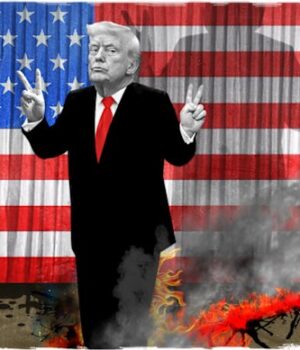
SOURCE :- THE AGE NEWS
September is upon us. Time to anticipate this US political year’s “October surprise”. The October Surprise – a shock that could decide the election – is an active virus.
In 1980, the Ronald Reagan camp let it be known that they expected president Jimmy Carter to save his presidency by making concessions to the Iranians, who had been holding 52 Americans hostages in Tehran for nearly 400 days. But there was no way then-supreme leader Ayatollah Khomeini was going to save Carter – just as Iran’s supreme leader today will not make any concessions before the midterms to give President Donald Trump an urgent political boost. Reagan romped into the White House.
But would Trump still pull an October surprise to end an unpopular war and reduce petrol prices? Republican senators are reported to be hoping that Trump may yet be tempted – declare victory and end the war. This scenario actually played out during another forever way, Vietnam. Two weeks before the 1966 midterm elections, then-senator George Aiken called for president Lyndon Johnson to declare victory in Vietnam and bring home the 500,000 troops fighting that war. Johnson never contemplated such a retreat. Johnson and the country lived with the consequences. His party lost 47 House seats and three Democratic senators. Trump has declared victory 32 times but has not ended the war.
Trump faces the same fate for his presidency. Midterm elections are a referendum on the president and his party. His approval is at a record low. His handling of the economy and the war are decidedly unpopular. Republicans up for election are concerned that Trump is more intent on securing his legacy than fighting for his programs on the campaign trail. As the northern summer ends and early voting begins in key states, Democrats are positioned to win control of the House and Senate in the midterm elections.
In 2000, George W. Bush’s drunk driving records emerged. Bush survived. In 2004, an Osama bin Laden video seemed to favour John Kerry over Bush, who led America through the terror of 9/11. Kerry lost. In 2016, there were two spectacular leaks: audio of Trump bragging about his ability, as a star, to grab with abandon the anatomy of women, followed immediately by the Wikileaks exposure of emails from Hillary Clinton’s campaign. Two weeks after that, then FBI director James Comey announced, just before the midterm election, an investigation into Clinton’s emails involving classified materials on non-government computers. Trump won.
What about October surprises outside the box of US politics? In October 1962, the Cuban missile crisis erupted just before the midterms. John F. Kennedy stared down Soviet Union leader Nikita Khrushchev, who dismantled and removed the nuclear missiles aimed at the US. Democrats had a net loss of only two seats in the House and gained four in the Senate – and kept control of Congress.
October is often volatile on Wall Street. Trump does not want to see a repeat of the crash of October 1929, which triggered the Great Depression. Trump has said, “I’ve studied presidents … And the one president I did not want to be was the late, great Herbert Hoover.” The markets keep setting records even in the face of uncontrolled wars in Ukraine and Iran, and relentless economic pressures from energy prices, interest rates, and affordability issues afflicting economies across the globe. Trump’s trade and tariff wars are now worldwide. The AI sector, led by Nvidia, continues to record astonishing gains. But there is a growing backlash across the US on data centres, unresolved issues with China, and industry financing cycles that are uncertain and perhaps unsustainable. Bill Gates has issued a dire warning that AI could leave us a legacy of frightening turbulence. If the sector stumbles, will Wall Street tumble? If there is a crash, Trump will share Hoover’s fate.
Will the Ukraine war explode across Europe? It is now nearing its fifth year with no end in sight, and both sides inflicting horrific damage on each other, with Russia’s bombing intensifying and Ukraine’s drones striking deeper into Russia. Last week, CIA director John Ratcliffe flew to Russia. He did not meet with Vladimir Putin but delivered a message that the Russian leader should not, and must not, attack a NATO country. Joe Biden’s CIA director, Bill Burns, similarly travelled to Moscow in October 2021 to warn Putin not to invade Ukraine. That failed. Nothing has dissuaded Putin from his objective of absorbing Ukraine into Russia. But what if Putin ups the ante and uses force against a NATO country or even detonates a small tactical nuclear weapon in Ukraine, all intended to deliver an unmistakable message: give me Ukraine now, or else! Who wins that confrontation?
Trump, who promised to end the war in Ukraine in his first 24 hours in office, would wear that October surprise too.
There may well be surprises on the upside for Trump. He will meet again with Chinese President Xi Jinping in Washington on September 24. If Trump and Xi can step back from trade wars and work to end the Iran war and promote stability in Asia, the mood in America and the world will improve. On the campaign trail, if Republicans can pin the label of radical extremism – and worse – on Democrats, they will have a stronger chance of holding on to the Senate by winning races in Michigan, Maine, Texas and Ohio.
Anything is possible this October.
Bruce Wolpe is a senior fellow at the University of Sydney’s United States Studies Centre. He has served on the Democratic staff in the US Congress and as chief of staff to former prime minister Julia Gillard.
The Opinion newsletter is a weekly wrap of views that will challenge, champion and inform. Sign up here.
 Bruce Wolpe is a senior fellow at the University of Sydney’s United States Studies Centre. He has served on the Democratic staff in the US Congress and as chief of staff to former prime minister Julia Gillard.

