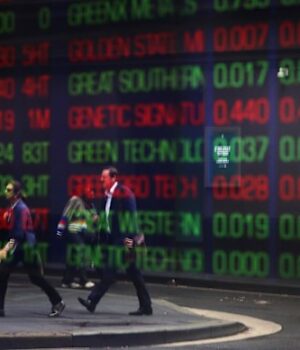
Source : the age
Australia’s sharemarket has started the week on the back foot as investor concerns about the economic outlook weigh on banks and consumer discretionary stocks.
The S&P/ASX200 fell 42 points on Monday, down 0.46 per cent to 9073.2, as the broader All Ordinaries lost 34.2 points, or 0.37 per cent, to 9279.
Energy and raw materials were the only sectors to end the session convincingly higher as commodity prices advanced, while banks and consumer cyclical stocks dragged the exchange lower.
In a worrying sign for the retail sector, consumer discretionary stocks fell 3 per cent after shares in segment bellwether JB Hi-Fi plunged more than 12 per cent.
The sell-off came despite a decent annual profit result and record group sales of $11.1 billion, as trading at its Australian flagship stores and The Good Guys dipped.
With cost pressures, high interest rates and an uncertain outlook continuing to weigh on household spending, investors have set a high bar for local retailers.
The macroeconomic gloom continued to weigh on the heavyweight financials sector, which has tumbled more than six per cent after spiking at an all-time high barely 10 days ago.
NAB led the big four banks lower with a 4.6 per cent slump to $39.46 a share, after its third-quarter $1.8 billion cash profit was delivered alongside grim housing market forecasts.
Non-energy miners outperformed the market, up 1.8 per cent as BHP advanced ahead of its full-year results on Tuesday, helped by an upswing in the copper price.
Gold miners were particularly strong as the precious metal edged higher to $US4395 ($A6177) an ounce, and battery minerals producers traded higher as lithium continued to rebound.
Energy stocks gained 0.9 per cent, with strong leads from coal miners and uranium producers as refinery operators edged lower and Brent crude consolidated near $US82 a barrel.
In other earnings news, Lendlease shares dived by more than 11 per cent after the real estate group swung to its fourth annual loss in five years as write-downs from its messy global retreat continued to hit its bottom line.
Rail freight operator Aurizon fell a similar amount despite lifting its full-year profit by 24 per cent to $463 million.
Looking ahead, BHP, CSL and Cochlear will report on Tuesday, followed by Santos, Evolution, Temple & Webster, Whitehaven Coal and Mirvac on Wednesday, with July employment figures on Thursday.
The Australian dollar was trading at its highest price in 11 weeks on Monday afternoon, buying US71.22¢, up from US70.68¢ on Friday at 5pm AEST.
On Friday on Wall Street, the S&P 500 slipped 0.2 per cent from its record set the day before. The Dow Jones Industrial Average dipped 107 points, or 0.2 per cent, and the Nasdaq composite sank 0.3 per cent.
Also raising uncertainty was a report showing that shoppers spent less at US retailers last month than the month before. That surprised economists, who were forecasting another month of growth.
On the bright side for financial markets, such a pullback in spending could take pressure off inflation. Inflation remains much higher than anyone would like, but reports earlier this week suggested the pace of price increases is decelerating.
If inflation keeps trending that way, it could encourage the Federal Reserve to hold off on raising interest rates. Higher rates would help keep a lid on inflation, but they do so by intentionally slowing the economy and making it more expensive for everyone to borrow money.
The downside of such data, including last week’s surprisingly weak report on the US jobs market, is that they raise the risk of a slowing economy. The Fed has no good tool to fix both a stagnating economy and high inflation at the same time, which is why what’s called “stagflation” is seen as a worst-case scenario.
Some on Wall Street cautioned against overreacting to the weak data on US retail sales, even if it was broad-based. It could simply be a snap back after retail sales in earlier months were boosted by unusual factors such as big tax refunds, the World Cup and even an earlier Prime Day event at Amazon, said Jennifer Timmerman, senior investment strategy analyst at Wells Fargo Investment Institute.
AAP with AP, Bloomberg
The Market Recap newsletter is a wrap of the day’s trading. Get it each weekday afternoon.