

Source : THE AGE NEWS
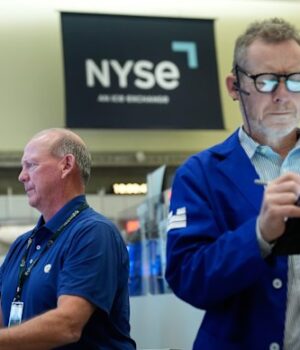
Pressure from the US bond market hit a new level on Wall Street after a surprisingly strong report on the economy raised worries about inflation, while oil prices halted their slide. The squeeze caused US stocks to sink.
The S&P 500 slid 0.7 per cent after finishing the prior day just 0.4 per cent below its record set last month. The Dow Jones was down 299 points, or 0.6 per cent, in mid-afternoon trade, while the Nasdaq composite was down 1.1 per cent from its own all-time high.
The Australian sharemarket is set to fall, with futures at 4.57am AEST pointing to a loss of 97 points, or 1.1 per cent, at the open. The ASX closed flat on Wednesday.
Stocks felt pressure after the yield on the 10-year Treasury jumped to 5.12 per cent from 4.96 per cent late Tuesday, which is a considerable move for the bond market. High yields undercut prices for stocks and other investments, while also slowing the economy by making it more expensive for everyone to borrow money.
Wednesday’s jump sent the 10-year yield back to where it was in 2007, before the global financial crisis caused yields to crater. Yields have been climbing steadily since bottoming out in the COVID pandemic, and they’ve accelerated recently because of worries about high inflation, the US government’s big debt and other concerns.
Worries about inflation got a jolt Wednesday morning after a preliminary report suggested growth in US business activity surged to its strongest level in more than five years. That’s an encouraging signal, to be sure, but it also indicates the economy may have plenty of fuel for more inflation.
The report also suggested costs for businesses are leaping at the fastest rate in four years, in part because of more expensive oil, according to Chris Williamson, chief business economist at S&P Global Market Intelligence. That could mean businesses will pass those higher costs onto their customers in coming months.
Fuel prices are high because oil is expensive due to worries that the war with Iran will keep oil bottled up in the Middle East for a long time.
The price for a barrel of Brent oil to be delivered in November rose 3.5 per cent to $US102.78 after climbing as high as $US103.12 earlier on Wednesday. That reversed a decline for Brent, which had been falling since it neared $US110 last week. Talks are continuing with mediators between US and Iranian officials, but nothing concrete has come from it yet.
Brent oil to be delivered in December, where most of the trading in the market has moved, rose 2.8 per cent to $US98.10 per barrel.
Even with its recent decline, the price for a barrel of Brent remains much higher than the roughly $US72 it cost before the war with Iran began.
Inflation has remained so high across the economy that the Federal Reserve raised its short-term interest rate last week for the first time in three years in hopes of slowing down increases for the cost of living.
Fed Gov. Michael Barr said in a speech on Wednesday that “further policy adjustments are likely to be needed to ensure inflation comes down to target in a timely fashion.” Traders now see better than a 50 per cent probability that the Fed will hike its federal funds rate at each of its next two meetings, in October and December, according to data from CME Group.
So far, strong growth in profits for US companies has helped support the US stock market despite higher interest rates and more expensive oil.
KB Home became the latest to deliver a stronger profit report for the latest quarter than analysts expected. But its stock nevertheless swung between losses and gains after the homebuilder’s executive chairman said conditions got even tougher for the industry over the last three months. It was most recently down 1.8 per cent.
Potential customers are becoming more cautious because of higher mortgage rates caused by the rise in the 10-year Treasury yield. They also are feeling pressure from “geopolitical uncertainty and broader economic headwinds,” Jeffrey Mezger said.
General Mills likewise reported a stronger profit for the latest quarter than analysts expected. But the company behind the Cheerios and Progresso brands said it also expects growth this fiscal year to fall below its historical track record “driven by a continued challenging consumer backdrop,” and it did not raise its forecast for profit over the full fiscal year.
Its stock flipped between gains and losses before rising 0.5 per cent.
In stock markets abroad, indexes slipped across much of Europe and Asia.
Stock indexes fell 1 per cent in Hong Kong and 0.4 per cent in Shanghai ahead of Chinese President Xi Jinping’s state visit to Washington, which is kicking off Wednesday, and his meeting this week with President Donald Trump.
The leaders are expected to attempt to steady fragile ties in their third meeting since Trump returned to the White House. That is despite the world’s two largest economies seeking the upper hand on artificial-intelligence developments and trade, while pushing for leverage in persistent hot spots like Iran and Taiwan.
AP
The Market Recap newsletter is a wrap of the day’s trading. Get it each weekday afternoon.


