Source : THE AGE NEWS
Global investors are balking at US bonds. Talk of the US dollar’s dwindling power is getting louder. Foreign governments are hauling their gold out of American vaults.
Almost two years into President Donald Trump’s second term, the world economy is increasingly looking for ways to distance itself from the United States. Concerns about a $US40 trillion ($56 trillion) debt burden, the excessive use of sanctions to solve foreign policy problems and Trump’s penchant for pushing the limits of the rule of law are raising questions about the appeal of the world’s largest economy as a haven for global investment.
Despite pledges by foreign companies and nations to invest in the United States — in many cases to curry favour with the White House — capital is starting to seek alternative destinations.
“Geopolitical factors and US weaponisation of the dollar through financial sanctions are causing central banks and other official investors to attempt to diversify away from dollar assets,” said Eswar Prasad, the former head of the International Monetary Fund’s China division.
The United States is not yet an investment pariah. Private investors are still pouring money into American financial markets and stocks, artificial intelligence infrastructure is booming and no rival currency is poised to topple the US dollar imminently.
In testimony before Congress last week, Treasury Secretary Scott Bessent said he remained confident in the credibility of the country’s financial system, arguing that bond auctions continue to operate successfully and that the dollar is still thriving as measured by its share of global transactions.
‘It’s like the countries don’t trust the US. I do think that there is a fear factor.’
Daniel Tannebaum, former Treasury Department and Federal Reserve Bank of New York official
“The US is, in fact, the leader, and the leader does not fear competition,” Bessent said. “Competition makes us better.”
But cracks in America’s economic dominance are starting to show.
The most glaring example is the bond market. Yields have been soaring as investors, nervous about the mounting national debt demand a higher rate of return for buying Treasury bonds. Earlier this month, the yield on the 10-year Treasury topped 5 per cent, reaching its highest level since 2007.
The ominous bond threshold was crossed a week after the US Treasury Department purchased $US5.2 billion of its own debt maturing in the next 10 to 20 years, part of a plan to inject demand into the Treasury market to try to push prices higher and yields lower. Bessent said investors were failing to understand the underlying strength of the economy and dared them to bet against him.
“It’s my dream,” Bessent said at Southern Methodist University. “I have asymmetric information. I am the house now.”
The Federal Reserve’s decision last week to raise rates has somewhat calmed concerns about the central bank’s grip on elevated inflation, fears that injected jitters into bond markets.
Yet with the United States’ long-term fiscal situation looking shaky, some countries are starting to wonder if America is a wise investment. Norway’s sovereign wealth fund, the largest in the world, has said it plans to reduce its holdings of US Treasurys as it looks elsewhere for stronger returns.
And then there is the future of the greenback.
Nearly 90 per cent of global foreign exchange transactions are in US dollars. But the share of dollars being held in central bank reserves has been steadily declining over the past decade, falling to 56 per cent at the end of 2025 from 64 per cent in 2015.
Last year, Christine Lagarde, the president of the European Central Bank, said erratic policymaking in the United States was setting the stage for a “global euro moment.”
The United States has taken advantage of the greenback’s special status to use it as a foreign policy tool, imposing stiff sanctions on adversaries such as Iran and Russia. As the United States ramps up its use of sanctions to resolve global conflicts, the permanence of the US dollar as the world’s reserve currency has come into question with greater frequency.
This year, the United States tried to start scaling back its sanctions program amid worries that an overuse of financial warfare was leading other countries to seek alternatives to the dollar. The dollar is used in most cross-border financial transactions, so sanctions can essentially cut off a country’s ability to interact with the Western financial system. Frustrated with how the US uses its economic might, more countries are seeking alternative financial systems that America cannot touch.
However, Bessent reversed course in August when he announced Operation Economic Outcast. The initiative aims to strangle Iran’s economy and threatens secondary sanctions on any country that maintains economic ties to Iran. Even the treasury secretary acknowledged that if the United States is forced to make good on that threat, it could “blow up the global financial system.”
Although the euro and China’s renminbi do not appear ready to overtake the dollar anytime soon, the emergence of central bank digital currencies, stablecoins and cryptocurrencies gives US adversaries new avenues to circumvent the American financial system when making international transactions.
China has been leading the development of a cross-border digital currency platform with Hong Kong, Thailand, the United Arab Emirates and Saudi Arabia that would allow money to move more quickly and with lower fees than what is possible with traditional banking transactions. A similar cross-border payments project led by some Group of 7 major industrialised nations and Western financial institutions is also in development but is not as far along as China’s initiative, which is known as mBridge.
Russia and India said this month they are working on a plan that would let them use central bank digital currencies to settle international trade payments. Such a mechanism would allow the countries to expand their trade relationship and reduce reliance on Western financial institutions that can be targeted by US sanctions.
“The story of moving away from the dollar is one of the oldest stories that exists,” said Josh Lipsky, the chair of international economics at the Atlantic Council. “Countries have thought about working around the dollar, and technology is making it a little cheaper and easier to do it than before.”
While some countries are focused on digital money, others are going for gold as they fret about the stability of the United States.
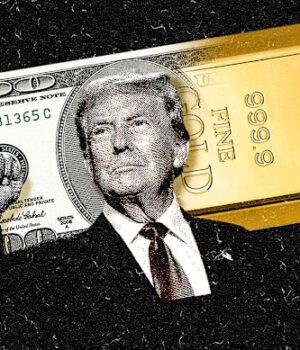
In 2025, world international reserves held in gold surpassed foreign official holdings of US Treasury securities. This year, the price of gold exceeded $US5000 per troy ounce for the first time in history as central banks stocked up on the metal amid intensifying global conflicts and concerns over inflation.
Demand for gold is so high that some countries also want to keep theirs closer to home. With geopolitical unrest rising and Trump lobbing tariff threats against European allies, some have even taken the rare step of relocating the gold they keep in vaults at the Federal Reserve Bank of New York.
This month, the central bank of the Netherlands said it transferred a large part of its 95 tonnes of North American gold reserves out of the US, citing “increasing geopolitical unrest” and the need to be prepared for crisis. In March, the Bank of France said it pulled 129 tonnes of gold from the Federal Reserve Bank of New York and moved it to Paris.
The Trump administration has not threatened to seize foreign gold held in the United States, but Trump has raised questions about his views of international law by floating the idea of colonising places like Greenland and Canada.
“It’s like the countries don’t trust the US,” said Daniel Tannebaum, who served at the Treasury Department’s Office of Foreign Assets Control and as the OFAC compliance coordinator at the Federal Reserve Bank of New York. “I do think that there is a fear factor.”
That fear factor is also creating blowback for American companies that are trying to do business abroad.
Tannebaum, who is a partner in global management consulting firm Oliver Wyman’s finance and risk practice, said the aggressive use of tariffs and export controls by the United States has made European countries and companies wary of adopting American technology for sensitive industries such as AI. They worry that if they are dependent on the US for such infrastructure, it could be used against them if Washington decides to ban or disable the technology, as it has done during disputes with China and Russia.
All of this has contributed to an erosion of the United States’ status as a safe haven.
“Governments and companies now have to ask what would happen if the United States turned its economic leverage against them,” Tannebaum said.
This article originally appeared in The New York Times.
The Market Recap newsletter is a wrap of the day’s trading. Get it each weekday afternoon.