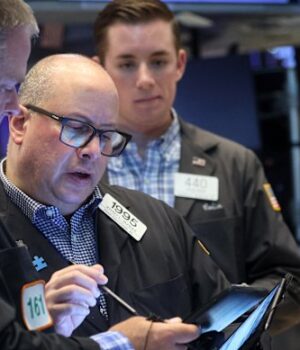
Source : the age
Australia’s share market has posted its worst week since April as investors take money off the table amid softer commodity prices and earnings uncertainty.
The S&P/ASX200 fell 73.3 points on Friday, down 0.8 per cent to 9115.2, as the broader All Ordinaries lost 68.2 points, or 0.73 per cent, to 9313.2. The ASX lost 0.2 per cent on Thursday.
The top-200 was down 1.6 per cent for the week, led by a sharp dip in financials stocks.
Housing market worries impacted bank stocks, while retreats in copper and gold prices weighed on miners.
Earnings season has delivered a mixed bag of beats and misses and with valuations near all-time highs, investors have set high bars to warrant further buying at these prices.
“The ASX has been caught between a strong run to fresh record highs last week and a more complicated reality check as the numbers started landing,” Vantage senior market analyst Hebe Chen said.
“The RBA kept another rate hike on the table, while results from the major banks exposed softer mortgage demand and an increasingly unforgiving market for forward guidance, giving investors more reasons to take some chips off the table.”
A more than three per cent slump in BHP to $61.35 loomed large over the exchange, as copper prices ground lower for a fourth straight session.
BHP will hand down its full-year results on Tuesday, along with CSL, Cochlear and Pro Medicus.
The energy sector dipped on Friday but gained 2.8 per cent for the week on the back of strong oil prices, as hopes for a deal to reopen the Strait of Hormuz evaporated.
Officials have claimed the US could maintain its naval blockade of Iran indefinitely, signalling a pivot from military pressure to economic isolation.
Utilities, health care and IT stocks were the only other segments to improve over the week, as each benefited from dip-buying, defensive inflows and company-level earnings beats.
Consumer-facing stocks came under pressure as macroeconomic worries weighed on spending expectations, but both staples and cyclicals have held on to most of their gains since May.
JB Hi-Fi, Temple & Webster, Breville, Super Retail and Zip Co will share their financial scorecards next week, offering more clues about how consumer confidence is tracking.
Looking to the broader economy, other names reporting include BlueScope Steel, GPT Group, Lendlease, Goodman Group, Santos, Charter Hall, Northern Star, Whitehaven Coal, Vicinity Centres, Dexus, Inghams and Telix Pharmaceuticals.
Investors will also be watching Wednesday’s wage price index data and Thursday’s employment figures.
The Australian dollar is buying 70.68 US cents, up from 70.45 US cents, as a softening US interest rate outlook keeps the greenback in check against most major currencies.
Overnight in the US, the S&P 500 climbed 0.7 per cent and topped its prior record set last week. The Dow Jones Industrial Average added 69 points, or 0.1 per cent, and the Nasdaq composite gained 0.8 per cent.
Wall Street relaxed after a report showed prices at the US wholesale level were 4.7 per cent higher last month than a year earlier. While that’s more painful than anyone would like, it’s not as bad as June’s 5.5 per cent inflation rate at the wholesale level, and it was slightly better than economists expected.
Back-to-back benign inflation prints, following last week’s softer-than-expected jobs report and a pullback in oil prices, are easing pressure on the Fed to tighten policy at its meeting next month. While the lack of a deal in the Middle East remains a concern, equity traders are also focusing on a revival in the artificial intelligence trade after a selloff in semiconductor stocks in July.
“The next round of data that we get in September and the lead up to the meeting will be pretty critical,” said BofA Securities economist Stephen Juneau. At the same time, “the market obviously has started to really discount hikes more and more given that the data in recent months has been more dovish.”
Fed officials are split on whether they should have already begun hiking interest rates. But Thursday’s report, following a similar update on inflation at the US consumer level the day before, has traders now betting on just a 35 per cent chance that the Fed will raise the federal funds rate at its next meeting in September. That’s down from the roughly 50 per cent probability seen two days ago, according to data from CME Group.
Any increase by the Fed would be the first in more than three years. It also could anger President Donald Trump, who has been lobbying for lower interest rates.
Treasury yields sank in the bond market, which eases pressure on stocks and other investments. The yield on the 10-year Treasury fell to 4.65 per cent from 4.68 per cent late Wednesday and from 4.72 per cent on Monday, though it’s still well above its 3.97 per cent level from before the war with Iran sent oil and gasoline prices surging.
With AAP, AP, Bloomberg
The Market Recap newsletter is a wrap of the day’s trading. Get it each weekday afternoon.