Source : Perth Now news
Facebook spammers are rewriting history, posting mock photos of Australian Holocaust survivors to drive clicks and make money.
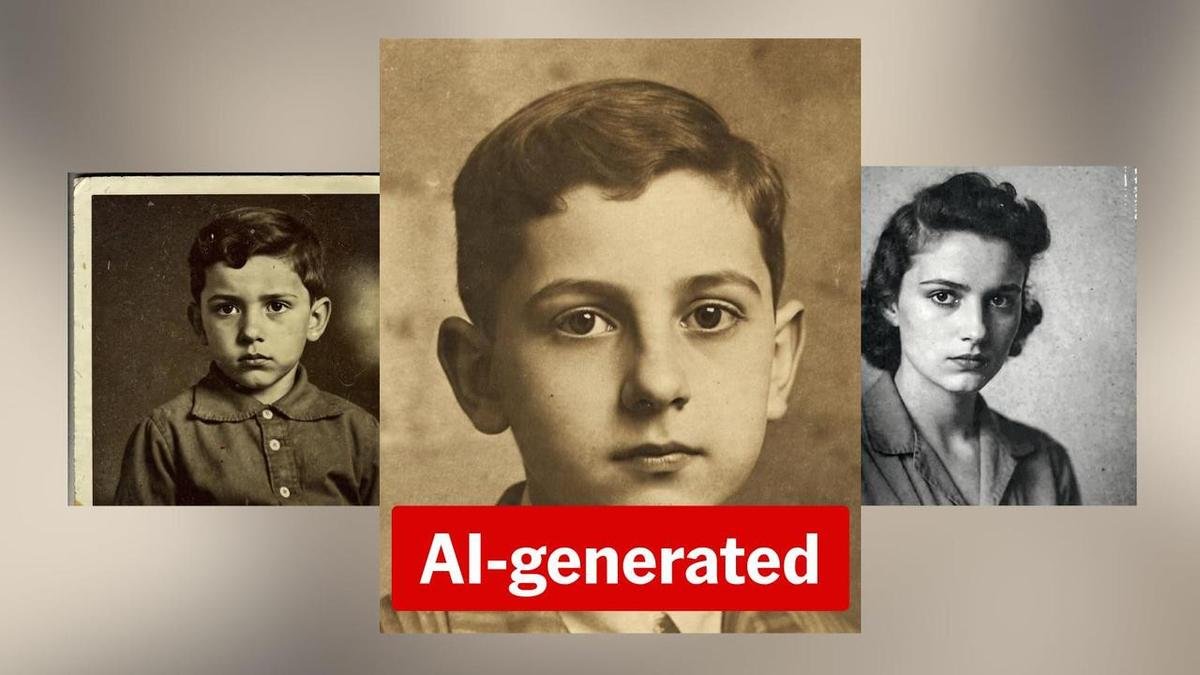
The images purport to be authentic photographs of people sent to concentration camps but are actually fakes created using artificial intelligence.
One of the Australian survivors whose story is being used to perpetrate the scam, Peter Kraus, says those responsible are simply trying to ”cash in” on the memory of the Holocaust.
Dr Kraus narrowly avoided being sent to Auschwitz as a child and was instead deported with his family to a Nazi labour camp in Austria.
After escaping confinement with his mother, he emigrated to Australia in 1948 and wrote about his family’s ordeal in the 2020 memoir Slow Train to Auschwitz.
One post claims the 84-year-old was born in Czechoslovakia in 1936.
When the Nazis marched on the Sudetenland two years later, on their way to full invasion in 1939, it asserts he ”was deported to Theresienstadt, then to Auschwitz”.
The post also includes a vintage-looking head-shot purporting to show Dr Kraus as an eight-year-old.
However the retired obstetrician, who now lives in Queensland, says the narrative contains multiple factual errors and the person depicted in the image bears little resemblance to how he looked as a child.
”The photograph is not of me,” he told an AAP FactCheck investigation.
”I was not born in 1936 … I wasn’t born in Czechoslovakia … I did not go to Auschwitz.
”It all sounds like a legitimate story but it isn’t; it is made up but not totally.”
Meta’s AI verification tool confirms the image professing to show him as a child was created using AI.
AAP FactCheck found dozens of posts retelling the stories of Australian Holocaust survivors using AI-generated photos.
Meta’s page transparency feature reveals the fake posts are being shared by a network of spam Facebook accounts operated out of Pakistan.
The accounts collectively pump out hundreds of fake Holocaust photos every week, including AI-generated images claiming to show real children who perished in Nazi death camps.
Some of the fake photos are labelled by Meta as ”AI content”, though many are not.
Another Australian whose story has been hijacked is Olga Horak OAM, a Slovak-born Australian who died in 2024.
Ms Horak survived five concentration camps as a young woman before moving to Australia in 1949 and settling in Sydney.
She later gained recognition as a talented artist and was awarded the Medal of the Order of Australia in 2014.
Facebook posts about Ms Horak’s experience include a black-and-white head-shot supposedly showing her aged 18.
However her grandson, human rights lawyer Anthony Levin, says the images are fake and appear to be AI-generated.
”Mr Levin says the posts retelling his grandmothers story also contain factual inaccuracies and risk undermining public trust in genuine accounts of the Holocaust.
”They impugn the value of other Holocaust material,” he says.
”The person doesn’t care about Holocaust education. It’s a commercial enterprise.”
Eddie Jaku OAM, an Auschwitz survivor who published a bestselling memoir in 2020 and died the following year aged 101, has also been targeted.
AI-generated images claim to show him as a teenager but his son confirms the photos are fake.
”They look nothing like Dad,” Michael Jaku says.
Tim Graham, an associate professor at Queensland University of Technology whose research focuses on social media misinformation, says the AI-generated Holocaust posts appear to be seeking ”sympathy clicks”, particularly from older Australians.
”The evidence overwhelmingly points to commercial motivation,” Dr Graham says.
He says Facebook’s content monetisation program pays creators based on metrics such as views and engagement.
As creators likely earn only a small amount from each interaction, spam accounts are viable ”only at volume”, he explains.
Dr Kraus says he won’t ”lose any sleep” over the fake photographs of him on social media but he doesn’t like the idea that ”someone is trying to cash in on something like this”.
”If you’re going to tell stories, tell true stories,” he says.
“There are plenty of true stories out there.”
The Auschwitz-Birkenau State Museum in southern Poland has also recently spoken out against AI-generated depictions of the Holocaust.
The complex, on the outskirts of the town of Oswiecim, has long used its own social media accounts to publish authentic victim photos, names and information to raise awareness.
It warns that fabricated content can undermine public understanding of history, disrespect the memory of victims, and contribute to the erosion of historical truth.
”The kind of AI-generated content we’re talking about is nothing new,” says AAP FactCheck editor Ben James.
“We are seeing it more and more as a way for people to ultimately make money and it seems nothing is off limits for those looking to exploit the technology.
”But hijacking the stories of Holocaust survivors to do so feels like a new low.”
Lifeline 13 11 14
beyondblue 1300 22 4636