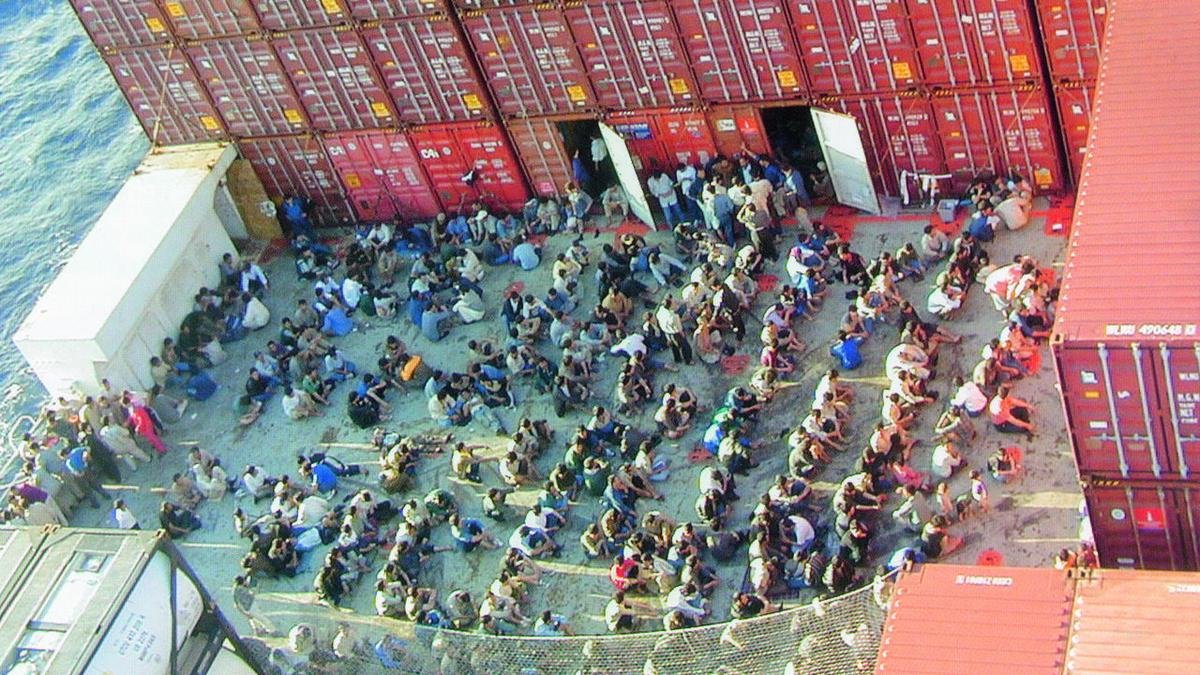
Source : Perth Now news
When a defiant Norwegian supertanker entered Australian waters in 2001 with hundreds of rescued asylum seekers aboard, political hell broke loose.
Lagging in the polls and with an election looming, the Howard government unsuccessfully attempted to repel the 66,000 tonne freighter, sparking a diplomatic crisis.
Amid growing international backlash, urgency demanded a circuit-breaker.
Within days, the government controversially rushed through a suite of brutally tough albeit publicly popular border-protection policies.
The frantic response and momentous upheaval that followed, now known as the Tampa affair, triggered a dark legacy still felt 25 years on.
The imbroglio began on August 26, with Australian authorities calling on MV Tampa captain Arne Rinnan to launch a rescue mission en route from Fremantle to Singapore.
Palapa 1, an overloaded Indonesian fishing boat carrying 433 asylum seekers, was in deep trouble near Christmas Island due to engine failure.
“The crew of the Tampa did an amazing feat of heroics,” according to Peter Mares, journalist and author of Borderline: Australia’s Treatment of Refugees and Asylum Seekers in the Wake of the Tampa.
“They rescued those people from a massively overcrowded wooden fishing boat that was breaking up in large swells.”
The government then refused Capt Rinnan permission to land the mostly Afghan Hazaras, who were fleeing the Taliban, instructing him to head for Indonesia.
Some of the asylum seekers needed urgent medical attention, while others threatened to riot or jump overboard.
They hadn’t risked all to get to Australia only to be turned back.
“That wasn’t a threat of violence against the crew but a threat of ‘chaos is going to be unleashed if people realise you’re taking us back to Indonesia’,” Mr Mares says.
The ship was also without enough life jackets and rations.
“It was an emergency; you had pregnant women, children, people with cuts and injuries on deck in the heat of the sun,” Mr Mares says.
“The captain decided, for the safety of all aboard, to go to Christmas Island but was told he would be charged with people smuggling as he did so.”
Capt Rinnan anchored just outside Australia’s 12-nautical mile buffer around the island, sparking a three-day stand-off.
“His view was the Tampa had … a legal right to disembark the rescued asylum seekers,” says Australian National University international law expert Donald Rothwell.
“A vessel in distress, historically and traditionally, is given a free right of entry into a port … and that eventually morphed into a diplomatic dispute between Australia and Norway.”
As the eyes of the world fell on Australia’s hardline stance, criticism mounted.
Without permission, Capt Rinnan sailed into Australian waters on August 29.
As a result, 45 elite Special Air Service troops boarded the Tampa and seized control.
“This is a very difficult – in fact for Australia, an unprecedented – situation,” then-prime minister John Howard told parliament.
“Nobody is lacking in compassion with genuine refugees … (but we have) become increasingly concerned about the incursions.
“Every nation has the right to effectively control its borders and to decide who comes here and under what circumstances.”
The government denied the need for medical evacuations and said Capt Rinnan had refused to turn back.
Later that day, Mr Howard tabled the Border Protection Bill 2001, seeking powers to remove any foreign ship in Australian territorial waters.
It was backdated to cover the Tampa dispute and block judicial review of any military action.
The Opposition-dominated Senate rejected the breadth of the proposed powers, saying they failed to resolve the issues involved.
Behind the scenes, diplomatic wheels were turning.
The United Nations asked Australia to allow the asylum seekers to land.
Norway and New Zealand agreed to take some but with the public wanting tough action, Canberra declined.
By September 2, alternative arrangements were hastily secured.
“The government was really scrambling to work out what to do,” Mr Mares says.
“It tried a lot of Pacific countries before it finally convinced Nauru to take people.”
The asylum seekers were offloaded onto a landing ship, HMAS Manoora.
“The captain of the Tampa ultimately won the day,” Professor Rothwell says.
New Zealand eventually took 131 people and the remaining 302 stayed on Nauru, with some waiting years for their asylum claims to be processed.
A few dozen were eventually settled in Australia and some returned to Afghanistan.
“They were dramatic days, with court action and huge public debates and arguments about whether Howard was doing the right thing,” Mr Mares says.
“It often looks like a political masterstroke in retrospect … but at the time, was a seat-of-the-pants exercise and for quite a while looked like it wouldn’t succeed.”
Incredibly, the crisis was soon overshadowed.
On September 11, the Twin Towers were felled in New York, claiming 2977 lives -11 of them Australian – and reshaping global security and foreign policy.
In the aftermath, Australia legislated the Pacific Solution.
The framework excised multiple offshore territories, including Christmas Island, from Australia’s migration zone.
It removed them as asylum application locations and paved the way for institutionalised offshore processing.
Labor opposed neither these changes nor a military-led border protection operation instigated soon after to stop boat arrivals.
Operation Relex was the forerunner to the more extensive and secretive Operation Sovereign Borders in 2013, which pushed asylum seekers back to departure points or sent them offshore.
In October, the children overboard scandal erupted amid false government claims asylum seekers had thrown children into the sea.
It was quickly followed by the tragic sinking of an overloaded Indonesian fishing boat, SIEV X, in which 352 mainly women and children drowned.
The Howard government had been on the nose with voters for most of 2001, largely due to a slump in the dollar and falling business confidence.
But with terrorism now on voters’ minds, border protection, unauthorised migration and national security threats dominated the federal “khaki election” campaign, which kicked off in early October.
Support grew. Mr Howard was increasingly viewed as a strong leader for tumultuous times, and the Liberal-National coalition was returned to power with an increased majority on November 10.
By the end of 2001, Australia’s language and mainstream views on “boat people” and unauthorised migration had morphed.
Tampa had reshaped the political landscape as the nation adopted the hardline national security approach that persists today.
“We lost a bit of our humanity at that point,” says Refugee Council of Australia policy expert Graham Thom.
“They were vulnerable people seeking protection in Australia and the government demonised them, used them as a political football.”
Instead of fulfilling international legal obligations to protect refugees, the government rushed processing deals through with Nauru and PNG.
“It’s been costing the taxpayers billions ever since,” Dr Thom says.
Almost $14 billion has been spent on detention and offshore processing since 2012, with another $605 million currently allocated.
The United States pioneered offshore processing in the 1980s, with at-sea screening and claim processing in response to an influx of Caribbean migrants.
But it’s the more recent Australian model that has become a blueprint for deterring asylum seekers in the United Kingdom Denmark and Italy. Few nations, though, have implemented it.
“Australians need to understand that all of that goes back to the Tampa,” Prof Rothwell says.