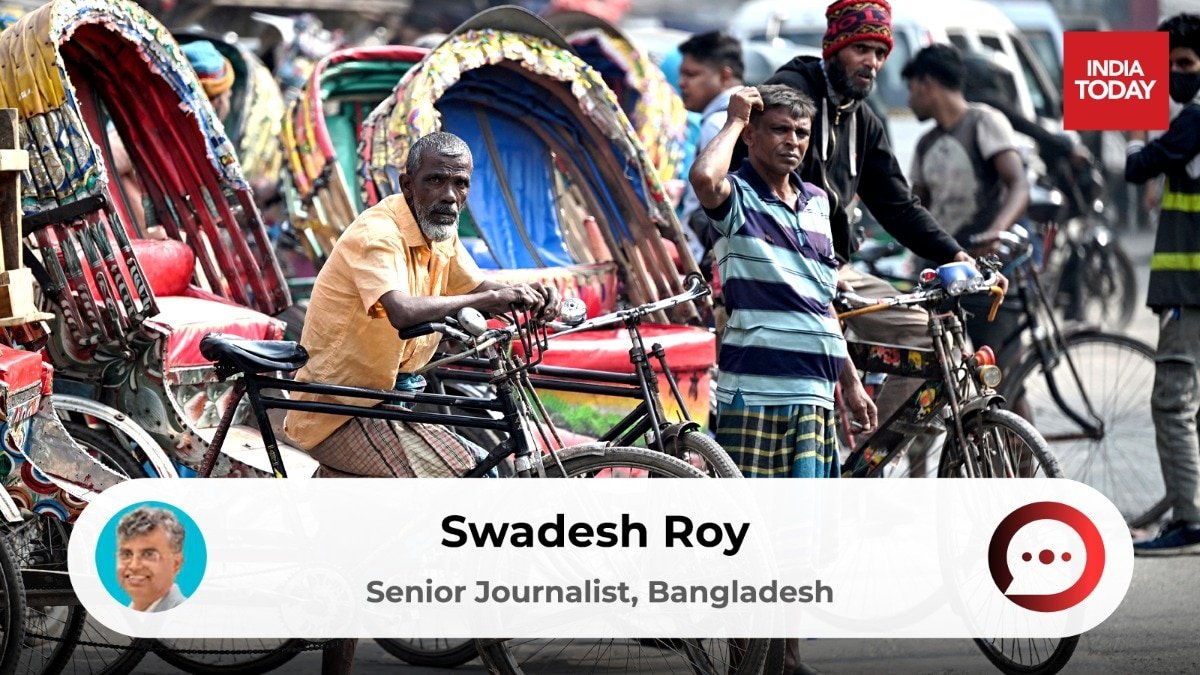
Source : INDIA TODAY NEWS
New Eskaton Road is one of Dhaka’s middle-class residential neighbourhoods. Many people take this road in the morning to walk in Ramna, one of the city’s large parks. On their way back, many can be seen carrying vegetables. They all buy their vegetables from vendors selling from cycle vans. People from the surrounding lanes also come to buy vegetables from these vendors. This is because Karwan Bazar, Dhaka’s large wholesale vegetable market, is only half a kilometre away. The vegetable vendors here can therefore quickly bring in fresh produce from the wholesale market. With lower transport costs, they can sell at comparatively lower prices.
advertisement
The quantity of vegetables now seen on these vans is half what it was in June 2024. When I asked a vegetable vendor over sixty why he was carrying fewer vegetables, he replied that vegetable prices had risen, but his capital had not. Where he might once have brought four kilograms of pointed gourd, he now brings two. Besides, some of his capital has also been depleted.
When I asked why his capital had been depleted, he looked at me in astonishment and said, with some irritation, “Don’t you live in this country? Don’t you understand why I have less money left to run my business?” In response to his sharp reply, I said very politely, “Look, vegetable prices have gone up, and you’re selling at higher prices. You’re still making the same profit. Why, then, would you have less money left in the business?”
Growing more irritated, he said, “Brother, do I do nothing all day but sell vegetables? Don’t I have a household to run? Leave meat aside; I still have to buy fish or eggs once a week. Even if I do without lentils, I still have to buy rice and flour, soybean oil or palm oil. I have to cook with cylinder gas. Have you seen what’s happened to the prices of all these things?”
By then, he was quite annoyed. Even so, I asked him, “But with prices going up, are you making more profit or less?” Irritated though he was by my persistence, he answered, “Look, when good leafy greens or vegetables are cheap, people buy one and a half kilograms instead of one. They eat a little more. When prices go up, some buy 500 grams instead of a kilogram, others 400 grams. Do you make more profit when you sell more, or when you sell less?”
I did not trouble him any further. On the afternoon before our early-morning conversation, the government had raised the price of a 12-kilogram LPG cylinder from Tk 1,585 to Tk 1,837. Just a day before that, most of Bangladesh‘s media had reported that although the government-set price of a 12-kilogram LPG cylinder was Tk 1,585, it was selling in the market for Tk 2,450 to Tk 2,500. Those were prices in the capital. On making enquiries in rural areas, I learnt that another Tk 50 to Tk 60 was being added to the Tk 2,500 there. With the official price now at Tk 1,837, its market price in Dhaka will undoubtedly exceed Tk 3,000. In the villages, that additional Tk 50 to Tk 60 will be added. The reason for this higher price in rural areas is that rising diesel prices have increased transport costs. The situation is exactly the same for soybean oil, palm oil and kerosene in rural areas.
In reality, the overall price level of goods in Bangladesh has risen by 15% between 2024 and 2026. Yet there is a statistical sleight of hand in the government’s figures for the rise in food prices in 2026. In 2026, the food price level has risen by 7 to 8%. Overall inflation, too, has fallen to a little over 8%. But this 8% is being added on top of the 20% increase in food prices in 2025. So, by the actual reckoning, the food price level has risen by 28% between June 2024 and June 2026.
One major reason the overall rise in the price level has remained at 15% is that people have cut back on buying many goods. At the same time, imports of essential products classified as luxury goods have effectively been stopped. Sellers consequently have to depend on so-called “luggage traders,” who bring goods into the country in their baggage from places such as India and Thailand. Bangladesh’s upper-middle and upper classes are accustomed to European and American products in these categories. They are therefore not buying these goods, or are buying fewer of them.
There are many other reasons for this decline in purchasing. Among the most significant is that, according to Bangladesh’s Industrial Police, a total of 457 industrial factories have closed so far. Those involved in industry or commerce know that at least several thousand other factories are connected to, or work as subcontractors for, those 457 factories. Even a modest biscuit brand has at least 10 to 15 factories producing biscuits for it under subcontract.
It therefore goes without saying that the actual number of people who have become unemployed in Bangladesh over the past two years is far greater than the official count of those who lost their jobs at these 457 factories. There is also another aspect of the labour market to consider. When an ordinary worker loses his job, he can turn to day labour or rickshaw pulling the very next day to earn a living. However little it may be, he can still earn something.
But when an executive loses his job, his only immediate option is to cut household expenditure. At the same time, new expenses are added to his household budget. Having lost his company car, for example, he now has to use Uber. He also has to pay for Uber rides for his children. Even his mobile phone bill must now come out of his own pocket.
With no income on one side and new expenses accumulating on the other, these people can no longer shop for clothing and various luxury goods unless absolutely necessary. As a result, the shortage of both goods and buyers across this vast segment is keeping the overall price level low. In other words, when a large section of the population begins buying less of everything from food to clothing and other goods, it is taken as a sign that the country is entering a kind of silent famine. It may not yet be causing deaths from lack of food, but it is causing severe deprivation. Some people’s bodies are quietly wasting away.
For example, in June 2024, the monthly cost of two meals a day supplied by roadside food vendors to day labourers, rickshaw pullers, drivers and Class IV office employees, or support staff, in affluent areas of the capital such as Gulshan and Banani was Tk 3,000. It is now Tk 6,000. Even so, the portions of meat, eggs and fish have been reduced. A Class IV employee earns Tk 10,000 to Tk 12,000 a month. If Tk 6,000 goes on his own food, what will he take home? For this reason, some are eating only one meal a day, while others are staving off hunger with bananas, biscuits and tea instead of rice, fish and meat.
Meanwhile, since this government took office, it has not received a single instalment of the IMF budget support agreed upon by Sheikh Hasina‘s government. This is because the conditions the IMF has set for the present government to receive budget support are much tougher. They include increasing reserves, ending subsidies on oil and gas, electricity and fertiliser, reforming revenue collection, reforming the banking sector and bringing political stability to the country.
To increase reserves, the government is buying dollars from the market on the one hand, while on the other, it has unofficially stopped supplying dollars for imports of factory machinery. It is certainly not providing subsidies in the energy sector. Ordinarily, when global energy prices rise, governments adjust domestic energy prices by reducing taxes or, sometimes, by levying no tax at all. This is because an increase in energy prices means an increase in the price of everything. As a result, more indirect tax revenue reaches the government, but ordinary people’s pockets are emptied.
Even so, ahead of its meeting with the IMF on 29 October, this government has raised energy prices three times in its seven months in office. This is a record in Bangladesh’s history. Meanwhile, with fertiliser factories closed because of energy shortages and insufficient fertiliser being imported because of a shortage of dollars, several fertiliser warehouses have already been looted in two districts as people try to obtain fertiliser.
Banking reform! In June 2024, the volume of defaulted loans in the country was below Tk 2 lakh crore. It is now above Tk 6 lakh crore. To understand how much political stability the country enjoys, the home minister’s announcement is sufficient. He has said that anyone who hands an Awami League member over to the police will be rewarded. According to the vote share in the 2008 election, Bangladesh’s last properly conducted election, more than 50% of the country’s people support the Awami League. After this, no one should have any difficulty understanding the government’s efforts to achieve political stability.
At the same time, the country’s economy must also be prepared for the adverse consequences of conserving dollars and holding their exchange rate steady by reducing or halting machinery imports and buying dollars from the market. On the one hand, thousands of factories have closed. At such a time, machinery cannot be freely imported to establish new factories. Consequently, a blow to domestic production and exports, compounded by the failure to create new employment opportunities, awaits the country in the near future.
And at some point, the dollar will have to be allowed to trade at the market rate. Its price will then naturally rise very rapidly. This happened once in Bangladesh around 2023. The dollar went from Tk 80 to almost Tk 100 in practically a single leap. It currently stands at around Tk 122. If it jumps by even Tk 20, it will reach Tk 142. It goes without saying how hard an exchange rate of Tk 142 to the dollar would hit the market in this already weakened economy.
And that shock will be felt everywhere, from the life of the vegetable vendor selling from his van to corporate houses and the ships carrying the country’s imports and exports.
– Ends
(Views expressed in the piece are those of the author)
SOURCE :- TIMES OF INDIA