Source : the age
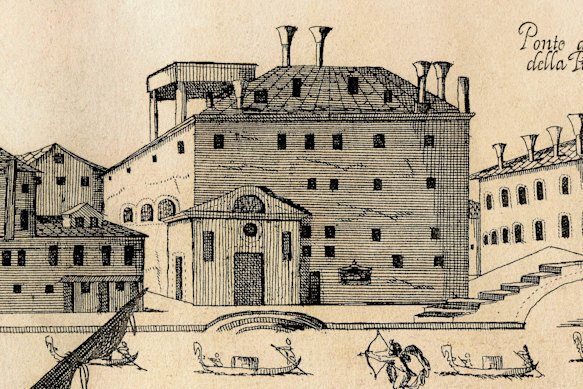
It seems only a matter of time before the story of Anna Maria della Pieta, the prodigious violinist who inspired Vivaldi, is turned into a movie. The opening scene might show a newborn being dropped off at Venice’s Ospedale della Pieta, a home for unwanted infants where the girls were trained as musicians and performed sacred music that drew audiences from across Europe.
Under the cover of darkness, Anna Maria is placed in the scafetta, an opening in the ospedale’s wall. Her mother rings a bell and walks away. It’s a harsh start to life, but preferable to being drowned in a canal, the fate of many of the city’s illegitimate babies in the 18th century.
Fast forward eight years and we find Anna Maria playing for the ospedale’s violin tutor Antonio Vivaldi, a red-haired Catholic priest. There are many fine musicians in Pieta’s all-female orchestra and choir – an ensemble that played, for modesty’s sake, behind metal grilles in raised galleries – but it is clear that Anna Maria is exceptional.
Vivaldi procures instruments worthy of her talent and begins to write music that showcases her technical ability. An anonymous poet declares that when she played her violin “countless angels dare to hover near”. Anna Maria, opined a French scholar, was on a par with, or perhaps even better than, the masterful Italian violinist Giuseppe Tartini.
Micky White, a Venice-based British researcher and the author of Antonio Vivaldi: A Life in Documents, says there is evidence to support the rave reviews. “She was an extraordinary musician who didn’t only play the violin, but other instruments such as the viola d’amore, mandolin, theorbo [a 14-string lute] and harpsichord,” she says. “These other instruments were not secondary; she was a virtuoso on all of them. She could play anything he [Vivaldi] could write for her.”
Evidence of the creative relationship between the tutor and his star pupil can be found in Anna Maria’s “part book”, a red leather-bound collection of her personal repertoire now held in the library of Venice conservatory. It contains the violin parts to 26 concertos Vivaldi wrote for her; an extraordinary testament to her ability and the faith the composer of The Four Seasons placed in it.
Some of that repertoire – notably the violin concerto in E major “per Anna Maria” as well as work written for her by Tartini and Pisendel – will be performed by the Australian Brandenburg Orchestra (ABO) in a recital designed to shine a spotlight on a woman who was a star in her lifetime, but relegated to a footnote by Vivaldi’s resurgence in the early part of the 20th century.
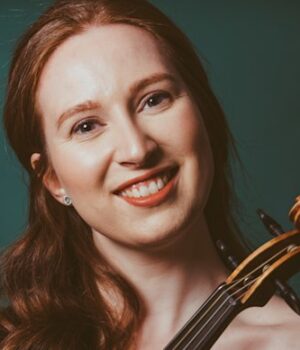
Augusta McKay Lodge, an American violinist living in Paris, will make her Australian debut as soloist and guest director and Anna Maria’s story will be narrated by NIDA graduate Lilian Alejandra Valverde from a script written by Alana Valentine. Poppy Townsend, another young NIDA graduate, has designed the lighting.
The ABO’s co-founder and artistic director, Paul Dyer, said it was a deliberate choice to get young talent to tell Anna Maria’s story. “I sat them down and said ‘I’ve got a gift for you’,” he recalls. “It’s the story of a young woman who lived 300 years ago and has only come into the public eye in the past 15 years or so. She was abandoned, she doesn’t have a surname and she lived with all these other girls in a place where there was just one man: a red-haired priest. I said I want this story to be factual, but I want to bring it into the 21st century.”
The Anna Maria revival that Dyer alludes to began, perhaps, with the rather breathlessly titled Vivaldi’s Virgins, an historical novel by Barbara Quick published in 2007. More recently, The Instrumentalist, a 2024 novel by Harriet Constable, imagines the relationship between Anna Maria and Vivaldi as a battle of wills that becomes increasingly acrimonious as the composer takes credit for his protégé’s work.
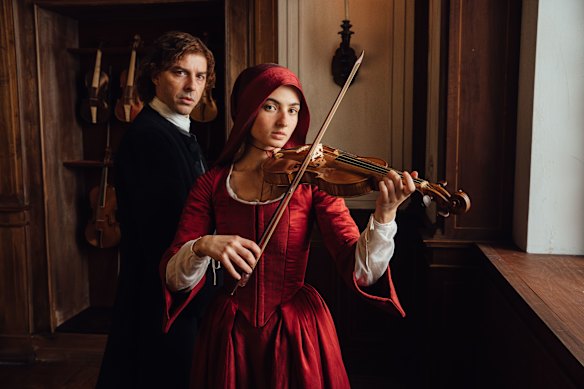
Meanwhile, Primavera, the debut feature of Italian director Damiano Michieletto, has Vivaldi tutoring Cecilia, a young orphan violinist who “channels” the spirit of Anna Maria. The film had its premiere at the Toronto Film Festival last year.
Anna Maria’s story lends itself to fiction because, despite her celebrity, she is something of an enigma. True, there are documents revealing details of her long life (she was 86 when she died at the Pieta on August 10, 1782), but they mostly focus on things like the purchase of her instruments or her rapid rise through the ranks (she was appointed maestra di violino and maestra di coro at the remarkably young age of 42).
Sadly, there are no portraits, so we have to take the word of a poet that she was blonde, beautiful and had a “snow-white breast”. Her inner life, her thoughts about her abandonment, her relationship with Vivaldi and the reason she never left the Ospedale della Pieta despite being free to do so if she married, are unknown and open to speculation.
McKay Lodge says she is reading The Instrumentalist “for fun” as she prepares for the ABO concerts. The novel “brings Anna Maria to life in a way that’s kind of hard for us to imagine just listening to the music,” she says.
Asked about the book’s suggestion that Vivaldi may have appropriated Anna Maria’s work, she says, “That’s only speculation. But at that time people were ‘stealing’ from each other all the time and recycling their own themes in new works. Handel is infamous for that. There was no copyright back then.” What is really unfortunate, says McKay Lodge, is the fact that none of Anna Maria’s compositions survived. “She probably was a very prolific composer and we’ll never know the extent of it.”
The “extremely virtuosic” nature of Vivaldi’s compositions are a testament to Anna Maria’s ability, says McKay Lodge. Some passages include notes so high that violinists have to venture beyond the fingerboard of the instrument. “It’s like a tightrope walk on the strings with nothing underneath,” she says. Likewise, the inclusion of “big double stops”, a challenging technique where notes are played simultaneously on different strings, could also be interpreted as evidence of her technical excellence.
Anna Maria and the women of Pieta’s orchestra and choir “had to do it all,” concludes the American violinist. “They played instruments that women weren’t supposed to play. They even sang the bass lines in the choir. They were making it happen.”
Dyer agrees that Anna Maria’s ability to master multiple instruments should not be underestimated. It is something that simply doesn’t happen today, he says. “If I said to Avi Avital, the greatest mandolin player of our age, ‘could you play the violin?’ he’d just laugh at me. Likewise as a keyboard player if I was asked to play the viola d’amore the answer would be ‘no’.”
Ultimately, Anna Maria appears to be a woman who chose music over all else. “Reading between the lines I’m sure she must have had men falling at her feet,” says Micky White. “But she devoted her life to music and the Pieta. She could have had a rich husband, anything, but she chose music.”
The Australian Brandenburg Orchestra’s Vivaldi’s Legacy is at Sydney’s City Recital Hall, August 12-18; Melbourne Recital Centre, August 20-23; and the Queensland Performing Arts Centre in Brisbane on August 25.